

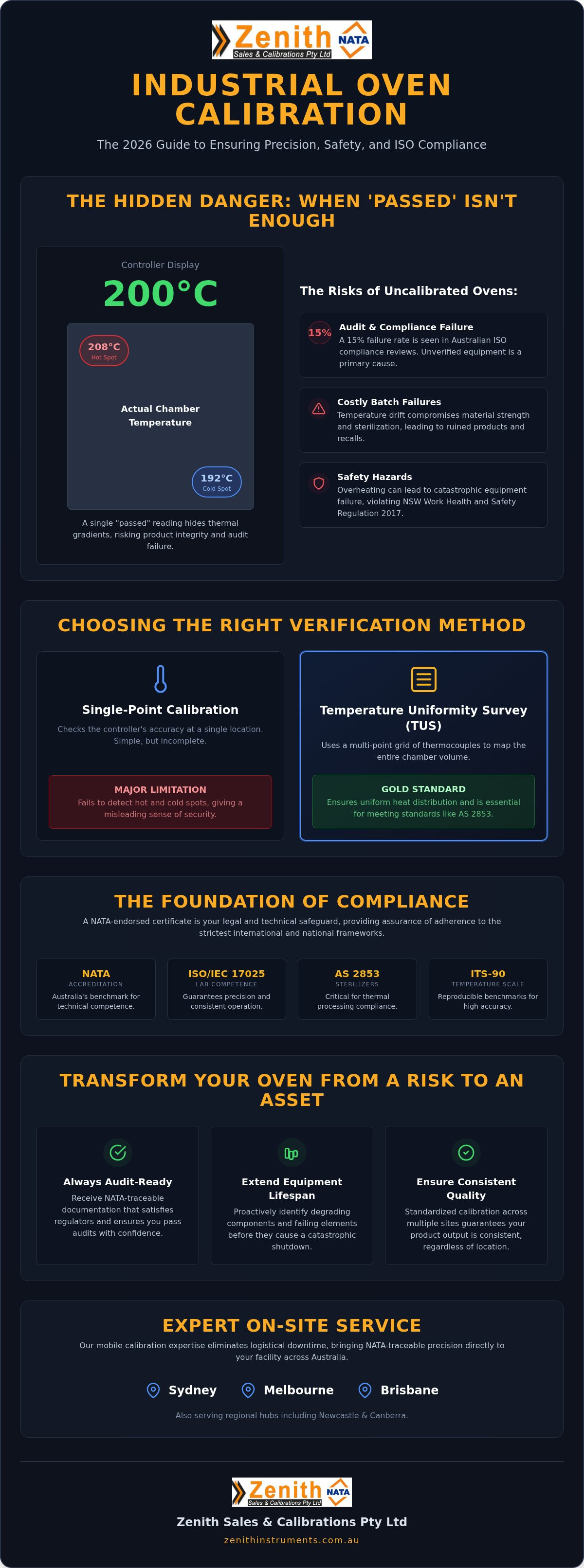
A single "passed" reading on your oven’s digital controller doesn't guarantee your production line is protected from costly batch failures. In many industrial applications, a controller might show perfect stability while hidden cold spots within the chamber compromise product integrity and risk a total failure of your next regulatory audit. Maintaining thermal precision is a relentless challenge for facility managers who cannot afford the high cost of instrument downtime or the 15% failure rate often seen in Australian ISO compliance reviews.
We understand that precision is the foundation of your operational safety and quality control. This 2026 guide explains how a comprehensive oven calibration service, backed by NATA-traceable certification, transforms your equipment from a compliance risk into a high-performance asset. By prioritizing technical exactness and thermal mapping, you'll ensure your facility meets the rigorous demands of AS 2853 and ISO/IEC 17025 standards. We'll explore the critical necessity of Temperature Uniformity Surveys, the impact of the NSW Work Health and Safety Regulation 2017, and how our on-site expertise in Sydney, Melbourne, and Brisbane minimizes disruption to your daily operations.
Key Takeaways
- Verify internal temperature accuracy against setpoints to safeguard product integrity and maintain industrial safety standards.
- Discover why a NATA-certified oven calibration service is the gold standard for audit readiness and regulatory compliance across Australia.
- Identify the critical differences between single-point testing and comprehensive thermal mapping to ensure uniform heat distribution.
- Implement a 2026 maintenance frequency strategy that balances operational usage with rigorous ISO technical requirements.
- Access mobile calibration expertise in Sydney, Melbourne, and other regional hubs to eliminate logistical downtime and equipment transport risks.
Why Professional Oven Calibration is Critical for Industrial Performance
Industrial precision starts with technical verification. Oven calibration involves confirming that the actual internal temperature of the chamber aligns precisely with the digital setpoint and controller display. Without this, your equipment operates in a vacuum of uncertainty. We rely on the International Temperature Scale of 1990 (ITS-90) to provide the reproducible benchmarks necessary for high-accuracy measurements. Professionals in the manufacturing and medical sectors don't just hope for accuracy; they prove it through rigorous testing.
Sensors and heating elements degrade over thousands of cycles. A controller might report 200°C while the actual environment sits at 192°C. This drift compromises chemical bonds, material strength, or sterilization efficacy. In 2026, regulatory bodies like NATA and frameworks such as ISO 9001 demand documented evidence of accuracy. Maintaining a frequent oven calibration service schedule prevents these issues from escalating. Relying on a "set it and forget it" approach doesn't account for the mechanical reality of thermal fatigue. This leads to hidden inaccuracies that compound over time, eventually causing significant operational failures.
The Risks of Using Uncalibrated Ovens
Operating unverified equipment creates immediate financial and safety liabilities. Inefficient heating cycles often result in increased energy consumption, as the system overcompensates for perceived temperature drops. In manufacturing, these variances lead to expensive product recalls or batch failures that damage brand reputation. Safety hazards are also a primary concern. Overheating in pressurized thermal units can lead to catastrophic equipment failure, violating the NSW Work Health and Safety Regulation 2017 and putting personnel at risk.
Benefits of Regular Certification
A professional oven calibration service provided by Zenith Sales & Calibrations Pty Ltd offers a technical foundation for your facility. Regular certification extends equipment lifespan by identifying failing components before they cause a total shutdown. We provide NATA-traceable documentation that ensures you remain audit-ready at all times. For organizations managing multiple production sites, standardized calibration protocols ensure consistent output quality regardless of location. Our teams provide specialized calibration services in Sydney and calibration service in Melbourne to support these national quality benchmarks. We also serve regional hubs including Newcastle, Canberra, and Brisbane to ensure compliance is accessible regardless of your location.
Understanding NATA Standards and Temperature Uniformity Surveys (TUS)
NATA accreditation serves as the ultimate benchmark for technical competence within the Australian calibration landscape. It provides independent assurance that a laboratory operates under the strict requirements of ISO/IEC 17025. For facilities managing thermal processing, a NATA-endorsed certificate isn't just paperwork; it's a legal and technical safeguard. We ensure every oven calibration service adheres to these rigorous frameworks, providing traceability back to national standards. This level of oversight is critical for sectors where even a two-degree variance can lead to catastrophic batch failure.
A core component of this compliance is the Temperature Uniformity Survey (TUS). While a standard calibration checks the controller's accuracy at a single point, a TUS maps the entire internal volume of the oven. We use high-precision data loggers and multi-point thermocouples to identify thermal gradients across the chamber. This process is essential for meeting AS 2853 requirements, ensuring that no hidden cold spots compromise the quality of your manufactured goods or laboratory samples. Technical precision here prevents the inconsistent product quality that often plagues unverified industrial setups.
ISO-Compliant Calibration Processes
Our technicians follow a disciplined protocol to verify temperature accuracy. We begin by deploying a grid of calibrated sensors throughout the chamber. These sensors are compared against a high-stability reference standard that is itself NATA-certified. This hierarchical chain of measurement ensures that your equipment's performance is verified against known, accurate values. We prioritize on-site testing to maintain the integrity of the unit in its actual operating environment. For a broader look at how these standards apply to your facility, see our Instrument Calibrations in Australia: The 2026 Professional Guide.
Documentation and Audit Readiness
A valid calibration certificate must do more than state a "pass" or "fail" result. It must detail the uncertainty of measurement, which quantifies the potential margin of error in the testing process. In 2026, auditors look for specific indicators of technical rigor, including environmental conditions during the test and the specific standards used for comparison. We maintain meticulous records of all service history to ensure your facility is always prepared for a surprise ISO inspection. Our structured reporting helps you avoid the 15% failure rate often seen in Australian ISO compliance reviews due to inadequate documentation. If your current records don't meet these standards, you can consult our experts to review your compliance framework.
Single-Point Calibration vs. Thermal Mapping: Which Do You Need?
Choosing the appropriate oven calibration service requires a clear understanding of how heat behaves within your specific equipment. A single-point calibration focuses exclusively on the temperature controller. Our technicians verify that the readout on your display matches the actual temperature measured at the sensor's location. This method is effective for small, high-circulating environments where the controller's feedback loop is the primary variable. However, it assumes the rest of the chamber is identical to that single sensor, which is rarely the case in larger industrial units.
Thermal mapping provides a more comprehensive diagnostic. We place multiple calibrated sensors at various depths, heights, and corners to identify hidden hot and cold spots. This multi-point profiling is essential for large industrial ovens where true accuracy depends on uniform heat distribution rather than just a correct controller reading. Without this data, you're essentially operating on an assumption that could lead to batch failure or non-compliance during a 2026 audit. We use this decision framework to help facility managers determine whether a basic check or a full Temperature Uniformity Survey (TUS) is necessary for their specific tolerances.
The Problem with Cold Spots
Hidden variances often stem from airflow obstructions, degraded door seals, or insulation gaps. Even if your controller reads a perfect 150°C, a product positioned in a corner cold spot might only reach 142°C, leading to under-processing. Thermal profiling is the process of mapping three-dimensional temperature distribution. By identifying these variances, we allow facility managers to adjust loading patterns or repair equipment before it impacts the bottom line. This technical insight is what separates a routine check from a professional performance verification.
Choosing the Right Service for Your Equipment
Equipment type dictates the depth of testing required. Laboratory incubators with small internal volumes often perform well with a high-accuracy Thermometer Calibration Service to verify the internal probe. Conversely, industrial curing ovens or large-scale drying units require a minimum of nine test points to account for the corners and center of the work zone. We determine the necessary number of sensors based on the total oven volume and your specific industry tolerance requirements. Our on-site teams provide this technical clarity across Sydney, Melbourne, and Brisbane, ensuring your choice of service aligns with your operational risks and regulatory obligations.
How Often Should You Calibrate? Frequency and Signs of Drift
Establishing a rigorous frequency for your oven calibration service is a technical necessity rather than a suggestion. Standard industry recommendations set 12 months as the maximum baseline for most industrial and laboratory applications. However, this interval isn't universal. If your facility operates high-duty cycles or maintains critical tolerances, you'll likely require semi-annual or quarterly verification. We recommend a risk-based approach where the cost of a potential batch failure outweighs the cost of frequent technical oversight.
Drift is often insidious and doesn't always trigger a controller alarm. You must monitor for warning signs such as inconsistent batch results or fluctuating digital displays that struggle to reach a steady state. Unusual mechanical noise from circulation fans often indicates airflow issues that directly compromise temperature uniformity. If you notice these symptoms, don't wait for your scheduled annual check. Immediate verification prevents minor component fatigue from escalating into a total system failure or a non-compliant audit result in 2026.
We enforce a strict "post-repair" rule for all our clients. You must recalibrate your equipment after any maintenance involving heating elements, sensors, or thermal insulation. Replacing a single component can alter the entire thermal profile of the chamber. Technical maintenance ensures the parts work; calibration ensures the system remains accurate. Skipping this step renders your previous certification void and leaves your production quality to chance.
Industry-Specific Requirements
Different sectors demand varying levels of exactness based on their specific regulatory frameworks. In the medical and pharmaceutical industries, strict adherence to sterilization temperatures is non-negotiable to ensure patient safety. Food processing facilities must meet HACCP standards for pathogen control, where a five-degree variance can lead to significant health risks. For manufacturing and aerospace, we align our testing with AMS2750 standards to ensure heat treatment processes meet the structural integrity requirements of critical flight components.
A Checklist for Equipment Maintenance
Routine visual inspections serve as your first line of defense between formal calibration intervals. We suggest monitoring door seals for brittleness and checking insulation for visible gaps or heat leakage. You should also log controller performance daily to spot trends in temperature drift before they exceed your tolerance limits. For facilities utilizing autoclaves or pressurized thermal units, we recommend integrating a Pressure Gauge Calibration into your maintenance schedule. This ensures both pressure and temperature remain within safe, synchronized parameters. To secure your facility's accuracy for the coming year, book your on-site calibration service with our technical experts today.
Zenith Sales & Calibrations Pty Ltd: Expert On-Site Oven Calibration Across Australia
Zenith Sales & Calibrations Pty Ltd operates as a high-performance partner for Australian industries requiring technical excellence. Our mobile laboratory capabilities allow us to bring a full-scale oven calibration service directly to your facility, eliminating the logistical risks associated with moving heavy or sensitive equipment. We deploy meticulous, disciplined technicians who function as dependable experts, ensuring your instrumentation adheres to the highest international standards. With a geographic presence spanning Sydney, Melbourne, Brisbane, Newcastle, and Canberra, we provide the localized touch of a regional partner with the technical resources of a national leader.
We prioritize reliability and speed because we understand the high cost of equipment inactivity. Research indicates that a single day of instrument downtime can cost an Australian industrial operation more than $50,000 in lost productivity. Our proactive service model focuses on rapid response times and immediate digital certification issuance. This commitment ensures your facility remains compliant and operational without the delays typical of laboratory-bound competitors. We've served the manufacturing, medical, and mining sectors since 2004 with a discipline that mirrors the exactness of our measurement services.
On-Site vs. Laboratory Services
The choice between on-site and in-house testing depends largely on the scale of your equipment. Large, non-portable industrial ovens require on-site verification to account for their specific installation environment and airflow characteristics. Conversely, we offer in-house laboratory options for smaller benchtop units and incubators that can be safely transported. Whether you require a calibration service in Sydney or Melbourne, we maintain standardized ISO-compliant processes across all our regional hubs.
Get a Professional Quote for 2026
Proper preparation ensures a seamless calibration visit. We require clear access to the equipment and stable power sources to run our reference standards and data loggers. For multi-instrument facilities, we provide customized service agreements that consolidate your calibration schedule, reducing administrative overhead and ensuring no equipment falls out of compliance. Our technicians work efficiently to provide full NATA-traceable certification with minimal disruption to your daily production cycles. This structured approach reflects our two decades of expertise in technical measurement. Contact Zenith Sales & Calibrations Pty Ltd today for a comprehensive oven calibration quote to secure your facility's precision for the 2026 audit cycle.
Securing Your Thermal Precision for 2026
Maintaining technical exactness in your industrial heating processes is a continuous commitment to quality and safety. We've explored how moving beyond basic controller checks to comprehensive Temperature Uniformity Surveys protects your facility from hidden cold spots and costly batch failures. Adhering to NATA-certified standards isn't just about passing an audit; it's about ensuring every cubic centimetre of your chamber performs with absolute reliability.
Our team brings over 20 years of technical expertise directly to your facility through our mobile laboratory capabilities. By choosing a professional oven calibration service, you eliminate the logistical burden of moving equipment while securing the audit-ready documentation required by ISO frameworks. Whether you operate in Sydney, Melbourne, Brisbane, Newcastle, or Canberra, we provide the localized support needed to keep your production lines moving. Don't leave your equipment's accuracy to chance when precision is within reach.
Request a Quote for Professional Oven Calibration and partner with the dependable experts today.
Frequently Asked Questions
What is the difference between oven calibration and thermal mapping?
Oven calibration verifies the controller's accuracy against a single reference point to ensure the display reflects the heat at the sensor. Thermal mapping involves placing multiple sensors throughout the chamber to identify gradients or cold spots. While a basic calibration ensures the system responds correctly, mapping guarantees the entire work zone meets specific tolerance requirements for batch consistency and material integrity.
Does Zenith Sales & Calibrations Pty Ltd provide NATA-traceable certificates for ovens?
We issue NATA-traceable certificates for every oven calibration service we perform. Our processes align with ISO/IEC 17025 standards, ensuring your equipment meets the technical requirements for Australian regulatory audits. These certificates include uncertainty of measurement data and recorded environmental conditions, providing a legally defensible record of accuracy. This technical documentation is essential for facilities operating under strict ISO 9001 or AS 2853 quality frameworks.
How long does a typical on-site oven calibration take?
A standard on-site procedure typically takes between two to four hours per unit, depending on the oven's size and the number of test points required. Complex profiling may extend this duration to ensure the chamber reaches a stable thermal equilibrium before final measurements are recorded. We work efficiently to minimize operational downtime, allowing your facility to return to full production capacity as soon as verification is complete.
Can you calibrate ovens in Sydney and Melbourne on the same day?
We maintain dedicated technical teams in both Sydney and Melbourne, allowing us to perform simultaneous calibrations across different geographical locations. Our broad reach across major Australian hubs ensures that large organizations with multiple sites receive synchronized service. While we don't typically offer same-day emergency response for new bookings, our scheduled mobile laboratory visits are highly organized to accommodate the specific logistical needs of regional and metropolitan industries.
What industries are required to have their ovens calibrated by law?
Industries governed by strict safety and quality regulations, such as medical device manufacturing and pharmaceuticals, must maintain calibrated thermal equipment. In New South Wales, the Work Health and Safety Regulation 2017 acts as a primary compliance driver for industrial equipment maintenance. Food processing facilities must also adhere to HACCP standards to prevent pathogen growth, while heat treatment plants must comply with specific structural integrity requirements for critical components.
What happens if my oven fails the calibration test?
If your equipment fails to meet the required tolerances, our technicians identify the specific points of variance and provide a detailed report on the drift. We provide "as-found" data that helps you understand if the issue stems from controller inaccuracy, failing heating elements, or degraded insulation. Once technical adjustments or repairs are completed, a follow-up oven calibration service is mandatory to re-verify the unit and issue a new, valid certificate of compliance.
Do you provide calibration for laboratory incubators and furnaces as well?
We provide specialized calibration for a wide range of thermal equipment, including high-temperature furnaces and laboratory incubators. Each instrument type requires a specific testing protocol to account for its unique operating range and stability requirements. Our technicians utilize high-precision reference thermometers and data loggers to ensure that even the most sensitive laboratory environments maintain the strict tolerances necessary for scientific research, material testing, and medical diagnostics. To see how these rigorous standards are implemented in a clinical setting, you can discover EcoSense and their range of diagnostic services.
The cost of calibration is determined by the specific technical requirements of your equipment, including the temperature range and the number of measurement points needed. A full multi-point survey requires more intensive resources than a single-point controller check. We provide customized, formal quotes based on your facility's specific instrumentation and location. To obtain an accurate price for your 2026 compliance needs, we recommend requesting a technical consultation with our team.