

A safety tag is only as reliable as the device that generated it. If your testing equipment hasn't been verified against national standards, your entire compliance history could be dismissed during a WorkSafe audit. With corporate penalties for non-compliance with AS/NZS 3760:2022 exceeding A$244,000 in some jurisdictions, understanding portable appliance tester calibration requirements isn't just a technicality; it's a critical risk management strategy. We recognize that the technical validity of your equipment is often a source of uncertainty, especially when you're balancing operational uptime with rigorous safety obligations.
You deserve absolute confidence in your safety documentation and the precision of your measurements. In this 2026 guide, we'll clarify the technical specifications, legal mandates, and essential testing procedures required to maintain Australian electrical safety standards. We'll outline a reliable schedule for your compliance needs and explain how NATA-certified calibration ensures your instruments remain accurate and legally defensible. By the end of this article, you'll have a clear roadmap to navigate the complexities of electrical testing with the authority of a dependable expert.
Key Takeaways
- Understand the updated safety benchmarks of AS/NZS 3760:2022 to ensure your workplace remains compliant with current Australian electrical standards.
- Learn why adhering to portable appliance tester calibration requirements is a non-negotiable step in maintaining the technical validity of your safety documentation.
- Identify the mandatory testing frequencies for various work environments, including the strict three-month cycles required for construction and demolition sites.
- Discover the standard technical procedures of a PAT test and why visual inspections remain the most effective way to identify equipment faults.
- Explore the operational advantages of NATA-certified calibration and how mobile on-site services can significantly reduce business downtime.
What is a PAT Testing Test? Compliance with AS/NZS 3760:2022
Portable appliance testing (PAT) is a systematic process of safety inspection and verification for electrical equipment. In Australia, this process is governed by the AS/NZS 3760:2022 standard. This updated framework provides the technical criteria for ensuring in-service electrical equipment remains safe for continued use. It applies to any device that connects to a 240V supply via a flexible cord and plug. While many associate the process solely with a "test and tag" sticker, the standard mandates a rigorous two-stage approach. First, a meticulous visual inspection identifies damaged casings, frayed cords, or scorched plugs. Second, a sequence of electrical tests measures insulation resistance, earth continuity, and polarity. Maintaining strict adherence to portable appliance tester calibration requirements ensures that this second phase is technically valid. Without a calibrated instrument, the data recorded is legally indefensible.
Legal Requirements for Australian Workplaces
Under Australian Workplace Health and Safety (WHS) laws, employers hold a strict Duty of Care to provide a safe working environment. AS/NZS 3760:2022 serves as the primary benchmark used by regulators like WorkSafe to determine if a business has met its obligations. Proper documentation and physical tagging are essential for insurance coverage and internal safety audits. In high-risk environments, such as construction sites or manufacturing floors, these testing intervals are mandatory. Failure to produce verifiable test records can lead to significant corporate penalties. In Victoria, for example, corporate fines for safety breaches can exceed A$244,212. Accurate record-keeping is your primary defense during a safety audit.
Who is a Competent Person for PAT Testing?
The Australian standard defines a competent person as someone who possesses the necessary practical and theoretical skills, acquired through training, experience, or a combination of both. While a licensed electrician is inherently qualified, individuals who have completed a recognized PAT testing course also meet the criteria. Regardless of who performs the test, the accuracy of the results depends entirely on the equipment's state of maintenance. We provide professional electrical calibration services to ensure your testers meet the rigorous portable appliance tester calibration requirements specified in the 2022 update. Using unverified equipment undermines the "competent" status of the operator. They simply cannot guarantee the precision of their safety measurements without a certified calibration certificate.
Technical Procedures: How Portable Appliance Testers Verify Safety
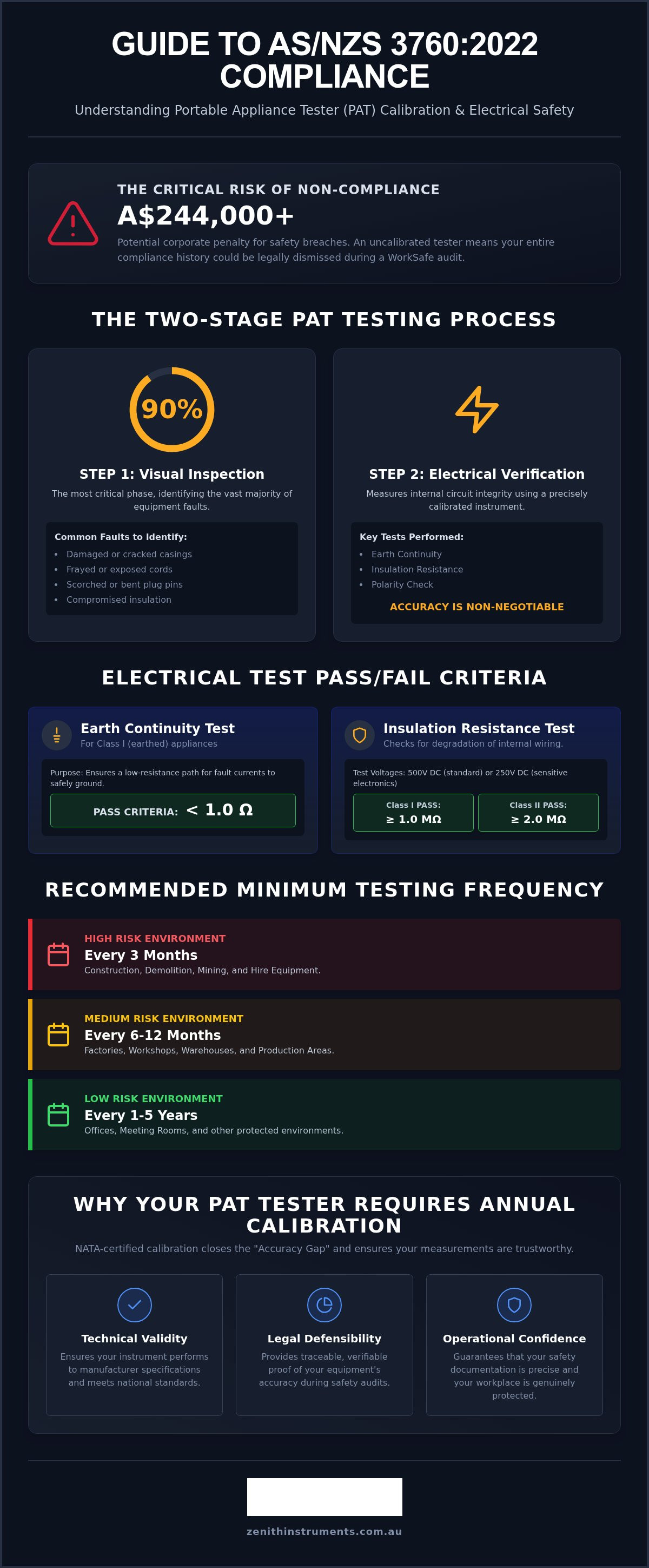
Modern PAT testing follows a logical, data-driven sequence to mitigate electrical risk in the workplace. Despite the advanced sensors found in digital testers, the initial visual inspection remains the most critical phase. Industry data suggests that visual checks account for nearly 90% of all discovered faults during routine testing. We look for physical compromises such as damaged insulation, frayed cords, or scorched plug pins. If an appliance passes this visual assessment, it proceeds to the electrical verification phase. During this stage, the tester applies specific voltages to measure internal resistance and circuit integrity. Modern digital testers simplify this by providing clear pass/fail indicators based on the pre-programmed thresholds of AS/NZS 3760:2022.
Earth Continuity and Insulation Resistance Tests
The Earth Continuity test is the primary defense for Class I (earthed) appliances. It measures the resistance between the earth pin on the plug and the metal casing of the device. This ensures a low-impedance path exists for fault currents to safely reach the ground. For a 'Pass' in Australia, the resistance must typically be less than 1.0 Ω. Simultaneously, the Insulation Resistance test ensures that internal live wiring is properly contained. The tester applies a 500V DC charge (or 250V for sensitive electronic equipment) to confirm the insulation hasn't degraded. A successful test requires a minimum reading of 1.0 MΩ for Class I equipment and 2.0 MΩ for Class II (double-insulated) appliances. Adhering to portable appliance tester calibration requirements is the only way to ensure these micro-measurements remain accurate over hundreds of test cycles.
Polarity and Leakage Current Testing
Polarity testing is vital for extension leads and power boards. It ensures the active, neutral, and earth wires are connected to the correct pins. Crossed polarity can leave a device "live" even when it appears switched off, creating a severe shock hazard. For appliances where internal switches must be closed to perform a valid test, we utilize Leakage Current testing. This measures the actual current flowing to the earth while the device is under power. The Australian standard sets the limit at 5mA for Class I and 1mA for Class II. We also include Residual Current Device (RCD) testing in this regime. This measures the trip time in milliseconds to ensure the safety switch activates fast enough to prevent a fatal shock. If your equipment yields inconsistent results on these critical thresholds, a professional Appliance Tester Calibration Service is necessary to restore measurement precision. These technical procedures prevent electric shocks and potential fire hazards, but their validity rests entirely on the integrity of the testing instrument itself.
Maintaining the accuracy of these readings is a foundational pillar of workplace safety. When your tester is calibrated to NATA-certified standards, you eliminate the guesswork from your compliance reporting. This rigorous approach to portable appliance tester calibration requirements protects both the technician and the business from the consequences of a false 'Pass' reading.
The Accuracy Gap: Why Your PAT Tester Requires Annual Calibration
A portable appliance tester is a high-precision measurement tool. It's not a simple binary sensor. Like all electronic instruments, its internal components are subject to gradual degradation, which leads to measurement inaccuracy over time. If your tester operates outside its intended tolerances, it may issue a "Pass" result for an appliance that actually poses a shock or fire risk. This creates a dangerous accuracy gap. Relying on an uncalibrated tester provides a false sense of security that can lead to catastrophic workplace failures. From a legal perspective, providing "Pass" tags using equipment that doesn't meet portable appliance tester calibration requirements can invalidate your safety records. This leaves your business exposed during insurance claims or WorkSafe investigations. We recommend NATA-traceable calibration to provide the highest level of measurement reliability and legal defensibility.
The Consequences of Instrument Drift
Instrument drift is the slow, incremental deviation of a device's readings from its original calibrated accuracy. This usually happens as electronic components age. Environmental factors in major Australian industrial hubs play a major role here. The high humidity levels in Sydney or the extreme temperature shifts common in Melbourne can cause sensitive internal resistors and capacitors to expand and contract. This affects measurement stability. We mitigate this through our professional Appliance Tester Calibration Service. Our technicians use high-precision master instruments to identify these deviations and recalibrate your device to its original factory specifications. This ensures every safety reading is technically sound and repeatable.
Calibration Certificates vs. Self-Testing
A professional calibration certificate serves as a legal document of traceability. It confirms that your instrument's performance has been verified against national standards in a controlled laboratory environment. Many modern testers include "self-check" or "checkbox" features, but these don't replace annual professional calibration. Self-checks merely confirm that the unit’s internal software is functioning. They can't verify the physical accuracy of the measurement circuit against an external reference. To maintain full ISO compliance and meet the portable appliance tester calibration requirements of AS/NZS 3760:2022, you must engage in regular Portable Appliance Tester calibration. This process ensures your safety documentation remains beyond reproach during any external audit or insurance review.
Frequency and Compliance: How Often Should You Test and Tag?
Under AS/NZS 3760:2022, the testing interval is dictated by the equipment's operating environment rather than the device type alone. Harsh conditions found on construction and demolition sites necessitate a strict three-month cycle to account for physical wear. Industrial workshops and commercial cleaning sectors typically move to a six-month interval. In contrast, low-risk environments such as corporate offices or retail spaces often utilize 12-month or even five-year cycles for stationary equipment that isn't subject to frequent cord flexing. We've observed that consistent adherence to these intervals is the only way to maintain a defensible safety posture during a regulatory review.
Maintaining these schedules is only effective if the instrument used for verification is accurate. High-volume testing on a construction site places significant stress on the tester's internal circuitry, which can lead to subtle measurement errors. This makes adhering to portable appliance tester calibration requirements essential to prevent measurement drift between scheduled site visits. We provide mobile services to ensure your testers remain compliant without disrupting your operational flow. Using an unverified tester on a high-risk site creates a significant liability gap that insurance providers may exploit in the event of an incident.
High-Risk vs. Low-Risk Environments
High-risk environments include mining operations and industrial kitchens where moisture, heat, or vibration is constant. In these areas, the "New to Service" rule is a critical compliance checkpoint. Every piece of equipment must be inspected and tagged before its first use on-site, regardless of its manufacture date. Zenith Sales & Calibrations Pty Ltd supports high-volume industrial users by offering on-site calibration to keep fleets of testers in peak condition. For low-risk environments like schools or libraries, the focus shifts to equipment that is moved frequently, such as laptop chargers, which still require annual verification despite the gentler environment.
Record Keeping and Tagging Requirements
A compliant test tag is a legal record that must clearly state the test date, retest date, and the name of the competent person who performed the work. Beyond the physical tag, a centralised equipment register is indispensable for safety audits. A compliant PAT testing report should include the Asset ID, test results (Pass/Fail), and the actual measurement values for earth continuity and insulation resistance. It also requires the date of the test and the identification of the specific test instrument used. This structured data provides a clear audit trail and proves you've met all portable appliance tester calibration requirements during an external review. If you need to verify your equipment's precision, book an electrical calibration service today to secure your compliance records.
Professional Calibration and Repair for PAT Testers
Securing your workplace's electrical safety requires a partnership with a laboratory that understands the technical depth of portable appliance tester calibration requirements. We position Zenith Sales & Calibrations Pty Ltd as that partner. By choosing a NATA-certified laboratory, you ensure that every certificate issued is traceable to national standards. This provides a level of legal certainty that non-accredited providers simply cannot match. Beyond simple verification, our professional repair services allow you to extend the operational life of sophisticated test equipment. This prevents the need for premature capital expenditure on new units and ensures your safety tools remain in peak condition for years to come.
On-Site Calibration in Sydney and Melbourne
Our mobile laboratory service is designed to eliminate the logistical burden of equipment maintenance. We know that sending your primary tester away for a week can halt your entire safety program. To address this, Zenith Sales & Calibrations Pty Ltd offers on-site calibration services across Sydney and Melbourne. We bring our precision master instruments directly to your facility. This proactive model ensures your equipment is back in service within hours. Our technicians possess deep technical expertise across all major industry brands, including Seaward, Metrel, and Wavecom. For businesses in Brisbane and other regional hubs, our laboratory-based services offer rapid turnaround times to minimize your operational downtime.
Comprehensive Instrumentation Solutions
While PAT testing is a vital component of your safety regime, it's often part of a broader instrumentation ecosystem. We provide a holistic approach to equipment maintenance. This includes specialized multimeter calibration for your electrical diagnostics and pressure gauge calibration for your hydraulic and pneumatic systems. Consolidating your calibration needs with Zenith Sales & Calibrations Pty Ltd streamlines your compliance management. It ensures a consistent standard of accuracy across your entire asset register. As you prepare for your 2026 safety audits, we invite you to contact our team to schedule a comprehensive review of your testing equipment. Let's ensure your business remains a leader in technical excellence and regulatory compliance.
Securing Your Workplace Compliance for 2026 and Beyond
Compliance with AS/NZS 3760:2022 isn't just about ticking a box; it's about maintaining a technically sound safety ecosystem. We've established that the validity of your safety tags depends entirely on the precision of your testing instrument. Regular adherence to portable appliance tester calibration requirements ensures that your measurements remain accurate, legally defensible, and ISO-compliant. By addressing instrument drift through professional verification, you eliminate the risk of false pass results and protect your personnel from electrical hazards.
We provide the industrial expertise needed to maintain these high standards across your entire asset register. Our technicians deliver NATA-certified standards and ISO-compliant calibration certificates to give you absolute confidence during your next safety audit. Whether you require Australia-wide mobile on-site service in Sydney and Melbourne or laboratory-based precision, we support your operational needs with meticulous care. Precision is the foundation of safety, and we're committed to helping you maintain it.
Ensure your safety equipment is accurate; book your PAT Tester Calibration today.
Take control of your electrical safety program today and ensure your equipment meets the highest standards of technical excellence.
Frequently Asked Questions
Is PAT testing a legal requirement in Australia?
PAT testing is a legal necessity under Australian Workplace Health and Safety (WHS) legislation. While the AS/NZS 3760:2022 standard isn't a law itself, it's the primary document used by regulators to verify that an employer has met their duty of care. Failing to implement a testing regime can lead to massive corporate penalties if an electrical incident occurs. It's the recognized benchmark for maintaining a safe work environment.
How often should my portable appliance tester be calibrated?
You should calibrate your portable appliance tester every 12 months. Regular calibration is essential to ensure your instrument remains within its original manufacturer specifications. Adhering to these portable appliance tester calibration requirements provides the technical foundation for your safety records. Without an annual certificate from a NATA-certified lab, your test results may be deemed invalid during a professional safety audit or insurance investigation.
Can I perform PAT testing myself if I am not an electrician?
You don't need to be a licensed electrician to perform PAT testing in Australia. The standard requires the individual to be a competent person, which means they've acquired the necessary skills through training or experience. Many professionals choose to complete a specific PAT testing course to gain this status. However, the accuracy of their work still relies entirely on using a properly maintained and calibrated testing device.
What items are exempt from PAT testing tests?
Several categories of equipment don't require routine PAT testing. This includes equipment that's hard-wired to the electrical installation, items located higher than 2.5 metres above the floor where they're out of reach, and devices that operate on extra-low voltage under 50V AC. Additionally, equipment that would need to be dismantled to be tested is typically exempt. Always consult the specific environment's risk assessment for final confirmation.
Does new electrical equipment need to be tested and tagged?
New electrical equipment doesn't require a full electrical test before its first use, but it does require a visual inspection and a New to Service tag. This tag must state that the item is new and specify the date it was placed into service and when the first formal test is due. Once that first interval passes, the item must enter the regular testing and tagging cycle mandated for that specific work environment.
What is the difference between a Class I and Class II appliance test?
Class I appliances are earthed devices where safety depends on a connection between the metal casing and the earth pin. The test sequence includes earth continuity and insulation resistance. Class II appliances are double-insulated and don't have an earth wire; they're identified by a square within a square symbol. For these, we only perform an insulation resistance test, as there's no earth circuit to verify for safety.
What happens if an appliance fails a PAT test?
If an appliance fails any part of the PAT test, it must be immediately withdrawn from service. You should label the item with a Caution or Danger tag to prevent accidental use and move it to a secure area. The device must either be repaired by a qualified technician and re-tested or permanently disposed of. You cannot return a failed item to the workspace under any circumstances.
How long does a PAT testing record need to be kept?
You must keep PAT testing records for at least the duration of the equipment's life or until a subsequent test is performed. However, many Australian businesses maintain these records for seven years to align with broader financial and safety auditing requirements. Digital record-keeping is highly recommended, as it allows for rapid retrieval during a WorkSafe inspection and ensures your compliance history is easily accessible and organized.