

A single day past a calibration deadline can turn a multimillion-dollar Australian tender bid into an immediate formal disqualification. When you're competing for Commonwealth contracts with thresholds starting at A$80,000, or major infrastructure projects worth millions, evaluators don't just look for your capability; they look for proof of your precision. We know the logistical stress of getting instruments ready for a tender application while managing daily operations. It's a complex balancing act between technical compliance and project deadlines that leaves little room for error.
This technical guide will help you master the requirements for instrumentation compliance to mitigate risk and win high-value tenders in the 2026 landscape. We'll clarify the critical differences between NATA-certified and traceable standards under the new National Measurement Guidelines 2026. You'll learn how to establish a tender-ready fleet and assemble bulletproof documentation that satisfies even the most meticulous auditor. By following this structured approach, we'll help you reduce your risk profile and position your business as a dependable expert in the eyes of any procurement board.
Key Takeaways
- Understand why NATA-accredited calibration is the definitive benchmark for demonstrating technical capability in high-value Australian industrial tenders.
- Learn how to conduct a rigorous technical audit of your measurement fleet to separate critical assets from non-critical equipment.
- Master the logistical process of getting instruments ready for a tender application to ensure every device meets the National Measurement Guidelines 2026.
- Discover how to compile a digital evidence pack that links valid calibration certificates directly to your asset register for seamless evaluator review.
- Find out how leveraging on-site calibration services in Sydney and Melbourne can eliminate fleet downtime before critical procurement deadlines.
The Role of Instrumentation in Australian Tender Compliance
Measurement accuracy serves as the bedrock of "demonstrated capability" in any technical bid. When evaluators review your submission, they look for evidence that your equipment performs to specified tolerances. Without verified accuracy, your operational claims lack technical weight. High-value Australian tenders, particularly those exceeding the A$80,000 threshold for Commonwealth goods, require rigorous proof that your instrumentation is fit for purpose. Getting instruments ready for a tender application isn't just about maintenance; it's about validating your ability to deliver project outcomes safely and reliably.
There is an inseparable link between instrument calibration and Workplace Health and Safety (WHS) compliance. Faulty electrical calibration services ensure that your insulation testers and multimeters protect staff from arc flash or shock. If an evaluator sees gaps in your calibration history, they see a business that tolerates unmanaged safety risks. One expired certificate can disqualify a million-dollar bid because it signals a systemic failure in your calibration and quality management systems.
Risk Management as a Tender Strategy
We define technical risk through the lens of measurement uncertainty. Every instrument has a margin of error; if that margin isn't quantified, your project data is technically indefensible. Proving that your tools are calibrated demonstrates that your business adheres to ISO 9001 quality management standards. This reliability acts as a powerful competitive differentiator. While lower-priced bidders might cut corners on maintenance, your commitment to precision reassures the client that your results are definitive.
Mandatory vs. Desirable Technical Requirements
Reviewing Invitation to Supply (ITS) documents requires a sharp eye for mandatory requirements. In many industrial sectors, NATA-endorsed certificates move from "desirable" to "mandatory" when the project involves high-pressure systems or critical infrastructure. We often see local government procurement requiring specific Australian standards for pressure gauge calibration to ensure public safety. When getting instruments ready for a tender application, identify these mandatory benchmarks early to avoid last-minute compliance scrambles:
- NATA Accreditation: Often required for high-risk environmental or safety measurements.
- Traceability to NMI: A fundamental requirement for all Australian legal units of measurement under the National Measurement Guidelines 2026.
- Calibration Frequency: Must align with manufacturer specifications or industry codes of practice.
Evaluators use your equipment logs to assess your operational risk profile. A meticulously documented fleet shows you are ready for the job, while a single missing record can halt your progress entirely.
Essential Calibration Standards for Competitive Bidding
The Australian procurement landscape has shifted with the implementation of the National Measurement Guidelines 2026. When getting instruments ready for a tender application, you must ensure your equipment aligns with these updated legal frameworks. The National Measurement Institute (NMI) maintains the primary standards that underpin all trade and safety measurements in Australia. For a tender submission to withstand technical scrutiny, every measurement must be traceable to these national standards through an unbroken chain of comparisons.
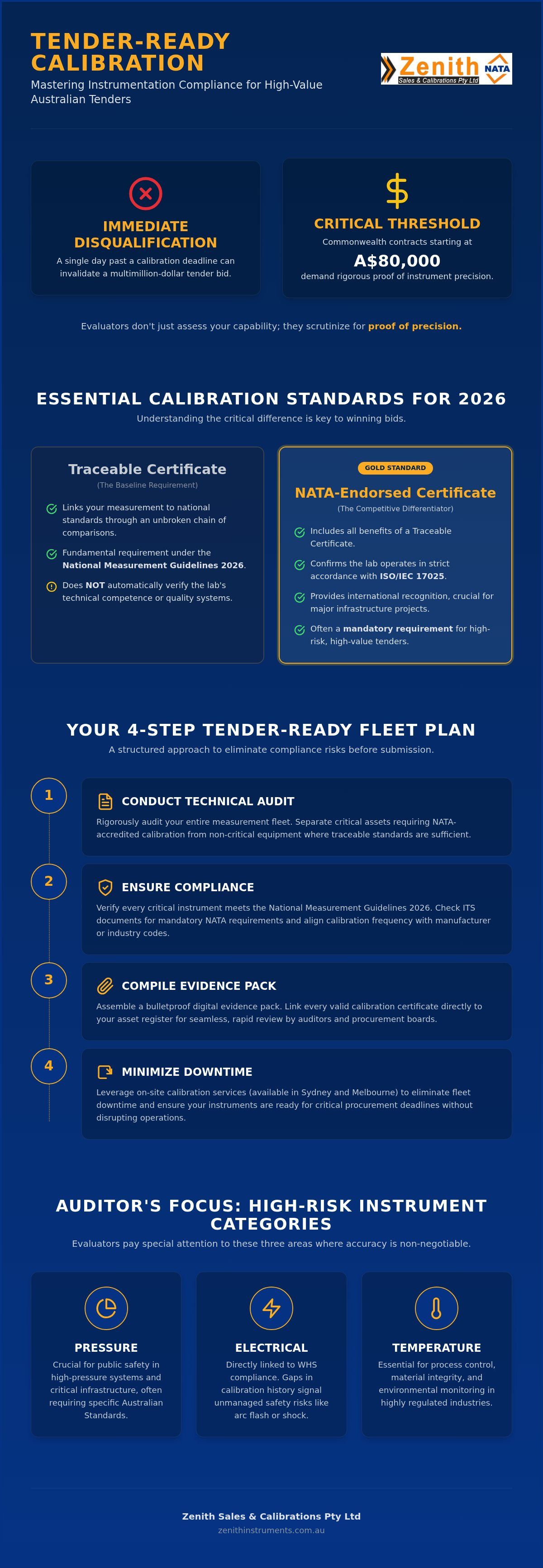
Evaluators typically focus on three high-risk categories: pressure, electrical, and temperature. Whether you're bidding for a water utility contract requiring Pressure Gauge Calibration Service or a government facility maintenance project, the standard of your documentation is as important as the accuracy of the tools themselves. We recommend checking your current certificate status against these updated 2026 benchmarks at Zenith Sales & Calibrations Pty Ltd to avoid last-minute disqualification.
NATA-Endorsed vs. Traceable Certificates
NATA accreditation is the definitive gold standard for Australian industrial tenders. It confirms that a laboratory operates in strict accordance with ISO/IEC 17025, providing international recognition through the ILAC Mutual Recognition Arrangement. While a standard traceable certificate might suffice for internal quality checks or small private sector quotes, government and high-value industrial tenders almost universally mandate NATA-endorsed certificates. These documents provide the highest level of legal and technical defensibility. For a deeper look at these requirements, see our guide on Instrument Calibrations in Australia: The 2026 Professional Guide.
Industry-Specific Standards (Mining, Medical, Manufacturing)
Different sectors demand specialized compliance evidence. In healthcare tenders, biomedical equipment calibration must meet stringent patient safety standards. Meanwhile, the oil, gas, and mining industries prioritize explosion-proof ratings and high-pressure tolerances. Construction and site-based contracts often require comprehensive electrical calibration services, including Portable Appliance Tester (PAT) records, to satisfy WHS obligations. Getting instruments ready for a tender application requires identifying these niche requirements within the Invitation to Supply (ITS) before the submission window closes. Using a partner who understands these regional and sectoral nuances ensures your fleet remains compliant with both national law and specific industry codes of practice.
Conducting a Technical Audit of Your Measurement Fleet
A successful bid starts with a meticulous technical audit of every device in your inventory. We recommend establishing a comprehensive asset register that tracks serial numbers, last service dates, and specific measurement ranges. Getting instruments ready for a tender application requires more than a cursory glance at calibration stickers; you must verify that each tool's performance aligns with the project's technical specifications. This audit serves as your primary internal control, ensuring that every piece of data you submit to a procurement board is backed by verified hardware.
Distinguishing between critical and non-critical instruments is a vital part of this process. Critical instruments are those directly responsible for safety, quality control, or contractual compliance. If you're bidding on a hydraulic infrastructure project, your Pressure Gauge Calibration Service records become high-priority evidence. Non-critical tools may only require standard traceable certificates, but critical assets often demand full NATA-endorsed documentation to satisfy risk-averse evaluators. You must also check expiry dates against the proposed contract commencement date. A certificate that is valid during the bid phase but expires one month into the project is a red flag for most auditors.
Identifying Compliance Gaps
We often see businesses discover "out-of-tolerance" instruments only after a bid has been submitted. Identifying these gaps early allows you to perform an impact assessment on any previous work and rectify the hardware before it becomes a liability. Your audit should also account for equipment currently off-site or "Missing in Action." High-impact tools, such as specialized gas monitors or high-voltage insulation testers, often require longer lead times for service. Prioritizing these items ensures your entire fleet is operational before the submission deadline.
The Logistics of Pre-Tender Servicing
Managing the service requirements of a large fleet can be a logistical challenge during a high-pressure bid phase. We provide on-site calibration services in Sydney and Melbourne to help you maintain fleet readiness without the downtime associated with laboratory shipping. This proactive model allows us to calibrate your multimeters, thermometers, and pressure gauges at your facility, keeping your tools in the hands of your technicians. If our technicians identify faulty equipment, we can schedule immediate repairs in our specialized laboratories, ensuring 100% fleet availability when the contract begins. This level of preparation demonstrates a sophisticated approach to risk management that evaluators value highly.
Documenting Compliance: Preparing Your Evidence Pack
Evaluators require more than a simple list of equipment; they need a structured evidence pack that proves every claim of accuracy. Getting instruments ready for a tender application culminates in the assembly of a digital compliance library. This library should contain current, high-resolution copies of all calibration certificates, organized by instrument type or project phase. We recommend creating a folder structure that mirrors your asset register, allowing an auditor to move from a line item in your bid to the supporting technical document in seconds.
Your "Instrumentation Capability" section should articulate how your fleet meets the specific tolerances of the contract. It’s vital to provide a clear paper trail of traceability. This means demonstrating how your tools are linked to the national primary standards held by the National Measurement Institute (NMI). A robust evidence pack shows that you understand the National Measurement Guidelines 2026 and have implemented them across your entire operational workflow. If you require assistance in compiling these technical records, we recommend booking a consultation with Zenith Instruments to ensure your documentation meets the highest regulatory standards.
Presenting Certificates to Evaluators
The visual presence of the NATA logo on your certificates serves as an immediate trust signal to procurement boards. It confirms that the calibration was performed by a laboratory accredited to ISO/IEC 17025. When presenting these documents, highlight "Pass" results and clearly indicate any adjustments made during the service. For bids involving site safety, including detailed records from your electrical equipment calibration services proves that your multimeters and insulation testers are not just functional, but legally compliant. Evaluators look for these specific markers to verify that your data is technically defensible.
Maintenance Logs and Future Schedules
A proactive maintenance schedule demonstrates that your business manages instrument drift effectively. Drift is the natural change in an instrument's accuracy over time; showing a history of regular service proves you don't wait for a failure before taking action. Your evidence pack should also address "New In Box" equipment. Many professionals mistakenly believe factory settings are sufficient for tender compliance, but most Australian contracts require an initial calibration from an accredited laboratory to establish a baseline. By including a forward-looking schedule for the duration of the contract, you reassure the client that your technical reliability will not degrade over time. This structured approach to documentation transforms your fleet from a simple toolset into a verified strategic asset.
Zenith Instruments: Your Partner in Tender-Ready Calibration
We recognize that the process of getting instruments ready for a tender application is a high-stakes operation. At Zenith Instruments, we position ourselves as your technical partner, removing the burden of compliance from your bid team. Our NATA-accredited laboratories in Sydney and Melbourne provide the definitive technical weight required for high-value Australian contracts. We offer a proactive service model that prioritizes precision and speed, ensuring your equipment is fully certified before the submission window closes. Our meticulous experts support a broad spectrum of measurement categories, from Thermometer Calibration Service to complex telecommunications networking tools and specialized biomedical equipment.
Strategic Calibration Support in Sydney and Melbourne
Our strategic presence in Sydney and Melbourne is supported by mobile service capabilities that reach critical regional industrial centers. We facilitate on-site calibration in Newcastle, Canberra, and Brisbane, allowing your fleet to remain operational while we verify its accuracy. This localized touch, combined with our national laboratory infrastructure, ensures that we can handle bulk fleet servicing for even the largest project scopes. Having a single partner for your pressure, electrical, and gas monitoring equipment reduces administrative complexity and ensures a uniform standard of documentation across your entire bid. For those managing mechanical assembly contracts, our Torque Wrench Calibration: The 2026 Guide offers essential insights into maintaining compliance in Sydney and Melbourne workshops.
Streamlining Your Compliance Process
We streamline your compliance process by delivering meticulous, audit-proof documentation. Every certificate we issue is designed to satisfy the rigorous demands of government and industrial evaluators, providing a clear chain of traceability to national standards. This level of detail is essential when getting instruments ready for a tender application, as it mitigates the risk of technical disqualification. Beyond the initial bid, we offer comprehensive contract maintenance programs. We partner with you for the duration of the project, providing scheduled on-site visits and rapid laboratory repairs in our specialized facilities to prevent downtime. Our commitment to international standards and meticulous technical execution ensures your business remains a dependable expert in your field.
Ensure your instruments are tender-ready with Zenith Instruments.
Securing Your Competitive Edge with Technical Compliance
Winning a high-value Australian contract requires more than just operational expertise; it demands a commitment to technical precision that stands up to the highest levels of scrutiny. By auditing your fleet against the National Measurement Guidelines 2026 and prioritizing NATA-accredited standards, you transform your equipment from a potential liability into a strategic advantage. This level of diligence, combined with the use of reliable industrial solutions from Liquimech, reduces your risk profile and provides the technical defensibility evaluators look for during the procurement process.
Zenith Instruments supports your bid strategy by handling the complex logistics of getting instruments ready for a tender application. Our NATA-accredited laboratories and ISO-compliant processes ensure your multimeters, pressure gauges, and gas monitors meet every mandatory benchmark. With expert technicians in Sydney and Melbourne, we provide the rapid response and on-site capabilities needed to meet tight submission deadlines. You can focus on your core bid strategy while we manage the granular details of your instrumentation compliance.
Get Your Instruments Tender-Ready: Request a Calibration Quote
We look forward to helping your business secure its next major project with a fleet that's verified, compliant, and ready for work.
Frequently Asked Questions
Do I need NATA-certified calibration for every tender?
NATA accreditation is necessary whenever the tender documents specify ISO/IEC 17025 compliance or high-risk operational environments. While some private-sector contracts accept traceable-to-standard certificates, government and tier-one industrial bids typically mandate NATA-endorsed documentation. We recommend reviewing the Invitation to Supply (ITS) carefully to identify these mandatory requirements early in the bid process.
How long does it take to get a full fleet of instruments calibrated for a bid?
Most laboratory calibrations are completed within three to five business days. For larger fleets, the timeline depends on the complexity of the instrumentation and current laboratory volumes. We offer on-site calibration services in Sydney and Melbourne to accelerate this process, allowing you to maintain operational readiness while meeting tight submission deadlines without shipping delays.
What happens if an instrument fails calibration during the tender preparation?
We immediately notify you if an instrument fails to meet its specified tolerances. Our specialized laboratories can often perform the necessary repairs to bring the device back into compliance before the bid is finalized. You shouldn't include failed equipment in your submission, as this presents an unmanaged risk that could lead to immediate disqualification by the procurement board.
Can I use factory calibration certificates for a government tender?
Factory certificates are generally insufficient for government tenders because they often lack traceability to the National Measurement Institute (NMI). Most Australian procurement boards require NATA-endorsed certificates that verify compliance with the National Measurement Guidelines 2026. This ensures your measurement data is legally and technically defensible under local regulations and international standards.
How far in advance of a tender deadline should I book calibration services?
You should book your calibration services at least four weeks before the submission deadline. This window provides enough time for a thorough technical audit and any necessary repairs for out-of-tolerance equipment. Getting instruments ready for a tender application involves meticulous documentation, so a proactive approach prevents last-minute logistical failures and ensures your evidence pack is complete.
Is on-site calibration as accurate as laboratory calibration for tender evidence?
Our on-site calibration services maintain the same rigorous ISO-compliant processes as our specialized laboratories. We utilize high-precision master standards to ensure that every measurement is accurate and traceable to national benchmarks. This provides a valid compliance record that evaluators accept as definitive proof of your operational capability and commitment to technical precision.
What instrumentation details should be included in a capability statement?
Your capability statement should list the make, model, and serial number of all critical instruments alongside their most recent NATA-endorsed calibration dates. We also suggest including a brief description of your internal quality management system. This demonstrates to evaluators that your business manages measurement uncertainty with a high degree of discipline and professional organization.
Does Zenith Instruments provide NATA-endorsed certificates in Melbourne and Sydney?
We operate NATA-accredited laboratories in both Sydney and Melbourne to provide the highest level of technical assurance. Our expert technicians deliver compliant documentation for a wide range of categories, including pressure, electrical, and temperature tools. This ensures your fleet meets the rigorous standards required for high-value Australian tenders and satisfies all regulatory frameworks.