

The most cost-effective way to manage your instrumentation isn't always to replace a failing unit, yet reflexively repairing every gauge can be an even more expensive mistake. We understand that industrial operators face a constant struggle between minimizing high downtime costs and adhering to strict budget constraints for new equipment. Deciding on pressure gauge repair vs replacement requires more than a simple price comparison; it demands a rigorous evaluation of technical integrity and regulatory standing.
In this 2026 guide, we provide the technical framework necessary to determine when a gauge remains a serviceable asset and when it poses an unacceptable safety risk. You'll learn how to weigh refurbishment costs against the price of new hardware while maintaining full NATA compliance and ISO standards. We'll examine the critical factors of Bourdon tube integrity, calibration traceability, and the long-term operational risks of using compromised measurement tools. This structured approach ensures your facility in Sydney, Melbourne, or regional hubs remains both precise and compliant. By applying these meticulous standards, we help you minimize operational risk and secure the longevity of your technical assets.
Key Takeaways
- Identify the "disposable threshold" where the initial unit cost of a gauge dictates whether technical refurbishment is a viable economic investment.
- Learn to distinguish between superficial external wear and critical internal structural damage that requires immediate instrumentation replacement to prevent safety incidents.
- Evaluate the complex decision of pressure gauge repair vs replacement by factoring in hidden costs such as re-fitting, system documentation updates, and NATA compliance.
- Understand why professional recalibration is mandatory following any mechanical adjustment to ensure your equipment meets ISO-compliant safety and accuracy standards.
- Access a structured framework for diagnostic assessments in Sydney and Melbourne to minimize operational downtime and maintain measurement precision.
Understanding the Pressure Gauge Repair vs. Replacement Dilemma
Industrial pressure instrumentation doesn't last forever. Whether you're operating in the oil and gas sector, which accounts for approximately 29% of the global market, or in a chemical processing plant, every gauge has a finite lifecycle. We see many facilities struggle with the pressure gauge repair vs replacement decision because the technical health of a gauge isn't always visible from the dial face. Routine wear on the internal Bourdon tube or linkage can occur long before the needle sticks or the glass cracks.
The "disposable gauge" threshold is a critical concept for plant managers. For standard, low-cost dry gauges, the labor involved in a professional teardown and recalibration usually exceeds the unit's value. However, specialized instrumentation, such as high-precision digital units or large-diameter process gauges, represents a significant capital investment. In these cases, professional intervention is the only way to preserve the asset's value. We prioritize a proactive service model to help you distinguish between a "dead" gauge and one that simply requires expert attention from our meticulous specialists.
The Risks of Incorrect Instrumentation Decisions
Relying on a compromised gauge is a gamble with your plant's safety. When a gauge fails to reflect the true state of Pressure measurement within a vessel, the risk of catastrophic overpressure increases exponentially. Beyond immediate safety, there is the issue of "drifting" gauges in manufacturing environments. Instrument drift is the gradual deviation of a measurement tool's accuracy over time, often caused by environmental stress or component fatigue, which directly compromises ISO 9001 compliance. We've found that field-level "fixes," such as tapping the glass or manually resetting a needle, are leading causes of instrument failure. These actions mask underlying mechanical fatigue, leading to inaccurate data and potential regulatory non-compliance.
The 50% Rule: A Simple Economic Starting Point
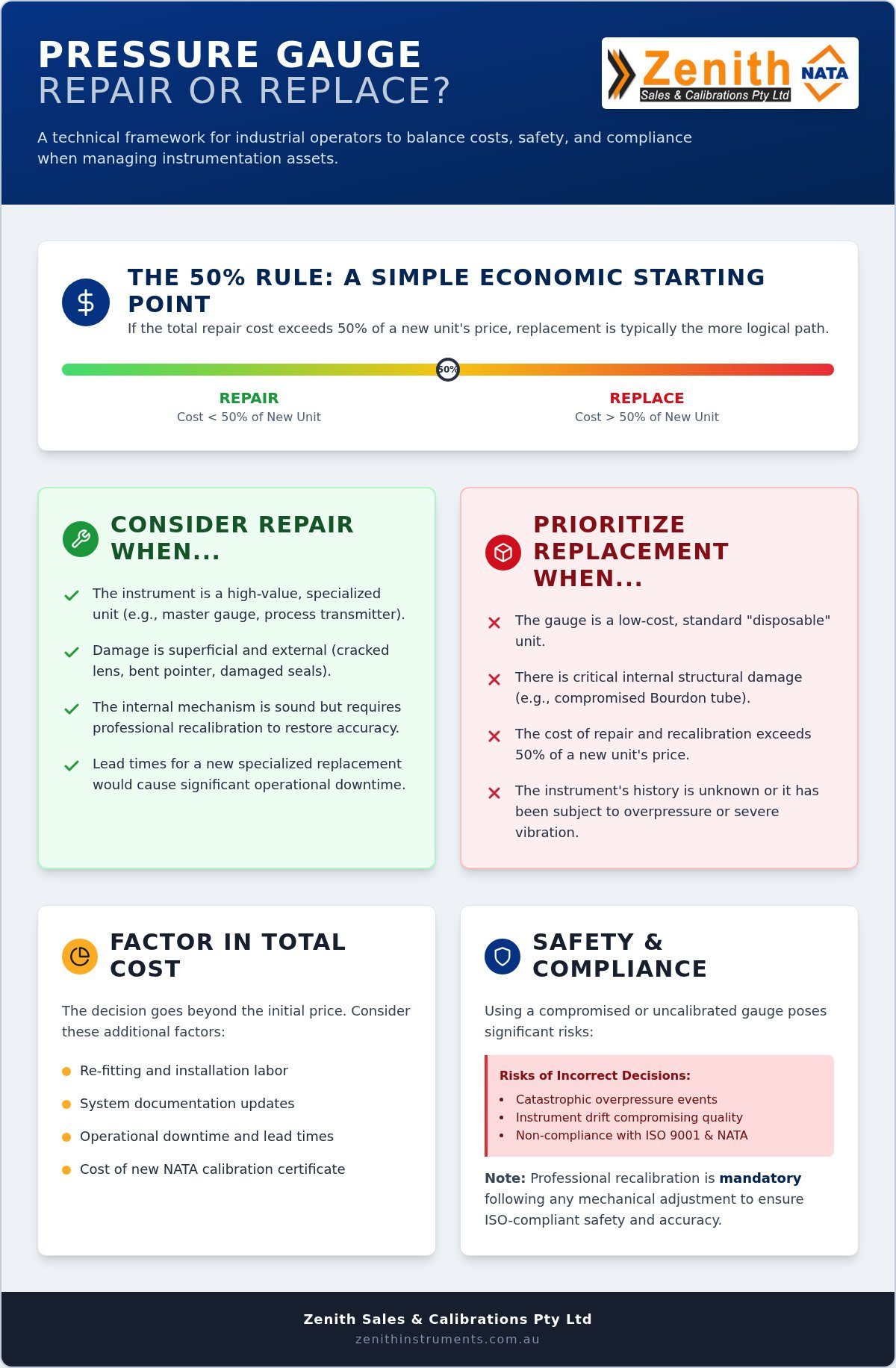
A structured approach to pressure gauge repair vs replacement often starts with the 50% rule. We recommend a straightforward economic audit: if the combined cost of repair labor and a new NATA calibration certificate exceeds 50% of the market price for a new unit, replacement is the more logical path. You must also consider the logistics of a new purchase. While a new gauge from our pressure gauges collection provides immediate reliability, specialized models may have lead times that disrupt your operations. In these instances, a rapid-response repair in our Sydney or Melbourne labs might be the faster way to restore your system's integrity. We provide a meticulous assessment to ensure your final decision aligns with both your budget and your safety obligations.
When is a Pressure Gauge Actually Repairable?
Determining the viability of a gauge often comes down to the integrity of its internal sensing element. While some low-cost units are strictly disposable, high-value master gauges and specialized process transmitters represent a different class of asset. For these instruments, a professional laboratory can often restore factory-spec accuracy through meticulous component replacement and precision pressure gauge calibration. The core of the pressure gauge repair vs replacement decision lies in the distinction between superficial wear and structural failure. We've seen many operators discard expensive master gauges because of a cracked lens or a bent pointer, unaware that these are easily serviceable components.
It's vital to distinguish between recalibration and structural repair. Recalibration involves adjusting the instrument's linkage or software to align its readings with a known standard. Structural repair, however, involves the physical replacement of parts like the movement, dial, or case seals. If the internal mechanism is sound, we can often bring the unit back to NATA-endorsed accuracy levels. If you're unsure whether your high-precision hardware is salvageable, we recommend a professional diagnostic assessment to prevent unnecessary capital expenditure.
Common Repairable Components
Many external issues are cost-effective to fix. Replacing cracked lenses and damaged pointers ensures visibility and prevents debris from entering the movement. We also specialize in refilling liquid-filled gauges with glycerin or silicone to dampen vibration and protect the internal gears from premature wear. Cleaning and degreasing for oxygen service applications is another critical technical service we provide, ensuring that instruments remain safe for use in high-risk environments where hydrocarbon contamination could lead to combustion.
Non-Repairable Failures: The Red Flags
Some failures indicate the point of no return for an instrument. A deformed Bourdon tube is the most common non-repairable fault; once the metal has reached its elastic limit due to over-pressurization, its accuracy can never be reliably restored. Internal corrosion from chemical incompatibility is another definitive red flag, as it compromises the structural integrity of the pressure-retaining parts. Finally, if the case has ruptured or the safety blow-out plug has deployed, the unit has fulfilled its safety function and must be replaced to maintain plant security.
The Economics of Instrumentation: Cost-Benefit Analysis
Evaluating the economics of pressure gauge repair vs replacement requires a shift from simple procurement costs to a Total Cost of Ownership (TCO) model. While the upfront purchase price of a standard industrial gauge may seem manageable, the hidden costs of replacement often go uncalculated. These include the technical labor required for re-fitting, potential piping modifications if the new unit's form factor differs, and the administrative burden of updating asset registers and compliance documentation. For high-precision test gauges, these secondary costs can quickly dwarf the price of a laboratory-grade repair.
A clear decision-making framework is essential for maintaining fleet efficiency. For standard industrial gauges in the $50 to $200 range, replacement is frequently the superior choice, as the cost of a NATA-certified teardown and recalibration may approach the price of a new unit. Conversely, for process-critical and high-accuracy test gauges, the economic balance shifts toward repair. Zenith Sales & Calibrations Pty Ltd assists in fleet evaluation by providing meticulous diagnostic reports that quantify the viability of each asset. We help you move from a reactive "break-fix" cycle to a proactive maintenance strategy that preserves high-value instrumentation while discarding low-cost, compromised units.
Impact on Operational Downtime
Lead time is often the deciding factor in the pressure gauge repair vs replacement debate. Importing new, specialized units from international manufacturers can take weeks, whereas our laboratories in Sydney and Melbourne offer rapid turnaround times. We understand that every hour of unplanned downtime carries a significant financial penalty. To mitigate this, we offer a Pressure Gauge Calibration Service that includes on-site options for minor adjustments. This middle-ground approach allows for immediate verification of accuracy without removing the instrument from the line, ensuring your facility remains compliant and operational with minimal logistical friction. Our local presence provides a localized service touch that international suppliers cannot match, reinforcing our role as a dependable expert for regional industries.
Safety and NATA Compliance: The Australian Standard
Regulatory compliance in Australia centers on the technical competence of the testing facility. When you evaluate pressure gauge repair vs replacement, the decision must be viewed through the lens of NATA accreditation. Performing field repairs or unauthorized adjustments often voids existing NATA endorsements because the technical integrity of the instrument can't be guaranteed without laboratory verification. In 2026, safety audit requirements have become increasingly stringent. This is especially true regarding the traceability of measurements back to national standards. We've observed that NATA reporting requirements for 2026 now demand more granular data within every Calibration Certificate, reflecting a national push for higher industrial accuracy.
A Calibration Certificate is a primary trust signal and a critical legal document. If a system failure occurs, the absence of a valid, NATA-endorsed certificate for your instrumentation exposes your business to significant legal liability. We provide meticulous assessments in our Sydney and Melbourne labs to ensure every gauge meets the highest safety standards. This proactive service model protects your facility from the operational risks associated with inaccurate or uncertified readings. We prioritize precision to ensure your equipment remains a dependable asset rather than a liability during a safety incident.
NATA Certified Lab vs. General Maintenance
During a NATA-certified pressure gauge calibration, our specialists use high-precision reference standards to verify accuracy across the instrument's entire range. General maintenance teams often lack the specialized equipment required for high-pressure verification, which is essential for maintaining ISO 9001 compliance. You can learn more about these requirements in our Instrument Calibrations in Australia: The 2026 Professional Guide. We ensure every adjustment is backed by a formal certification, providing the technical assurance your stakeholders demand.
Documenting the Decision for Audits
Maintaining a comprehensive history of instrument service is a cornerstone of disciplined asset management. Digital records allow Sydney and Melbourne facilities to track the performance of their fleet and justify the choice of repair over replacement during external audits. When an instrument reaches its end-of-life, we ensure all new pressure gauges meet site-specific standards and are integrated into your compliance framework. This structured approach simplifies the audit process and reinforces your commitment to technical excellence.
Ensure your facility meets all national safety standards by booking a NATA-certified calibration service with our expert team today.
Professional Servicing at Zenith Sales & Calibrations Pty Ltd
The final stage of the pressure gauge repair vs replacement decision involves a professional diagnostic assessment. At Zenith Sales & Calibrations Pty Ltd, we provide the industrial expertise required to make this determination with absolute certainty. Our diagnostic process identifies the specific failure mode of your instrumentation, whether it involves a simple linkage adjustment or a catastrophic Bourdon tube deformity. This professional oversight ensures that you don't discard salvageable assets or keep dangerous equipment in service. We act as a dependable expert to guide your procurement and maintenance strategy through meticulous technical analysis.
Our Sydney and Melbourne Laboratory Capabilities
Our facilities house qualified technicians who specialize in both mechanical and electronic pressure repair. We utilize state-of-the-art deadweight testers and digital pressure controllers to verify accuracy across extremely high pressure ranges. This technical infrastructure allows us to restore instruments to their original factory specifications, backed by full NATA-certified calibration. For businesses requiring Calibration Services Sydney, our laboratory provides a controlled environment where precision is the only priority. We meticulously document every adjustment, ensuring your equipment meets the rigorous standards of your industry.
If our assessment reveals that a repair is technically unviable or economically unsound, we facilitate an immediate transition to new hardware. We maintain access to a wide range of new pressure gauges from leading global brands. This ensures that your facility doesn't suffer from extended procurement delays often associated with laboratory-bound competitors. We position ourselves as the expert partner who manages the entire lifecycle of your measurement tools, from initial calibration to eventual decommissioning.
On-Site Service for Large-Scale Facilities
Minimizing downtime is a primary objective for critical Australian infrastructure. We operate mobile calibration labs that bring our technical capabilities directly to your site. This Calibration Service Melbourne and across regional hubs allows for an immediate "Pass/Fail" assessment of your entire instrument fleet. By triggering replacement orders or performing minor adjustments on-site, we significantly reduce the logistical friction of equipment maintenance. This proactive service model is essential for manufacturing and power generation sectors where unplanned outages carry severe financial penalties. We provide a steady, reassuring flow of technical solutions that keep your operations moving without compromise.
Securing Your Measurement Infrastructure in 2026
Deciding on pressure gauge repair vs replacement requires a disciplined assessment of both economic thresholds and technical integrity. We've established that while standard gauges are often disposable, high-value instrumentation warrants a laboratory-grade diagnostic to preserve its operational life. Maintaining NATA compliance is not just a regulatory hurdle; it's a foundational safety requirement that protects your facility from catastrophic failures and legal liability. Every measurement counts when the integrity of your pressurized systems is at stake.
Our NATA Accredited Laboratories in Sydney and Melbourne provide the meticulous precision your industry demands. Whether you require an Australia-wide Mobile Service for on-site verification or Expert Technical Support for specialized hardware, we ensure your measurement tools remain reliable assets. Don't leave your plant's safety to chance with unverified field repairs. Take a proactive step toward technical excellence and regulatory certainty today. Request a Professional Pressure Gauge Assessment to optimize your instrumentation fleet and minimize operational risk. We look forward to partnering with you to maintain the highest standards of industrial accuracy.
Frequently Asked Questions
Can a mechanical pressure gauge be repaired if the needle is stuck?
Yes, we can often repair a mechanical gauge if the needle is stuck due to internal debris or minor linkage misalignment. Our technicians disassemble the unit to clean the movement and inspect the internal gears for signs of wear. However, if the needle is stuck because the sensing element has permanently deformed from a severe over-pressure event, the instrument's accuracy cannot be restored. In those cases, we recommend a full replacement to maintain site safety.
Is it cheaper to repair a digital pressure transmitter or replace it?
The cost-effectiveness of repairing a digital transmitter depends on the failure mode and the unit's initial capital value. For high-precision transmitters, replacing a damaged sensor module or housing is often more economical than buying new hardware. If the main circuit board has failed due to significant environmental ingress, the labor and component costs might approach the price of a new unit. We provide a meticulous assessment to help you decide the most efficient path for your instrumentation.
How do I know if my pressure gauge is beyond repair?
A gauge is typically beyond repair if it shows evidence of internal metal fatigue or housing breaches that compromise the pressure-retaining boundary. If the sensing element has reached its elastic limit, the instrument can no longer provide stable or repeatable readings. Our diagnostic assessment helps you navigate the pressure gauge repair vs replacement dilemma by identifying these non-serviceable faults before you invest in unviable maintenance labor.
Will a repaired pressure gauge still be NATA compliant?
A repaired gauge remains NATA compliant only if the work is performed and verified within a NATA-accredited laboratory. When evaluating pressure gauge repair vs replacement, you must ensure that any mechanical intervention is followed by a full calibration to national standards. We provide the technical assurance and traceable documentation required to keep your facility's safety systems fully certified and audit-ready, ensuring your legal liability is fully managed.
What is the typical turnaround time for a pressure gauge repair in Australia?
Turnaround times depend on the repair's complexity and the availability of specialized components. We prioritize speed to minimize your operational downtime, with most standard repairs in our local laboratories completed within several business days. This rapid response is a significant advantage over importing new, specialized units from international manufacturers, which often takes weeks. Our localized service touch ensures your critical infrastructure remains operational without unnecessary procurement delays.
Does Zenith Sales & Calibrations Pty Ltd provide a warranty on pressure gauge repairs?
We provide a formal technical warranty on all repair services to ensure our adjustments and replacement components meet rigorous reliability standards. This commitment to quality reassures you that your equipment is in the hands of meticulous experts. We stand behind the precision of every instrument that leaves our laboratories, ensuring it withstands the operational stresses of specialized industrial sectors. Our goal is to build trust through technical excellence and precision.
Can you calibrate a gauge without repairing it if it is reading incorrectly?
We can calibrate an instrument without structural repairs if the inaccuracy is caused by simple "drift" rather than mechanical damage. Recalibration involves adjusting the internal linkage to align the dial readings with a known reference standard. If our pre-test reveals that the error stems from worn gears or a compromised sensing element, we'll notify you that a repair is necessary. A calibration certificate cannot be issued for a gauge that is mechanically unstable or failing.
What should I do if my pressure gauge is leaking oil or glycerin?
You should remove the gauge from service immediately to prevent environmental contamination and protect the internal movement. A leak indicates a failed case seal or gasket, which allows moisture and dust to enter the gears. We specialize in resealing and refilling liquid-filled gauges to dampen vibration and prevent premature wear. Addressing a seal leak promptly is a cost-effective way to extend the life of your asset before the internal mechanism suffers permanent damage.