

Could a single PSI variance compromise your entire facility’s compliance under the updated March 2026 high-risk plant legislation? For industrial operators, securing reliable pressure gauge testing brisbane isn't just a technical preference; it's a critical legal mandate. We understand the challenge of balancing rigorous safety audits with the need to keep production lines moving. You need precision that doesn't cause bottlenecks.
Local environmental factors play a significant role in equipment longevity. Brisbane’s humid climate and coastal salt air accelerate the degradation of mechanical gauge components. Bourdon tubes can suffer from internal oxidation or lose their elastic properties over time, leading to inaccurate readings. To mitigate these risks, many facilities source robust components from industry leaders like Samvay Fluid Tekniks Inc, whose specialized instrumentation valves and fittings are designed for durability in harsh environments. These inaccuracies often go unnoticed until a safety audit or a mechanical failure occurs. Regular audits are not just a recommendation; they're a technical necessity to counteract the atmospheric challenges unique to South East Queensland.
We provide the technical expertise to secure your facility with NATA-traceable certification, ensuring every instrument aligns with AS 1349 and ISO/IEC 17025 standards. Our team prioritizes a 4:1 Test Uncertainty Ratio to guarantee the highest level of accuracy for your critical systems. By utilizing our mobile service options, you can eliminate the risks of system failure and the logistical burden of laboratory shipping.
This guide explains how to manage the 2026 WHSQ compliance campaign, optimize your 12-month calibration cycles, and leverage on-site testing to maintain peak operational uptime.
Key Takeaways
- We don't just verify equipment; we provide full instrument calibration to help you maintain rigorous safety standards across your facility.
- We explore how on-site pressure gauge testing brisbane reduces logistical risks and keeps your manufacturing or maritime operations running.
- Understand the importance of NATA traceability in creating a documented chain of comparison to national primary measurement standards.
- We help you determine the optimal testing frequency based on Brisbane's unique environmental factors and standard industrial intervals.
- Learn how leveraging 20 years of Australian instrumentation expertise ensures your specialized equipment meets the highest levels of accuracy.
Essential Pressure Gauge Testing for Brisbane Industries
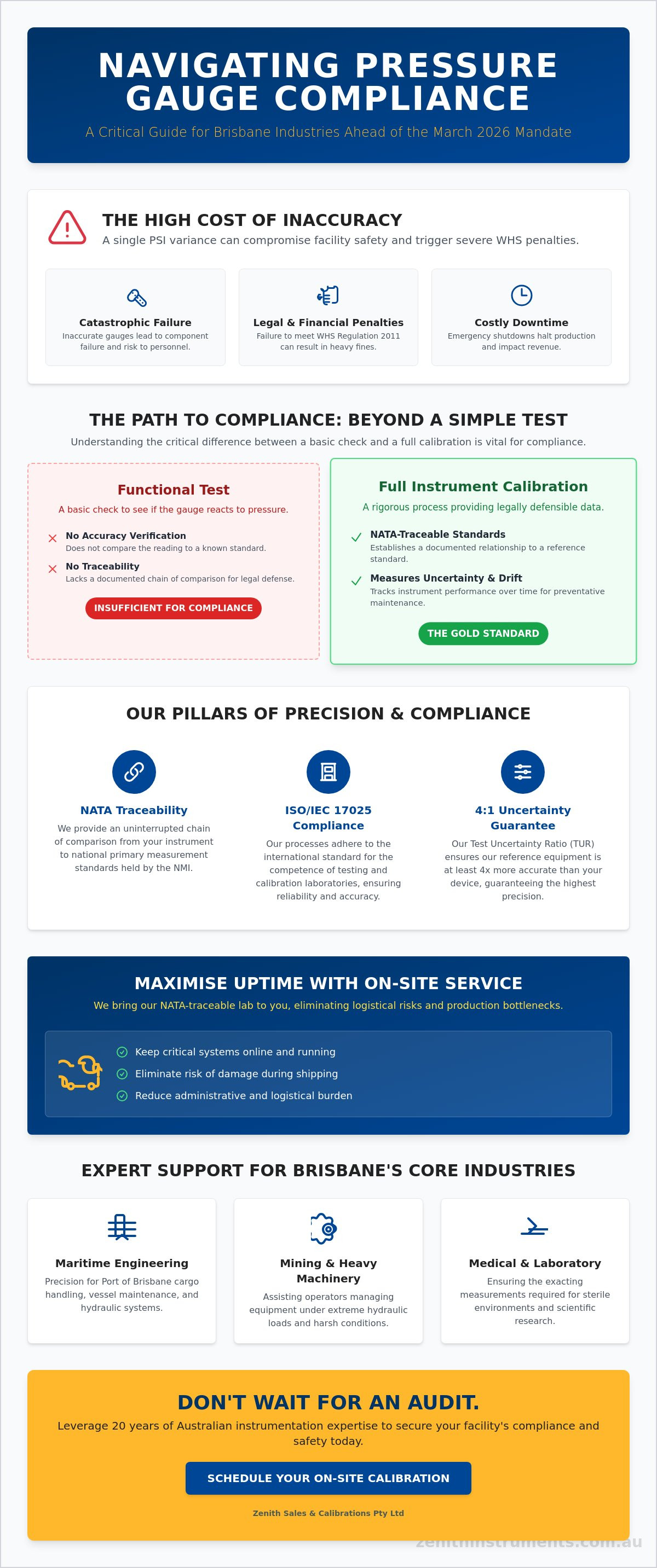
Brisbane’s industrial landscape demands more than just occasional maintenance; it requires a disciplined approach to instrumentation. In the high-stakes environments of manufacturing and maritime hubs, precision is the primary safeguard against catastrophic failure. We recognize that pressure gauge testing brisbane is a fundamental pillar of operational integrity. It isn't merely about checking a dial. It's about ensuring every component in your pressure system operates within its engineered tolerances. Distinguishing between a simple functional test and a full pressure gauge calibration service is vital for compliance. While a test confirms the gauge reacts to pressure, full calibration establishes a documented relationship between the instrument and a traceable reference standard. Understanding foundational pressure measurement principles allows site managers to identify subtle drift before it results in a system-wide shutdown.
Local environmental factors play a significant role in equipment longevity. Brisbane’s humid climate and coastal salt air accelerate the degradation of mechanical gauge components. Bourdon tubes can suffer from internal oxidation or lose their elastic properties over time, leading to inaccurate readings. These inaccuracies often go unnoticed until a safety audit or a mechanical failure occurs. Regular audits are not just a recommendation; they're a technical necessity to counteract the atmospheric challenges unique to South East Queensland.
Why Brisbane Businesses Prioritise Regular Verification
Adherence to AS/NZS standards for pressure vessel safety remains a top priority for local operators. Under the Work Health and Safety Regulation 2011, failing to provide accurate data for WHS reporting can lead to severe penalties. This is especially critical given the WHSQ compliance campaign targeting the manufacturing sector through June 2026. We help businesses avoid costly emergency shutdowns by identifying failing gauges during routine checks. Accurate instrumentation ensures that safety relief valves and pressure switches activate at the correct set points, protecting both personnel and expensive capital plant.
Sectors Served: From Mining Support to Maritime
The technical requirements for pressure systems vary significantly across Brisbane's diverse industrial base. We provide specialized support for several key sectors:
- Maritime Engineering: Supporting the Port of Brisbane with precise instrumentation for cargo handling and vessel maintenance.
- Mining Supply Chain: Assisting heavy machinery operators in South East QLD who manage equipment under extreme hydraulic loads.
- Medical and Laboratory: Ensuring the exactness required for sterile environments and high-precision scientific research.
Whether you're managing a processing plant in Rocklea or a maritime facility at the mouth of the river, our commitment to technical excellence ensures your equipment remains compliant and reliable.
The Technical Standards: NATA Traceability and ISO Compliance
Adherence to rigorous technical standards is the only way to transform a simple measurement into a legally defensible data point. In the context of pressure gauge testing brisbane, we prioritize NATA traceability to ensure your equipment meets the exacting requirements of Australian industry. Without a documented chain of comparison, a gauge reading is merely an estimate. For Brisbane’s high-risk sectors, such as gas processing or heavy manufacturing, estimates are insufficient. We utilize ISO/IEC 17025 as our foundational framework, which is the international standard for the competence of testing and calibration laboratories. This compliance ensures that our laboratory environment, equipment, and technical personnel meet specific criteria for accuracy and reliability.
Traceability is the uninterrupted chain of comparisons to international standards. This chain begins at your facility and extends through our reference equipment to the primary standards held by the National Measurement Institute (NMI). When we perform a pressure gauge calibration service, we establish this link formally. A professional calibration certificate must include the specific uncertainty of measurement, the environmental conditions during the test, and the "as found" and "as left" data. These details allow site managers to track instrument drift over time and make informed decisions about equipment replacement or repair.
Understanding NATA-Traceable vs. NATA-Endorsed
It's vital to distinguish between different certification levels to meet your specific audit requirements. NATA-traceable calibration means the service is performed using equipment that has been calibrated by a NATA-accredited laboratory, maintaining the chain to national standards. This level is often sufficient for standard industrial quality systems. However, certain high-risk plant registrations in Queensland may require NATA-endorsed reports, which carry the NATA logo and satisfy specific legal evidentiary requirements. We help you determine which level of certification is necessary to remain compliant with the Work Health and Safety Regulation 2011.
The Process of Precision Pressure Verification
Precision isn't accidental; it’s the result of disciplined methodology. We compare your gauges against high-accuracy digital masters or deadweight testers that maintain a Test Uncertainty Ratio (TUR) of at least 4:1. This means our reference standard is four times more accurate than the device under test. Our technicians perform hysteresis testing to ensure the gauge reads accurately while pressure is both increasing and decreasing. We also conduct repeatability checks, confirming the instrument provides consistent readings across multiple cycles. For facilities requiring absolute certainty, our pressure gauge calibration service provides the necessary documentation to satisfy both internal quality systems and external regulatory bodies.
On-Site vs. Laboratory Testing: Minimising Downtime in Queensland
Operational efficiency hinges on equipment availability. We recognize that taking critical gauges out of service for off-site testing can disrupt production schedules and impact your bottom line. Choosing the right service model for pressure gauge testing brisbane depends on your specific accuracy requirements and logistical constraints. While some facilities prefer the controlled environment of a laboratory, others require the speed of on-site verification to maintain their 2026 compliance targets. We provide a flexible approach that prioritizes both technical exactness and operational uptime.
Mobile Calibration: Bringing the Lab to Your Facility
We offer mobile service capabilities to eliminate the risks and costs associated with shipping delicate instruments. For large manufacturing plants in areas like Wacol or Pinkenba, our technicians arrive equipped with portable master standards to perform testing directly on your production line. This proactive service model provides immediate certification for critical path equipment, allowing you to return to full operation without the typical multi-day turnaround associated with freight. It's an ideal solution for standard industrial gauges where the environmental variables of a factory floor don't compromise the required Test Uncertainty Ratio. By verifying equipment in situ, we also account for the specific installation conditions that might affect gauge performance.
In-House Laboratory Testing for Maximum Precision
High-precision instruments or those requiring specialized repair often necessitate a trip to our dedicated facilities. Our pressure gauge calibration laboratory provides a climate-controlled environment that minimizes thermal expansion and other variables that can affect ultra-high accuracy measurements. In the lab, we utilize specialized master standards, such as high-range deadweight testers, which are too heavy or sensitive for field use. If your gauges are part of a national fleet, we leverage Zenith’s Melbourne and Sydney labs to provide consistent, cross-border support with the same technical rigor found in our local Brisbane operations.
The primary objection to regular testing is the fear of production halts. We solve this through structured scheduling and clear communication. By batching instruments during planned maintenance windows or utilizing our mobile units, you can satisfy WHSQ requirements without sacrificing output. We work as your partner to map out a testing schedule that aligns with your operational flow, ensuring that precision never comes at the cost of productivity. Whether you require a single gauge verified on-site or a full suite of instruments calibrated in our laboratory, our meticulous approach ensures your facility remains compliant and safe.
When to Schedule Your Next Pressure Gauge Verification
Determining the correct interval for pressure gauge testing brisbane is a matter of proactive risk management. While most industrial standards recommend a 12-month calibration cycle, this is a baseline, not a universal rule. For gauges operating in high-vibration environments or those subjected to frequent pressure surges, a more aggressive schedule of 3 to 6 months is often necessary to maintain required accuracy levels. With Workplace Health and Safety Queensland (WHSQ) maintaining high levels of scrutiny through June 2026, waiting for a scheduled audit to identify a failing instrument is a significant operational gamble. We help you establish a disciplined verification schedule that ensures your documentation is always audit-ready and your systems remain within safe operating limits.
Ignoring uncalibrated tools creates a "financial risk of silence." An inaccurate reading doesn't just threaten system safety; it invalidates quality control data and can lead to the rejection of entire production batches. If an incident occurs and your records show overdue calibration, your legal and insurance standing is severely compromised. We recommend a risk-based approach to scheduling, where the frequency of testing is proportional to the criticality of the measurement and the harshness of the operating environment.
Factors Influencing Calibration Frequency
Several variables dictate how quickly a gauge will drift from its calibrated state. Intensity of usage is the primary driver; a gauge cycled hundreds of times daily will wear mechanical linkages faster than one used for occasional monitoring. Exposure to pressure spikes or hydraulic shocks can also deform the internal Bourdon tube, leading to immediate and permanent offsets. In Brisbane, the combination of high ambient humidity and salt-laden air near the port can cause internal corrosion in non-sealed units. Additionally, sectors like the medical and gas industries must adhere to specific regulatory frameworks that mandate strict, non-negotiable testing intervals to maintain their operating licenses.
Signs Your Gauge Requires Immediate Attention
Technicians should be trained to identify the physical indicators of gauge failure before they lead to a system-wide incident. Visible damage to the casing or a cracked lens is an obvious red flag, but more subtle signs exist. Moisture or oil inside the dial often indicates a seal failure, which will inevitably lead to corrosion and inaccurate readings. Look for "sticky" needle movement or a pointer that jumps rather than moving smoothly; this suggests internal friction or worn gears. One of the most critical signs is the failure of the needle to return to the zero pin when the system is fully vented. If you've noticed any of these indicators, it's time to secure a professional pressure gauge calibration service to restore your system's technical integrity.
Zenith Instruments: Your Partner for Precision in Brisbane
Zenith Instruments has provided technical measurement solutions for over 20 years. We understand that Brisbane's industrial sectors require more than just a certificate; they need a partner who understands the complexities of regulatory compliance. Our commitment to rapid turnaround times ensures your operations remain productive without compromising on technical exactness. While we're recognized for our expertise in pressure gauge testing brisbane, our capabilities extend across a broad spectrum of instrumentation. This includes electrical calibration, gas monitor calibration, and temperature sensing equipment. We offer a single-point solution for multi-disciplinary facilities. This simplifies your vendor management and ensures consistent documentation standards across all your assets.
Why Leading Australian Firms Trust Zenith
Our reputation is built on the technical proficiency of our technicians. Every member of our team possesses deep knowledge of instrument calibrations in Australia, ensuring that your equipment meets both national standards and specific industry requirements. We combine the resources of a nationwide provider with a localized service touch that respects the specific logistical needs of those seeking pressure gauge testing brisbane. By maintaining meticulous records, we ensure your audit trail is seamless and technically defensible. We don't just return your equipment; we provide the data-driven confidence required to operate high-risk plants safely and efficiently. Our experts prioritize precision so you can prioritize production.
Getting Started with Your Brisbane Service
We've streamlined our booking process to minimize administrative friction for your team. Whether you require on-site mobile service at your facility or high-precision laboratory testing, we coordinate the logistics to fit your maintenance schedule. Our consultative approach goes beyond the immediate task. We help you manage your entire instrument inventory, identifying optimal calibration cycles to prevent drift and reduce long-term costs. This proactive management style is essential for facilities navigating the increased scrutiny of the 2026 WHSQ compliance campaign. If you're preparing for an upcoming safety audit or need to verify a critical system, we provide tailored quotes that reflect your specific technical requirements. Contact Zenith Instruments for Pressure Gauge Testing in Brisbane to secure your facility’s compliance and operational reliability today.
Secure Your Industrial Compliance for 2026 and Beyond
Maintaining technical integrity in a high-pressure environment requires more than just reactive maintenance. It demands a disciplined approach to instrumentation that aligns with NATA-traceable standards and ISO/IEC 17025 requirements. We've explored how regular pressure gauge testing brisbane serves as a critical defense against system failures and regulatory non-compliance. By prioritizing accuracy through a 4:1 Test Uncertainty Ratio and utilizing on-site mobile services, your facility can achieve peak safety without sacrificing operational uptime.
Zenith Instruments brings over 20 years of industrial expertise to every calibration, providing the meticulous documentation needed for seamless safety audits. Our technicians understand the specific stressors of Brisbane's industrial hubs, offering tailored solutions that keep your equipment within engineered tolerances. Don't let uncalibrated tools become a legal or financial liability for your business. We're ready to partner with you to ensure your entire instrument inventory remains precise and compliant. Request a Quote for Pressure Gauge Testing in Brisbane today and keep your operations moving forward with confidence.
Frequently Asked Questions
How much does pressure gauge testing cost in Brisbane?
Pricing for calibration services is determined on a case-by-case basis rather than through a fixed rate. Factors influencing the final assessment include the specific instrument type, the required pressure range, and whether the service is performed at our laboratory or via our on-site mobile unit. We provide tailored quotes based on your inventory and technical requirements to ensure you receive an accurate reflection of the specialized work involved.
What is the difference between pressure gauge testing and calibration?
Testing simply confirms that an instrument is functional, whereas calibration establishes a formal, documented relationship between the gauge and a traceable reference standard. During our calibration process, we record "as found" and "as left" data to quantify measurement drift. This rigorous approach ensures your equipment remains compliant with AS 1349 and ISO/IEC 17025 standards, providing the technical defensibility required for industrial safety audits.
How long does a typical pressure gauge calibration take?
Turnaround times depend on the service model you select and the volume of instruments requiring verification. Laboratory-based calibrations typically involve a window of several business days to account for environmental stabilization and technical review. However, our on-site mobile service provides immediate certification for critical path equipment. This allows your facility to return to full operation without the logistical delays associated with shipping and freight.
Do you provide NATA-endorsed certificates for Brisbane clients?
We provide NATA-traceable calibration certificates that satisfy the requirements for most industrial quality systems and workplace safety audits. These reports document the uninterrupted chain of comparison to national primary standards held by the National Measurement Institute. For specific high-risk plant registrations that mandate NATA-endorsed reports carrying the official logo, we can facilitate the appropriate certification level to ensure your facility meets all legal evidentiary requirements.
Can you calibrate digital pressure gauges and transducers?
We calibrate a diverse range of digital pressure gauges and transducers using high-accuracy digital masters and deadweight testers. Our technicians are trained to handle electronic instrumentation that requires precise voltage or current output verification alongside pressure measurement. This specialized pressure gauge testing brisbane ensures that your digital systems provide the repeatability and linearity necessary for complex industrial processing and real-time monitoring tasks.
What happens if my pressure gauge fails the test?
If an instrument fails to meet its engineered tolerances, we provide a detailed report outlining the specific points of non-compliance. Depending on the condition of the gauge, we may offer repair services to restore its accuracy or recommend a replacement from our stock of industrial-grade equipment. Our priority is to ensure that no faulty instrumentation is returned to your production line, effectively mitigating the risk of system failure.
Is on-site pressure gauge testing available in regional QLD?
We offer broad geographic presence, extending our mobile service capabilities to various regional hubs beyond the immediate metropolitan area. Our technicians are equipped to handle the specific logistical and technical needs of regional industries, ensuring remote facilities receive the same precision as city-based sites. This proactive service model for pressure gauge testing brisbane and regional Queensland minimizes operational downtime by bringing our expert technicians directly to your facility.