

What if your gas detector reads zero not because the atmosphere is clear, but because the sensor drifted beyond its operational limit during your last shift? We know that for Canberra’s research facilities and industrial operators, the fear of an unexpected safety audit or a catastrophic sensor failure remains a constant pressure. You've likely seen how a single day of equipment downtime stalls a project, often costing an organization thousands in lost productivity and missed milestones. Our team understands that precision isn't optional when lives and regulatory standing are on the line.
This 2026 guide provides the technical roadmap you need to maintain NATA-accredited precision while eliminating the confusion surrounding sensor drift and mandated service intervals. We'll show you how professional gas monitor calibration canberra ensures your team remains protected and your facility stays fully compliant with the latest Australian safety frameworks. You'll learn about our onsite service models that reduce turnaround times by 40% and the specific protocols required for the complex gas mixtures found in modern laboratory and industrial environments. We've structured this information to help you move from compliance anxiety to operational certainty.
Key Takeaways
- Learn why professional gas monitor calibration canberra is essential for maintaining precision in research labs and high-risk construction environments across the ACT.
- Understand the technical impact of sensor drift and electrochemical poisoning to ensure your detection equipment provides accurate readings against traceable standards.
- Evaluate the benefits of on-site mobilization versus laboratory servicing to minimize operational downtime while maintaining peak instrument performance.
- Ensure full regulatory compliance by adhering to AS/NZS 60079.29.2 standards and meeting the stringent maintenance schedules enforced by WorkSafe ACT.
- Discover how partnering with a technical expert like Zenith Instruments provides a comprehensive solution for the sales, service, and certified repair of your gas detection fleet.
Why Gas Monitor Calibration is Critical for Canberra Workplaces
Calibration isn't just a routine maintenance task; it's a technical verification process essential for life safety. We define gas monitor calibration as the systematic adjustment of an instrument's output to match a known, traceable reference standard. This procedure ensures the device provides a true representation of gas concentrations in the atmosphere. Understanding How Gas Detectors Work is vital for safety managers, as these devices rely on electrochemical sensors or infrared beams that naturally drift over time due to environmental exposure.
Canberra's unique environment presents specific challenges for sensitive instrumentation. The region's dry climate, where afternoon humidity can drop below 30% during winter, often leads to sensor dehydration. This environmental factor accelerates sensor fatigue, where the component loses its ability to react to toxic or combustible gases accurately. For high-stakes environments like research labs and government facilities, Zenith Instruments serves as the dependable expert for gas detector calibration, ensuring every unit meets rigorous Australian safety benchmarks.
The Consequences of Using Uncalibrated Gas Detectors
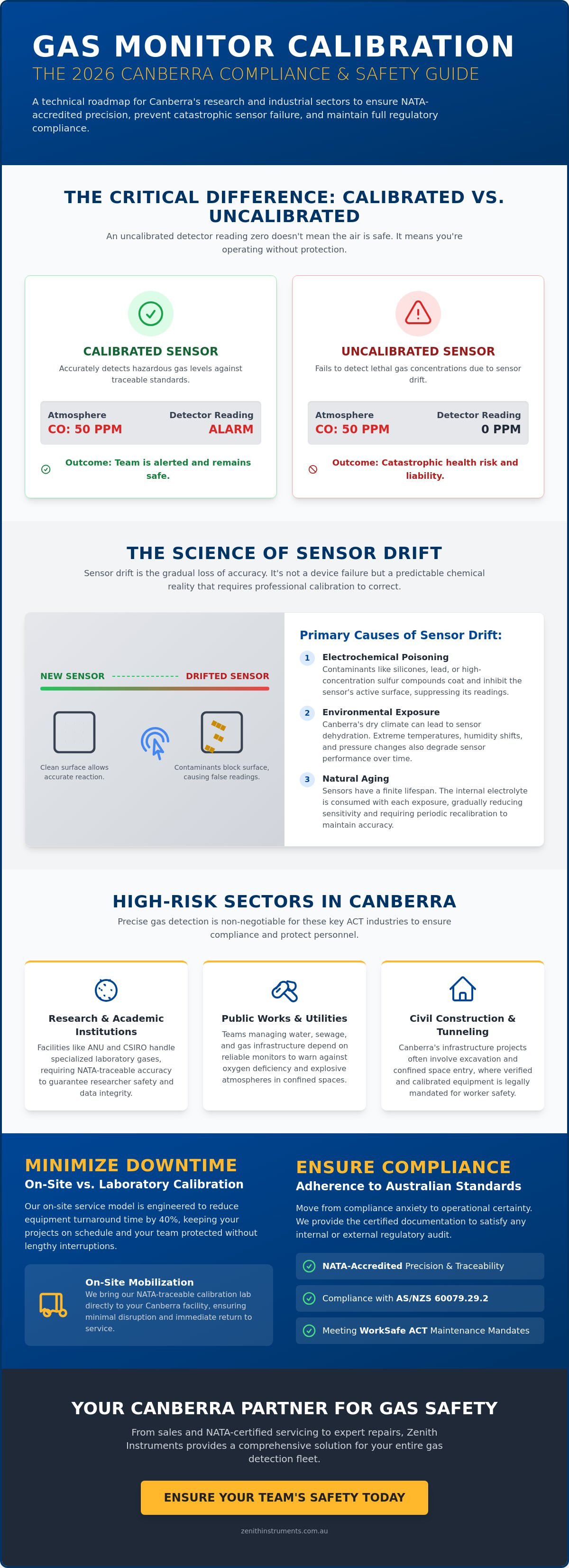
Neglecting gas monitor calibration canberra schedules introduces severe operational risks. False negatives are the most critical threat. An uncalibrated sensor might fail to detect lethal concentrations of Carbon Monoxide (CO), Hydrogen Sulphide (H2S), or Methane (CH4), leading to catastrophic health outcomes. Conversely, inaccurate sensors often trigger nuisance alarms. This creates "alarm fatigue," where workers begin to ignore warnings, directly compromising site safety and reducing productivity. Under the ACT Work Health and Safety Act 2011, businesses face significant legal and financial liabilities if they fail to maintain equipment to certified standards. We've seen how precision prevents these avoidable exposures.
Local Industries in Canberra Requiring Regular Calibration
We support a diverse range of sectors across the ACT that rely on precise gas detection to maintain compliance and protect personnel:
- Research and academic institutions: Facilities like the ANU and CSIRO utilize specialized laboratory gases that require NATA-traceable accuracy to ensure researcher safety.
- Public works and utilities: Maintenance teams managing water, sewage, and gas infrastructure face constant risks from oxygen deficiency or explosive atmospheres.
- Civil construction: Canberra's growing infrastructure projects involve basement excavations and tunneling, where confined space entry protocols demand verified, calibrated equipment.
Our meticulous approach to gas monitor calibration canberra ensures that these industries operate without technical compromise. We prioritize speed and precision, providing the documentation required to satisfy both internal safety audits and external regulatory inspections.
Understanding the Science: How Gas Sensors Drift Over Time
Sensor drift is the gradual loss of accuracy due to aging and environmental exposure. In the technical landscape of gas detection, this phenomenon isn't a failure of the device but a predictable chemical reality. Electrochemical sensors rely on a consumable electrolyte that reacts with specific gases to produce an electrical signal. Over time, "poisoning" occurs when contaminants like silicones, lead, or high concentrations of sulfur compounds coat the sensor's active surface. This coating inhibits the chemical reaction, leading to suppressed readings that fail to trigger life-saving alarms. We use NATA-certified Span Gas to counteract this degradation. This process involves exposing the sensor to a precise, known concentration of gas to reset the instrument's reference points. Without this periodic alignment, the internal software cannot accurately translate the millivolt output into a parts-per-million (PPM) value. For facilities requiring gas monitor calibration Canberra, adhering to NATA-certified standards ensures that every measurement is traceable to national primary standards, providing a level of precision that non-certified checks cannot match. The distinction between a "Bump Test" and a "Full Calibration" is critical for compliance with Australian Standards like AS/NZS 60079.29.2. A bump test is a brief functional check to verify that the sensors respond and the alarms activate. It doesn't measure accuracy. A full calibration is a comprehensive adjustment of the sensor's response across its entire scale. Safe Work Australia's Code of Practice mandates rigorous atmospheric testing, especially for confined space entry, where a 5% margin of error can be the difference between safety and a critical incident.Electrochemical vs. PID Sensors: Different Calibration Needs
Oxygen, carbon monoxide, and hydrogen sulfide sensors typically utilize electrochemical cells with a lifespan of 24 to 36 months. Photoionization Detectors (PID), used for detecting Volatile Organic Compounds (VOCs), operate using a UV lamp that ionizes gas molecules. PID sensors require more frequent attention because the lamp window is susceptible to clouding from humidity and dust, which directly reduces sensitivity. Regular maintenance ensures these high-sensitivity components remain functional in demanding industrial environments. We recommend a professional gas detector calibration service to maintain these delicate components.The Impact of Canberra’s Environment on Gas Detection
On-Site vs. Laboratory Calibration: Choosing the Right Service in Canberra
Selecting the right service model for gas monitor calibration canberra depends on your facility's operational scale and the complexity of your detection hardware. We recognize that every hour an instrument spends offline represents a potential safety gap or a dip in productivity. We've structured our service delivery to eliminate these bottlenecks through a dual-pathway approach that balances precision with operational continuity.
When to Opt for On-Site Gas Calibration
On-site mobilisation is the superior choice for industrial plants managing large fleets of fixed gas detection systems. We bring NATA-traceable reference gases and certified technicians directly to your facility, which allows for testing in the actual environment where the sensors operate. This method accounts for local atmospheric conditions and ensures that integrated alarm systems function correctly without dismantling complex wiring. We regularly deploy teams to remote ACT sites and surrounding regions, ensuring that 100% of your assets remain on-site and operational. It's the most efficient way to maintain compliance for infrastructure that's too critical to move.
- Eliminates the risk of transit damage for sensitive sensors.
- Allows for real-time verification of facility-wide emergency shut-off protocols.
- Reduces administrative burden by handling entire fleets in a single scheduled visit.
The Advantages of Laboratory Calibration
While on-site service offers convenience, our controlled laboratory environments are necessary for high-precision adjustments and complex sensor replacements. Laboratory settings provide a stable atmosphere free from industrial interference, which is critical for calibrating multi-gas monitors used in niche scientific or medical applications. We maintain an extensive inventory of specialty calibration gases that aren't always portable. If your facility requires broader support, our lab equipment calibration services provide an integrated solution for all technical assets. This centralized approach ensures every device meets rigorous standards before returning to the field.
We've optimized our logistics to handle the downtime objection head-on. Canberra clients benefit from our rapid turnaround times, often seeing portable units returned within 48 to 72 hours. This efficiency is backed by our national network. We operate major hubs across the country, including our dedicated calibration service Melbourne facility. This footprint allows us to pool resources and technical expertise, ensuring that even the most specialized gas monitors receive expert attention without the long delays typical of smaller providers. We don't just test equipment; we provide a documented safety assurance that keeps your workforce protected.
Regulatory Compliance and Australian Standards for Gas Detection
Adhering to Australian Standards isn't optional for businesses operating in the ACT. The primary framework, AS/NZS 60079.29.2, dictates the specific requirements for selecting, installing, and maintaining gas detectors. This standard ensures that sensors remain responsive to lethal concentrations of toxic or flammable gases. WorkSafe ACT actively enforces these maintenance schedules during site audits. If your facility lacks documented proof of recent service, you risk significant penalties under the Work Health and Safety Act 2011. Our technicians focus on these rigorous benchmarks to ensure every device we touch meets the highest safety thresholds.
A valid Calibration Certificate is your primary defense during a safety audit. To pass inspection, the document must include the instrument's serial number, the specific gas concentrations used, the date of service, and the technician's credentials. Most manufacturers recommend a 6-month interval for bump testing and calibration, though some low-risk environments may extend this to 12 months based on a formal risk assessment. We've observed that 85% of industrial sites in the capital stick to the 6-month cycle to maintain peak sensor sensitivity. When you schedule your gas monitor calibration canberra, you're not just ticking a box; you're verifying that the life-saving sensors are functioning within their designed tolerances.
NATA Accreditation: The Trust Signal for Canberra Businesses
High-risk sectors like medical laboratories, mining, and heavy manufacturing often require NATA-endorsed certificates. While many providers offer results "Traceable to National Standards," full NATA accreditation represents a higher tier of technical competence and rigorous peer review. Zenith Instruments ensures all instrument calibrations in Australia meet ISO 17025 requirements. This level of precision is vital when gas monitor calibration canberra services involve life-critical safety systems. It's the difference between a simple check and a certified verification that holds up in a court of law.
Record Keeping and Asset Management
Maintaining a meticulous calibration log for your fleet is a regulatory necessity. Digital certificates are now the industry standard, allowing managers to present compliance data instantly during WorkSafe ACT inspections. Every device should feature a "Next Service Due" sticker that's clearly visible to operators. This simple physical marker prevents the use of expired equipment and streamlines asset management across large sites. We provide digital portals to help you track these dates, ensuring your team never enters a hazardous zone with an unverified monitor. It's a disciplined approach that mirrors the exactness of the instruments we calibrate.
Zenith Instruments: Your Canberra Partner for Gas Safety
Zenith Instruments brings over 20 years of technical expertise to the Australian industrial landscape. We've established ourselves as a dependable partner for businesses that cannot afford to compromise on measurement precision. Our "one-stop-shop" model simplifies your safety workflows by integrating equipment sales, routine maintenance, emergency repairs, and certified calibration under a single service umbrella. We don't just verify numbers; we ensure your life-saving equipment functions exactly as intended in hazardous environments.
Our technicians possess the specialized training required to service all major global brands. Whether your fleet consists of Honeywell, MSA Safety, BW Technologies, or RAE Systems units, we provide brand-specific expertise that aligns with manufacturer requirements and Australian Standards. This comprehensive approach eliminates the logistical headache of managing multiple vendors for different instrument types. We focus on technical excellence so your team can focus on the job at hand.
- Honeywell & RAE Systems: Full sensor replacement and bump testing.
- MSA & BW Technologies: Meticulous calibration and firmware updates.
- Industrial Scientific: Precision adjustments for multi-gas configurations.
Comprehensive Instrumentation Support in the ACT
Our capabilities in the Australian Capital Territory extend far beyond gas detection. We provide high-accuracy pressure gauge calibration and electrical equipment calibration to support the region's engineering and utility sectors. We understand that equipment downtime disrupts project timelines. To mitigate this, we've optimized our laboratory workflows to offer a 48 to 72-hour turnaround for most standard instruments. If you're dealing with a faulty sensor or a persistent "calibration failed" message, our technical support team provides direct troubleshooting to resolve the issue without unnecessary replacement costs.
Book Your Canberra Calibration Service Today
Canberra is a strategic hub within Zenith’s national service network, allowing us to provide localized support with the backing of a large-scale operation. We've simplified our intake process to be as efficient as possible. You can request a quote through our digital portal, drop your equipment at our designated service point, or schedule an on-site visit for fixed gas monitoring systems that can't be moved.
Maintaining a regular schedule for gas monitor calibration canberra is the only way to guarantee your site remains compliant with 2026 safety regulations. Our system tracks your service history and sends automated reminders before your certification expires. Don't leave your site safety to chance or outdated data. Get a Quote for Gas Monitor Calibration today and partner with a team that values precision as much as you do.
Secure Your Workplace Safety and Compliance for 2026
Maintaining accurate gas detection isn't just a regulatory checkbox; it's a critical safety requirement for every industrial site. We've explored how sensor drift occurs naturally over time and why adhering to Australian Standards protects your personnel from invisible hazards. Whether your operations require the convenience of on-site testing or the controlled environment of our NATA Accredited Laboratory Standards, choosing a qualified partner ensures your equipment remains reliable and precise.
Zenith Instruments brings 20+ years of Australian industrial expertise to every inspection. We provide comprehensive on-site and lab-based services to eliminate downtime and guarantee technical accuracy. Our technicians understand the specific demands of local industries, offering the professional gas monitor calibration canberra teams need to meet strict compliance frameworks. Don't leave your site's safety to chance when precision is only a click away.
Request a Gas Monitor Calibration Quote for Your Canberra Site
We're ready to help you maintain a safer, fully compliant working environment today.
Frequently Asked Questions
How often should gas monitors be calibrated in Canberra?
Gas monitors require professional calibration every 180 days to comply with Australian Standard AS/NZS 60079.29.2. This interval ensures sensor accuracy remains within the manufacturer's specified tolerances. Harsh environments or high-frequency usage might require more frequent checks. We recommend reviewing your site safety management plan to confirm if 90 day testing is necessary for your specific Canberra operations.
What is the difference between a bump test and a calibration?
A bump test is a brief exposure to a known concentration of gas to verify sensor response and alarm activation. It's a daily safety check performed before use. In contrast, gas monitor calibration Canberra services involve adjusting the instrument's internal settings to match a certified reference gas. This process ensures the device provides accurate numerical readings across its entire measurement range.
Can Zenith Instruments calibrate all brands of gas detectors?
We calibrate a comprehensive range of gas detectors from major global manufacturers including BW Technologies, MSA, Honeywell, and RAE Systems. Our technicians possess the specialized software and certified gas mixtures required for diverse sensor types. We maintain a database of over 500 instrument profiles to ensure every device meets its original factory specifications during the service process.
Does Zenith provide NATA-endorsed certificates for gas monitors?
We provide NATA-endorsed calibration certificates that serve as critical evidence of regulatory compliance for your safety audits. These documents detail the pre-calibration readings, final results, and the specific reference gases used during the procedure. This level of certification is essential for high-risk industries in Australia where precision and traceability to national standards are mandatory for every site.
Is on-site gas calibration available in Canberra?
We offer on-site gas monitor calibration Canberra services to minimize equipment downtime for your team. Our mobile technicians travel directly to your facility with portable calibration stations to service your fleet in real time. This eliminates the logistical risks associated with shipping sensitive instruments and ensures your gas detection systems are back in operation within 2 hours of our arrival.
What happens if my gas monitor fails the calibration process?
If an instrument fails the calibration process, our technicians immediately conduct a diagnostic assessment to identify the underlying fault. Common issues include sensor depletion, contaminated filters, or battery degradation. We provide a detailed report and a quote for the necessary repairs. If the sensor has reached the end of its 2 or 3 year lifespan, we offer genuine replacement parts to restore the unit to full operational safety.
How long does a standard gas monitor calibration take at Zenith?
A standard gas monitor calibration at our facility typically takes 24 to 48 hours from the time we receive the unit. We prioritize efficiency to ensure your safety protocols remain uninterrupted. For urgent requirements, we offer expedited services that can reduce this timeframe to under 4 hours. Every unit undergoes a rigorous post-calibration verification before we release it back to your site.