

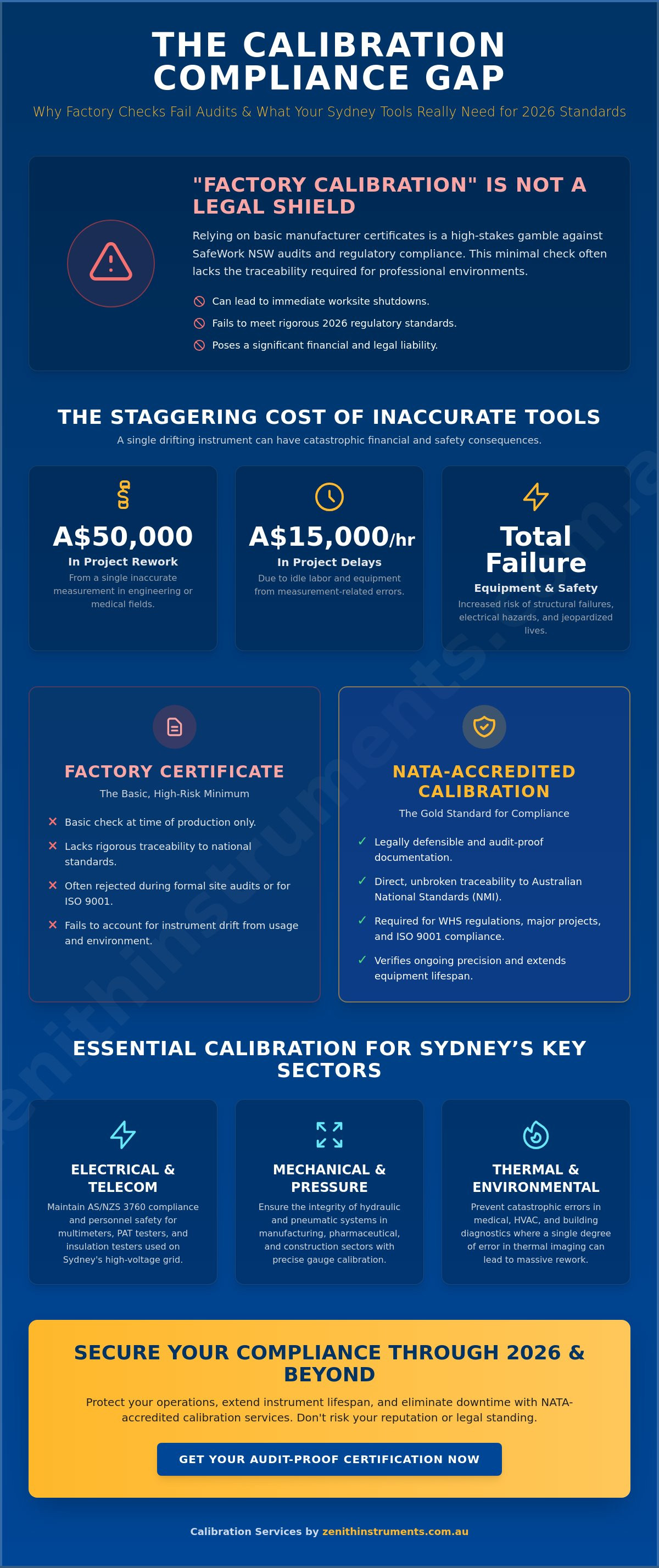
A "factory calibration" certificate from a retail outlet is not a legal shield against a SafeWork NSW audit. Relying on these basic documents often leads to immediate worksite shutdowns, as 2026 regulatory standards demand rigorous, traceable accuracy for all precision instruments. You already know that in high-pressure engineering or medical environments, a single inaccurate measurement can result in A$50,000 in project rework or total equipment failure. Maintaining your professional sydney tools requires a disciplined approach to technical maintenance that goes beyond the basic manufacturer's manual.
We'll show you how to secure full regulatory compliance and extend the operational lifespan of your expensive precision instruments through NATA-accredited services. This guide breaks down the critical differences between standard retail checks and the NATA-endorsed certifications required for quality audits. We provide a structured roadmap to ensure your instruments remain precise, certified, and ready for any industrial challenge across New South Wales, ensuring your operations never miss a beat due to non-compliance.
Key Takeaways
- Understand the critical distinction between NATA-accredited calibration and basic traceability to ensure your instruments meet the highest Australian regulatory standards.
- Identify the specialized calibration protocols required for electrical, pressure, and thermal equipment across Sydney’s medical, manufacturing, and engineering sectors.
- Learn how to establish an optimal maintenance cycle for your sydney tools by accounting for usage frequency and local environmental impact.
- Discover how to minimize operational downtime through localized service models that prioritize rapid turnaround and onsite technical expertise.
- Gain actionable insights into maintaining precision and industrial safety to protect your business's reputation and operational compliance through 2026.
Beyond the Purchase: Why Precision Matters for Tools in Sydney
Acquiring high-end sydney tools is only the first step in maintaining industrial excellence. We distinguish between general-purpose hardware and precision industrial instrumentation by the level of verifiable accuracy required for complex tasks. Sydney’s infrastructure projects, such as the Sydney Metro expansion and the Western Sydney Airport development, demand tolerances often measured in microns or milliamps. These projects rely on the absolute reliability of measurement data to ensure structural integrity and operational safety. Even the most reputable brands experience "instrument drift" over time. This phenomenon occurs when environmental factors, mechanical stress, or repeated use cause a tool’s readings to deviate from its original specifications. We define Calibration as the formal process of comparing a measuring instrument against a traceable national standard to identify and correct these discrepancies.
The High Cost of Inaccurate Instrumentation
A single degree of error in thermal imaging or a minor variance in torque can lead to catastrophic results. On Sydney construction sites, inaccurate measurements increase the risk of structural failures or electrical hazards that jeopardize lives. These aren't just safety concerns; they're significant financial liabilities. A 2023 industry analysis indicated that measurement errors contribute to project delays that can cost Tier 1 contractors upwards of A$15,000 per hour in idle labor and equipment. Tool calibration is the vital link between physical measurement and international standards. We provide comprehensive calibration services in Sydney to ensure your fleet remains within strict operational limits, preventing costly rework and downtime.
Regulatory Expectations for Sydney Workplaces
Compliance with NSW Work Health and Safety (WHS) regulations isn't optional for local businesses. While many sydney tools arrive with a "factory calibration" certificate, this document often lacks the rigorous traceability required during a formal site audit or ISO 9001 certification process. Regulatory bodies and insurance providers expect evidence that your equipment links back to Australian National Standards maintained by the National Measurement Institute (NMI). We help you meet these benchmarks by providing detailed documentation that stands up to professional scrutiny. Relying on outdated factory settings puts your NATA accreditation and your legal standing at risk. Our technicians ensure every device we service meets the specific regulatory frameworks governing the engineering and manufacturing sectors in Australia.
Essential Calibration Services for Sydney’s Industrial Sectors
Sydney's industrial landscape relies on the precision of its equipment. Whether it's a construction site in Parramatta or a medical lab in Macquarie Park, the accuracy of sydney tools directly impacts operational safety and legal compliance. We ensure that every instrument meets the rigorous standards set by the National Measurement Institute (NMI), providing the traceability required for high-stakes environments. Our technical team focuses on eliminating measurement uncertainty to protect your project timelines and bottom line.
Electrical and Telecommunication Tool Maintenance
Licensed contractors across New South Wales face strict regulatory requirements regarding equipment safety. We provide comprehensive electrical equipment calibration services for multimeters, PAT testers, and insulation testers. In 2024, maintaining accurate readings is vital for high-voltage work within Sydney’s expanding power grid. A deviation of even 1% in an insulation tester can lead to catastrophic safety failures or non-compliance with AS/NZS 3760 standards. Our technicians verify that your gear performs within manufacturer specifications to protect both personnel and infrastructure.
Mechanical and Pressure Instrumentation
Local manufacturing and pharmaceutical sectors require exact environmental and mechanical controls. We offer precise pressure gauge calibration to maintain the integrity of hydraulic and pneumatic systems. Industrial safety hinges on these readings; a faulty gauge in a high-pressure system is a significant liability. For Sydney’s food and pharma industries, we calibrate thermometers and humidity sensors to ensure perishable goods remain within the strict 2 to 8-degree Celsius range required for many medical supplies.
Beyond electrical and pressure tools, Sydney workshops require specialised maintenance for torque wrenches and gas detectors. Torque wrench calibration prevents over-tightening of critical fasteners in automotive and aerospace engineering, where specific Newton-metre (Nm) targets are non-negotiable. We also manage dimensional tool checks for calipers and micrometers, ensuring that machining tolerances remain within microns. For teams working in confined spaces, our gas detector calibration services provide the life-saving assurance that sensors will trigger at the correct parts-per-million (PPM) thresholds.
Maintaining a regular schedule for your sydney tools reduces downtime and avoids the costs associated with equipment failure. You can view our full range of NATA-accredited services in Sydney to keep your operations running at peak performance.
NATA Accreditation: The Gold Standard for Sydney Tool Compliance
NATA (National Association of Testing Authorities) provides the essential framework that ensures your sydney tools meet rigorous national standards. For businesses operating in 2026, the distinction between a "traceable" calibration and a NATA-accredited one is significant. While traceable calibration indicates that a tool was checked against a master standard, NATA accreditation confirms that the laboratory itself has been independently audited for technical competence, equipment accuracy, and staff proficiency. We maintain strict ISO/IEC 17025 compliance in our Sydney labs to ensure every measurement we take stands up to the highest level of scrutiny.
Sydney government bodies and Tier-1 contractors mandate NATA-endorsed certificates for a specific reason: risk mitigation. Major infrastructure projects, such as the Sydney Metro or Western Sydney Airport, require objective proof of equipment accuracy to meet safety and quality benchmarks. A non-endorsed report might not hold up in a legal challenge or during a safety investigation following an equipment failure. By choosing an accredited provider, you're protecting your business from the liabilities associated with inaccurate instrumentation.
Reading and Understanding Your Calibration Certificate
Every certificate we issue contains critical data points that define the tool's performance. You must look specifically at the uncertainty of measurement, which quantifies the margin of error for each test point. A NATA-endorsed report is a globally recognised mark of technical competence. These documents also include traceability statements and clear pass/fail criteria based on manufacturer specifications or industry standards. During a site audit, these certificates serve as your primary evidence of compliance, demonstrating that your sydney tools are maintained within a controlled quality system.
Zenith’s Commitment to Precision and Standards
As a leading provider of calibrations in Australia, Zenith Instruments prioritises technical excellence over simple throughput. We operate state-of-the-art laboratory facilities in NSW equipped with the latest reference standards. Our Sydney-based technical specialists undergo continuous training to master evolving ISO frameworks and complex instrumentation protocols. We don't just process equipment; we offer a high-performance service model designed for the engineering and manufacturing sectors. For more details on our local capabilities, view our calibration services Sydney page to see how we support NSW industry standards.
Optimising Tool Performance: When to Calibrate Your Equipment
Maintaining the accuracy of your sydney tools requires more than occasional checks; it demands a rigorous, usage-based calibration cycle. We recommend a risk-based approach where tools used in high-volume production lines or safety-critical applications undergo testing every 6 months. For general-purpose equipment, an annual schedule often suffices. Recent industry data indicates that 85% of measurement failures stem from environmental degradation or improper storage between uses.
Sydney's unique coastal geography introduces specific challenges. High salt spray and humidity levels in areas like Port Botany or the Northern Beaches accelerate corrosion on precision surfaces. This oxidation can alter the physical dimensions of micrometers or the internal mechanisms of pressure gauges. Before commencing any major Sydney infrastructure project or commercial contract, a "Pre-Project Check" is essential. This proactive step ensures that all equipment meets the required ISO 9001 or NATA standards before work begins, preventing costly rework or compliance disputes later.
Systematic documentation serves as the backbone of asset management. By recording every calibration result, businesses create a traceable history that identifies drifting trends. This data allows for predictive maintenance, where you can replace or repair a tool before it falls outside of tolerance limits. It's a disciplined strategy that transforms calibration from a reactive expense into a proactive asset protection plan.
Signs Your Tools Need Immediate Attention
Don't wait for your scheduled date if you notice physical or functional red flags. Visual scoring on contact points or rust on threads indicates that precision is compromised. If a digital display fails to return to zero or provides inconsistent readings during repetitive tasks, the internal sensor is likely damaged. Any tool subjected to a drop or high-impact event must undergo a safety re-check immediately. A single impact can misalign internal components by fractions of a millimetre, rendering the tool unreliable for professional use.
Industry-Specific Calibration Intervals
Calibration frequency isn't universal; it depends on your sector's regulatory framework. We provide specialized torque wrench calibration for automotive and aerospace workshops, typically recommended every 12 months or 5,000 cycles. High-precision medical and laboratory equipment often requires semi-annual checks to maintain compliance with stringent health standards. For sydney tools operated in harsh outdoor environments, we suggest shortening intervals by 25% to account for accelerated wear from grit and moisture.
Ensure your equipment meets the highest standards of precision by booking your NATA-accredited calibration in Sydney today.
Zenith Instruments: Sydney’s Partner for Local Tool Calibration
Zenith Instruments provides a localized, technical response to the evolving calibration needs of New South Wales industries. We recognize that precision isn't just a checkbox; it's a fundamental safety and compliance standard for every professional. For teams managing a diverse fleet of sydney tools, our facility offers a streamlined path to NATA-traceable compliance. We focus on eliminating the logistical bottlenecks that often plague maintenance schedules. Our technicians prioritize efficiency, frequently delivering turnaround times within 3 to 5 business days. This speed ensures your equipment returns to the worksite without stalling your project timelines or compromising your 2026 output targets.
Our support extends to a wide array of leading global brands, including Fluke, Megger, and Hioki. By maintaining a deep technical knowledge of these manufacturers, we act as a single point of contact for complex inventories. We don't just verify numbers; we ensure your gear operates within the exact parameters defined by international standards. This commitment to industrial expertise makes us a dependable partner for the engineering, medical, and manufacturing sectors across the state.
On-Site vs. Laboratory Calibration in Sydney
Deciding between on-site and laboratory service depends on your specific accuracy requirements and logistical constraints. Our mobile calibration units bring NATA-traceable standards directly to your facility. This is the optimal choice for high-volume tool kits or fixed machinery where transport risks damage or excessive downtime. We service the entire Greater Sydney region, from the high-density CBD to the sprawling industrial hubs of Western Sydney and Parramatta. If you're running a 24-hour production line, our on-site mobilisation keeps your operations moving without the need for courier delays. For high-precision tasks requiring a strictly controlled, climate-stabilized environment, our local laboratory provides the necessary conditions for sensitive instrumentation and dimensional metrology.
Getting Started with Zenith Sales & Calibrations
Managing a professional tool inventory in 2026 requires a proactive maintenance strategy rather than reactive repairs. We make the onboarding process straightforward by providing detailed technical quotes based on your specific inventory list. Our capabilities go beyond simple verification. We offer comprehensive repair and maintenance for damaged instrumentation. If a device fails its initial assessment, our technicians can often perform the necessary component replacements to bring it back within tolerance. This integrated model saves your business the capital expenditure of total equipment replacement. You can trust that every piece of gear leaving our care is certified and ready for immediate use. Ensure your tools are fit for purpose with Zenith’s Sydney calibration experts. We invite you to book your next service through our dedicated calibration services in Sydney portal to maintain your competitive edge.
Future-Proof Your Sydney Tools with Professional Calibration
Maintaining the accuracy of your sydney tools is a critical component of operational safety and regulatory compliance. As we move into 2026, the demand for precision within the engineering and manufacturing sectors continues to rise. Relying on NATA-accredited laboratories ensures your equipment meets the rigorous ISO/IEC 17025 standards, providing the legal and technical certainty your business requires. Zenith Instruments delivers this expertise directly to your facility through our expert on-site mobilisation across the Sydney metropolitan area.
We understand that downtime impacts your bottom line. That's why we offer fast 3-5 day turnaround options to keep your projects on schedule without compromising on quality. Our technicians focus on meticulous detail, ensuring every instrument performs to its exact specifications. Partnering with a local specialist means you gain access to high-performance calibration that supports long-term equipment reliability and industrial excellence.
Book Your NATA-Accredited Tool Calibration in Sydney Today
Your precision is our priority, and we're ready to help you maintain the highest standards of accuracy today.
Frequently Asked Questions
How often should I calibrate my tools in Sydney?
Most industrial equipment requires professional calibration every 12 months to maintain compliance with ISO 9001 standards. If your sydney tools operate in harsh environments like high-heat construction zones or high-vibration manufacturing plants, we recommend a 6 month interval. Regular testing ensures your measurements remain within the manufacturer's specified tolerances and prevents costly project errors.
What is the difference between a standard calibration and NATA calibration?
A NATA calibration provides the highest level of technical assurance and is recognized internationally through the ILAC MRA. While a standard calibration traces back to national standards, a NATA endorsed certificate confirms that the laboratory meets ISO/IEC 17025 requirements for specific testing scopes. We provide both options to ensure your equipment meets the exact regulatory demands of your specific industry.
Does Zenith Instruments provide on-site calibration in Western Sydney?
We provide comprehensive on-site calibration services across Western Sydney, including major industrial hubs like Blacktown, Parramatta, and Penrith. Our mobile technicians bring precision master instruments directly to your facility to minimize downtime. This service allows your team to keep essential sydney tools in operation without the logistical delays associated with laboratory transport.
Can you calibrate tools from major brands like Fluke or Megger?
We specialize in the precision testing of Tier 1 brands including Fluke, Megger, Keysight, and Hioki. Our technicians utilize high accuracy calibrators specifically designed to verify the complex electrical and thermal functions of these premium instruments. We ensure every device performs to its original factory specifications before issuing a certificate of compliance.
What happens if my tool fails calibration during testing?
If an instrument falls outside its acceptable tolerance range, we provide a detailed failure report and offer adjustment or repair services. Our team communicates the specific deviation found during the test so you can assess the impact on previous measurements. We don't just identify the problem; we provide the technical solution to restore your equipment to its required accuracy levels.
How long does the calibration process typically take at your Sydney lab?
Our standard turnaround time for laboratory calibration is 3 to 5 business days from the moment we receive your equipment. For urgent requirements, we offer an expedited service that can often be completed within 24 hours. We track every stage of the process through our management system to ensure your tools return to service as quickly as possible.
Is NATA accreditation required for all NSW construction sites?
NATA accreditation is mandatory for most Tier 1 government infrastructure projects and high risk engineering environments across New South Wales. While some private residential sites accept standard traceable certificates, NATA endorsed testing is the gold standard for legal and safety compliance. We recommend checking your specific contract requirements to ensure your equipment meets the necessary ISO standards.
Do new tools purchased in Sydney need to be calibrated immediately?
New tools often require immediate calibration because factory certificates don't always meet Australian regulatory or NATA requirements. Equipment can also lose its precision during international shipping or long periods of storage in a warehouse. Performing an initial calibration establishes a reliable baseline for your instrument’s performance history and ensures it's accurate from the first day of use.