

A single millimetre of over-torque can compromise the structural integrity of a heavy-duty assembly, leading to catastrophic component failure and significant rectification costs. You've likely seen the fallout of inconsistent readings in the workshop, where even a 5% deviation from specified torque values results in stripped threads or broken bolts. We understand that maintaining precision is a constant challenge, especially when trying to balance operational uptime with the rigorous demands of torque wrench calibration. You need your tools to perform exactly as the manufacturer intended, every single time they're clicked.
This 2026 guide provides the technical clarity you need to master Australian compliance standards and ensure your instruments meet NATA-traceable requirements. We'll outline the critical differences between basic verification and full ISO 6789 compliance, helping you avoid the confusion of DIY checks that leave your business vulnerable to liability. You'll discover how to streamline your maintenance schedules and access rapid onsite services in Sydney and Melbourne to keep your workshop moving. By the end of this article, you'll have a clear roadmap for maintaining tool accuracy without the traditional delays of sending equipment away for weeks.
Key Takeaways
- Understand the critical requirements of ISO 6789:2017 to ensure your workshop maintains strict compliance within Australia’s rigorous industrial landscape.
- Implement a professional framework for torque wrench calibration that includes essential pre-test cycling and scale verification to guarantee mechanical reliability.
- Learn why NATA-traceable certification is non-negotiable compared to DIY checks, particularly when accounting for Australian environmental variables like humidity and heat.
- Establish precise recalibration intervals based on usage cycles and environmental stressors to mitigate the risk of over-torquing and costly equipment failure.
- Discover how leveraging onsite calibration solutions in Sydney and Melbourne can streamline your maintenance schedule and eliminate workshop downtime.
Understanding Torque Wrench Calibration in Australia’s Industrial Landscape
Torque wrench calibration is the precise process of verifying a tool's performance against a traceable national standard and making necessary adjustments to ensure its output remains within specified tolerances. In the high stakes environments of Sydney and Melbourne workshops, this procedure ensures that the rotational force applied to a fastener matches the indicated value on the tool. We recognize that torque wrench calibration is a fundamental pillar of mechanical integrity and safety. Without regular verification, even the highest quality tools drift from their original settings due to mechanical wear and component fatigue.
Australian workshops must adhere to the ISO 6789:2017 standard, which is the international benchmark for hand torque tools. This standard is divided into two parts: Part 1 focuses on the requirements for design and manufacture, while Part 2 details the requirements for calibration certificates and the calculation of measurement uncertainty. Adhering to these standards is essential for maintaining NATA (National Association of Testing Authorities) compliance. NATA accreditation serves as the primary trust signal in the Australian measurement industry, ensuring that calibration laboratories meet rigorous technical and management requirements under the National Measurement Act 1960.
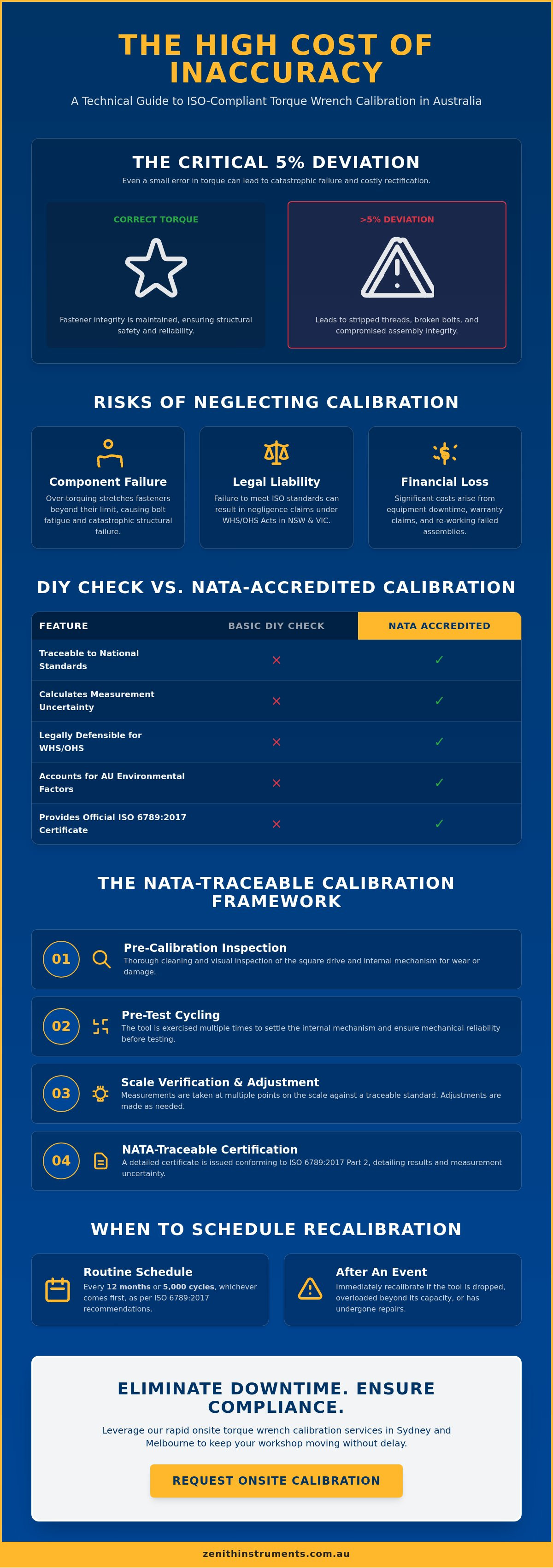
The consequences of neglecting calibration are severe. Using uncalibrated tools often leads to bolt fatigue, where fasteners are either stretched beyond their elastic limit or left too loose to withstand operational vibrations. This can result in catastrophic structural failure, especially in heavy machinery or infrastructure. From a legal perspective, workshops face significant liability under the Work Health and Safety (WHS) Act 2011 in NSW and the Occupational Health and Safety Act 2004 in Victoria. If an accident occurs and records show that tools weren't maintained to ISO standards, the business owner is often held responsible for negligence.
The Science of Torque Measurement
Torque is the product of force multiplied by distance. A Torque wrench relies on internal components, usually a calibrated spring, to resist the rotational force until a specific threshold is reached. Over time, these springs experience "set," which is a minor but permanent deformation caused by being held under tension. This physical change directly impacts the tool's accuracy. It's vital to distinguish between accuracy and precision. Accuracy is how close the measured torque is to the actual target value. Precision, or repeatability, is the tool's ability to deliver the same result across multiple applications. Our torque wrench calibration services address both factors to ensure your tools perform reliably under load.
Key Industries Requiring Calibration in Sydney and Melbourne
In the automotive and heavy vehicle sectors across NSW and VIC, technicians must use calibrated tools to meet Heavy Vehicle National Law (HVNL) requirements. Mining and construction firms in Brisbane and Newcastle rely on high capacity torque equipment for critical plant maintenance where failure isn't an option. Aerospace and medical manufacturing hubs in Melbourne require even tighter tolerances, often demanding precision within a 1% to 4% margin to satisfy Civil Aviation Safety Authority (CASA) or TGA regulations. We provide the technical expertise needed to keep these diverse sectors compliant and operational.
How to Test and Calibrate Your Torque Wrench: A Professional Framework
Precision in mechanical fastening requires more than a simple click; it demands a repeatable, documented process. We adhere to a technical framework that mirrors ISO 6789:2017 requirements to ensure every tool leaving our bench is fit for industrial use. This rigorous process identifies mechanical fatigue before it leads to critical fastener failure in the field.
Step 1: The Pre-Calibration Inspection
We begin by cleaning the tool to remove grease and metal shavings that can migrate into the internal mechanism. Our technicians inspect the square drive for rounding, as even 0.5mm of wear can compromise how torque is transferred to the fastener. We also verify the handle integrity and ensure the locking mechanism prevents setting drift during high-repetition tasks. Pre-test cycling is a mandatory step for spring-loaded wrenches where we exercise the tool at its maximum capacity five times to distribute internal lubricant across the spring and pivot points.
Once the tool is physically sound, we move into the testing phases. We measure the output at 20%, 60%, and 100% of the tool's maximum range. Testing at these specific intervals allows us to detect non-linear spring behavior. We record the deviation at each point and calculate the error percentage using the formula: (Measured Torque - Set Torque) / Set Torque x 100. If the error exceeds the standard 4% limit, the tool requires internal adjustment.
Step 2: Verification and Adjustment
We utilize laboratory-grade digital torque testers or transducers with a verified accuracy of +/- 0.5% to obtain precision readings. When a wrench falls outside of tolerance, we adjust the internal tension screw to bring the spring back into alignment with the graduated scale. We don't just stop at one successful reading; we re-test across all three points to confirm the tool's linearity. In our Sydney and Melbourne laboratories, we find that approximately 15% of tools require these internal adjustments to regain their certified status. For workshops that prioritize safety, our torque wrench calibration services ensure your equipment remains compliant with Australian standards.
This systematic approach guarantees that your measurements are not just estimates, but verified data points. Maintaining this level of accuracy is essential for heavy vehicle maintenance and structural engineering projects where bolt tension is a matter of safety. By following these steps, we provide the technical assurance that your tools will perform exactly as specified under load.
DIY vs. NATA-Accredited Calibration: Why Precision Matters for AU Workshops
Many technicians rely on "WikiHow" methods involving hanging weights from a bench-mounted wrench to verify accuracy. While this serves as a basic functional check, it doesn't constitute a valid torque wrench calibration. Static weight tests fail to account for the dynamic friction and pivot point variances that occur during real-world application. Without a controlled environment and certified reference standards, these garage-built rigs often introduce more error than they resolve.
Environmental conditions in Australian workshops directly impact tool performance. In high-humidity regions like Brisbane or during a Sydney summer, moisture ingress and temperature fluctuations alter the viscosity of internal lubricants and the elasticity of the main spring. A professional laboratory maintains a controlled climate (typically 20°C ± 2°C) to ensure these variables don't skew results. We provide the technical rigor necessary to identify these subtle shifts that a DIY check will inevitably miss.
Traceability is the most critical factor for commercial operations. An unofficial check provides no protection during a safety audit or an insurance investigation following a mechanical failure. For workshops maintaining Instrument Calibrations in Australia, a NATA-endorsed certificate is the only document that proves compliance with ISO 9001 and ISO 6789 standards. This documentation ensures your workshop meets the highest regulatory benchmarks in the country.
The Hidden Risks of DIY Calibration
Home-made test rigs often use non-certified weights that lack a traceable mass value, leading to cumulative errors. These setups frequently fail to detect non-linear inaccuracies. A wrench might appear accurate at its midpoint but deviate by more than 10% at the lower or upper limits of its scale. Additionally, improper adjustment of the tension screw without specialized tooling can permanently damage the internal mechanism, rendering a premium tool useless.
Benefits of Professional Calibration in Sydney and Melbourne
Our laboratories in Sydney and Melbourne utilize high-precision master sensors with an uncertainty of measurement of less than 1%. This level of detail is essential for heavy industry and precision automotive work. When you book torque wrench calibration services with us, you receive a comprehensive report that identifies wear patterns before they lead to tool failure. Our expert technicians analyze the "click" mechanism and reset the tool to factory specifications, extending its service life and ensuring workshop safety.
When to Schedule Calibration: Frequency and Compliance Standards
Precision isn't permanent. We recommend a baseline frequency of 12 months or 5,000 cycles, whichever occurs first, in accordance with ISO 6789 standards. High-volume workshops in Melbourne or Sydney often reach this cycle limit within six months. Environmental factors also dictate your schedule. If a tool is dropped from a height or left in a service vehicle where temperatures exceed 40 degrees, internal spring tension changes. Over-torquing a tool beyond its rated capacity by just 20% can permanently deform the internal mechanism, leading to immediate inaccuracy.
We also insist on strict storage best practices to preserve tool life. You must always wind the torque wrench back to its lowest scale setting after every use. Leaving a wrench under tension causes the spring to take a "set," which ruins accuracy and forces an early torque wrench calibration. For multi-site operations across Canberra and Newcastle, we help managers develop a centralized tool management schedule. This ensures that assets are rotated and serviced in batches, preventing a situation where an entire fleet of tools expires simultaneously during a peak project phase.
Recognising the Signs of Calibration Drift
A soft or "mushy" click is the first warning sign of internal trouble. If the tactile feedback feels inconsistent during application, the internal lubrication has likely dried out or the spring is fatigued. You should also watch for visible corrosion on the spring or mechanism, which is an immediate fail. We suggest a "buddy check" on the shop floor; if two tools used on the same fastener produce different results, stop work immediately. These discrepancies indicate that your tools are no longer operating within their 4% or 6% allowable tolerance levels.
Regulatory Audit Preparation
Preparation for a NATA audit starts with meticulous documentation. We provide a digital log of all torque wrench calibration services to ensure your records stay accessible for inspectors. Every tool in your workshop must feature a legible calibration sticker that clearly displays the certificate number and the next service due date. We recommend integrating these torque checks into your broader maintenance schedule. This disciplined approach mirrors the requirements of ISO 9001 and ensures that every instrument in your facility meets international precision standards without exception.
Ensure your workshop remains compliant and safe. Book your NATA-traceable calibration with Zenith Instruments today.
Zenith Instruments: Expert Torque Wrench Calibration in Melbourne and Beyond
Zenith Instruments provides the technical precision required to keep Australian workshops operational and safe. We adhere to NATA-traceable standards, ensuring your torque wrench calibration meets the strict compliance demands of 2026. Our technicians understand that a tool out of spec is a liability. We service and sell leading brands like Norbar and Warren & Brown, offering a full lifecycle solution from initial purchase to regular maintenance and complex repairs.
Downtime costs money. In the automotive and manufacturing sectors, a 24-hour delay can stall a production line or delay a critical delivery. We offer on-site calibration services across Sydney and Melbourne to eliminate transport time and logistics hurdles. Our mobile labs bring laboratory-grade accuracy directly to your factory floor. This proactive approach helps local businesses maintain 100% equipment availability throughout the year without the need for redundant backup tools.
Our turnaround times are engineered for the high-pressure needs of the AU industrial sector. We've streamlined our intake and testing processes to ensure your tools are back in service within minimal timeframes. By combining speed with technical rigor, we support the efficiency of local manufacturing hubs and heavy vehicle workshops across the country.
Local Service, National Expertise
We operate dedicated, state-of-the-art facilities in Sydney, Melbourne, Brisbane, and Perth. This national footprint allows us to support large-scale industrial projects with a local touch. Our mobile technicians provide an efficient calibration service Sydney wide, reaching clients in Western Sydney industrial parks and the CBD. Beyond torque, we offer expert support for pressure gauges and other critical measurement tools. Our team manages the technical logistics so your staff can stay focused on production targets.
Why Choose Zenith for Your Torque Tools?
With over 20 years of experience in the Australian instrumentation market, we've built a reputation for meticulous accuracy and industrial reliability. Every service concludes with a detailed certification that serves as a legal record of compliance and a proof of precision for your auditors. Zenith provides a comprehensive one-stop shop for all your metrology needs, ranging from dimensional calibration to torque. We don't just check numbers; we ensure your workshop's safety and long-term reliability.
Our technicians handle complex repairs in-house, reducing the need for expensive third-party shipping or tool replacement. We've optimized our workflow to deliver the fastest possible torque wrench calibration results without compromising on the depth of our analysis. Whether you're managing a fleet of tools in a Melbourne automotive plant or a single wrench in a Sydney workshop, our commitment to technical excellence remains the same.
Secure Your Workshop’s Precision for 2026
Maintaining mechanical integrity in Sydney and Melbourne workshops requires more than just high-quality tools; it demands absolute measurement certainty. As Australian industrial standards evolve toward 2026, the risks associated with uncertified equipment grow. Relying on professional torque wrench calibration ensures your team meets strict NATA-accredited laboratory standards, protecting both project outcomes and workplace safety. We provide a streamlined solution to keep your operations moving without delay.
Our technicians deliver flexible on-site service across Sydney, Melbourne, and Brisbane, bringing precision directly to your facility. For those requiring laboratory testing, we guarantee a fast 3-5 day turnaround to minimize downtime. This proactive approach eliminates the inaccuracy of DIY methods and ensures your business remains fully compliant with rigorous ISO frameworks. We're here to support your technical requirements with meticulous attention to detail and industry-leading expertise. Your equipment represents the backbone of your productivity, and we're ready to help you maintain its peak performance.
Book Your NATA-Traceable Torque Wrench Calibration Today
Frequently Asked Questions
How much does torque wrench calibration cost in Sydney?
Torque wrench calibration costs in Sydney typically range from A$45 to A$150 per unit depending on the tool's capacity and complexity. These rates reflect the technical labor required to meet ISO 6789 standards and the type of certification requested. High-capacity industrial wrenches or those requiring NATA-accredited reports sit at the upper end of this price scale. We provide transparent quotes based on your specific fleet size and the technical precision required for your sector.
Can I calibrate my own torque wrench for industrial use?
You cannot perform your own torque wrench calibration for industrial applications because DIY methods lack the controlled environments and master sensors required for compliance. Industrial standards demand a 4:1 accuracy ratio between the master device and the tool under test. We use laboratory-grade equipment that's regularly audited to ensure your measurements stand up to legal and safety inspections. Self-calibration often leads to a 12% margin of error, which is unacceptable in precision engineering.
How often should a torque wrench be calibrated in Australia?
Most Australian workshops must calibrate torque wrenches every 12 months or after 5,000 cycles to remain compliant with international safety standards. If a tool is dropped or sustains a 25% overload, you'll need immediate testing regardless of the date on the last certificate. Harsh environments in Sydney and Melbourne construction sites often make 6-month intervals a safer choice. We track these intervals for our partners to ensure no instrument falls out of its certified window.
What is the difference between NATA and traceable calibration?
NATA calibration involves a formal endorsement from the National Association of Testing Authorities, while traceable calibration links measurements to national standards without the same level of external audit. NATA-accredited reports are a mandatory requirement for high-risk industries like aerospace, defense, and medical manufacturing. Traceable certificates are usually sufficient for general automotive or heavy machinery workshops. We offer both tiers to match your specific regulatory and risk management needs.
What happens if I use an uncalibrated torque wrench?
Using an uncalibrated tool leads to catastrophic fastening failures like bolt stripping, shearing, or insufficient clamping force. Industry data shows that 15% of mechanical failures in heavy transport are caused by improper torque application. These errors compromise the structural integrity of your projects and void manufacturer warranties instantly. We eliminate these risks by verifying that your tools provide repeatable, accurate results across their entire operating range.
Do you provide on-site torque wrench calibration in Melbourne?
We provide comprehensive on-site torque wrench calibration services across Melbourne and surrounding industrial precincts to minimize your operational downtime. Our mobile technicians bring the laboratory to your workshop, performing the necessary tests and issuing digital certificates on the spot. This service model is designed for high-volume facilities that can't afford to have critical tools off-site for several days. We focus on speed and precision to keep your production lines moving without interruption.
Is it necessary to reset my torque wrench to zero after use?
You must reset mechanical "click" torque wrenches to their lowest scale setting after every use to prevent the internal spring from losing its tension. Leaving a wrench under high compression causes a permanent set in the spring, which can degrade accuracy by 10% within a few months. Digital models don't have this physical limitation, but they still require regular professional checks. We recommend this simple maintenance habit to extend the life of your precision instruments between scheduled service dates.
What standards govern torque wrench calibration in Australia?
The primary standard for torque wrench calibration in Australia is ISO 6789, which defines the requirements for both manufacturing and periodic re-testing. This standard specifies that tools must be tested at 20%, 60%, and 100% of their maximum capacity to ensure linear accuracy. We follow these rigorous frameworks to ensure your business meets the audit criteria for ISO 9001 and other quality management systems. Our technicians stay updated on all 2026 regulatory shifts to keep your workshop at the forefront of compliance.