

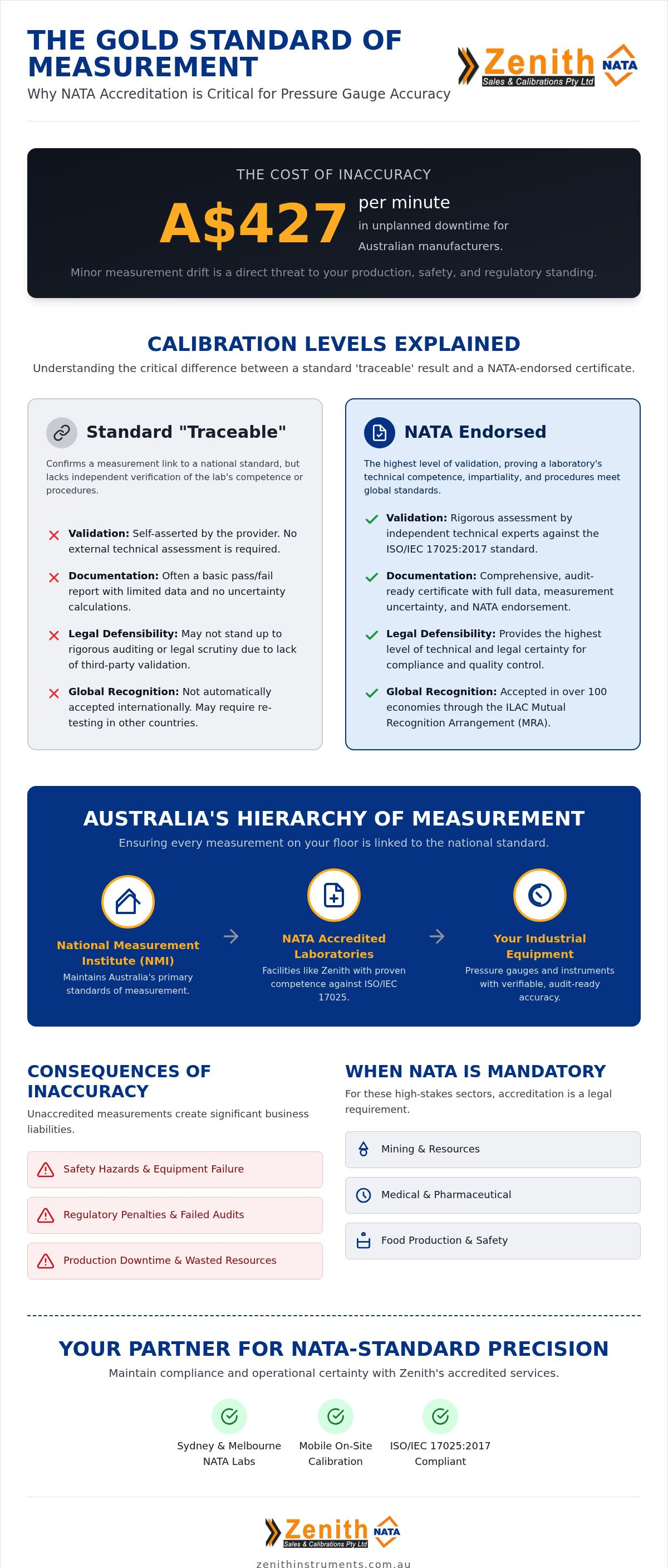
Unplanned downtime for Australian manufacturers can cost as much as A$427 per minute, a figure that underscores the critical importance of pressure gauge accuracy in maintaining industrial safety and efficiency. When your facility operates within tight tolerances, a minor measurement drift is more than a technical error; it's a direct threat to your production schedule and regulatory standing. You likely recognize the need for precision, yet the technical distinction between "traceable" results and NATA-endorsed certificates often complicates procurement decisions and risk management strategies.
This 2026 professional guide clarifies why NATA accreditation remains the gold standard for Australian industry, shielding your business from technical, safety, and compliance risks. We'll demonstrate how partnering with an accredited laboratory ensures absolute certainty in your measurements and provides the audit-ready documentation required for ISO/IEC 17025:2017 compliance. We'll also break down the rigorous technical assessments that differentiate accredited facilities, helping you eliminate confusion between various service levels and ensuring your equipment remains a reliable asset rather than a liability.
Key Takeaways
- Identify the technical differences between standard "traceable" calibration and NATA-endorsed services to ensure your equipment meets the highest validation standards.
- Recognize the importance of pressure gauge accuracy as a primary defense against unplanned production downtime and significant regulatory penalty risks.
- Ensure your facility remains audit-ready by utilizing ISO/IEC 17025:2017 compliant documentation that provides full legal and technical defensibility.
- Determine when NATA endorsement becomes a mandatory legal requirement, particularly within the medical, pharmaceutical, and mining sectors.
- Leverage Zenith Sales & Calibrations Pty Ltd's dedicated laboratories in Sydney and Melbourne or our mobile on-site capabilities to maintain NATA-standard precision without disrupting your workflow.
Understanding NATA Accreditation in the Australian Regulatory Landscape
NATA serves as the cornerstone of technical integrity across the country. The National Association of Testing Authorities (NATA) operates as Australia's sole accreditation body for laboratories, providing a formal recognition of a facility's competence. While many providers claim to offer quality services, NATA accreditation specifically validates a laboratory's technical proficiency against the ISO/IEC 17025:2017 standard. This international benchmark, reaffirmed in 2023, isn't a mere management guideline; it's a rigorous set of requirements for the competence, impartiality, and consistent operation of laboratories. The importance of pressure gauge accuracy is central to this framework, as accredited labs must prove their measurement uncertainty is within strict, verified limits.
It's vital to distinguish between a "certified" business and an "accredited" laboratory. An ISO 9001 certification focuses on general management systems and can apply to any industry, from retail to logistics. In contrast, ISO 17025 accreditation is a technical requirement that proves a laboratory can produce precise and reliable data. This distinction protects your business from the risks of "traceable" calibrations that lack external validation. Because NATA is a signatory to the ILAC Mutual Recognition Arrangement (MRA), any NATA-endorsed report is recognized in over 100 economies. This global acceptance facilitates international trade by ensuring your equipment's calibration is accepted without the need for additional testing overseas.
The Role of the National Measurement Institute (NMI)
The NMI is the peak measurement body responsible for maintaining Australia's primary standards of measurement under the National Measurement Act 1960. NATA works in tandem with the NMI to establish a clear hierarchy of traceability. This chain begins with the primary national standards held by the NMI and flows down to accredited facilities, such as our calibration services in Sydney and Melbourne. By adhering to this hierarchy, we ensure that every measurement on your shop floor is linked back to a recognized national standard, providing the legal defensibility required for modern industrial operations.
Why Accreditation is Australia’s Gold Standard
Achieving NATA status involves a grueling peer-review process where independent technical experts scrutinize every facet of a laboratory's operations. These assessors evaluate staff qualifications, equipment maintenance, and the validity of specific calibration methods. This process verifies both the integrity of the management system and the actual technical competence of the personnel performing the work. NATA accreditation is the highest level of third-party measurement validation available in Australia. It ensures the importance of pressure gauge accuracy is never compromised, providing a level of certainty that standard "traceable" calibrations simply cannot match.
Technical Superiority: Traceable vs. NATA Accredited Calibration
A traceable calibration confirms that an instrument's measurements are linked to a national standard through an unbroken chain of comparisons. While this sounds sufficient, it lacks the rigorous external validation that defines a NATA-accredited service. In a traceable-only scenario, the laboratory asserts its own competence. In a NATA-accredited scenario, an independent board of technical experts confirms that the lab's specific procedures, equipment, and personnel meet the highest global standards. This distinction is vital when considering the importance of pressure gauge accuracy, as an unvalidated process can lead to hidden measurement drifts that compromise industrial safety.
The depth of documentation also varies significantly between these two service levels. Standard reports often provide a simple "pass/fail" result or a basic list of readings compared against a master tool eventually linked to the National Measurement Institute (NMI). NATA-accredited certificates include a detailed calculation of "Measurement Uncertainty." This figure represents the statistical range within which the true value lies, accounting for environmental factors, equipment resolution, and operator variability. By understanding the importance of pressure gauge accuracy through the lens of uncertainty, you can make more informed decisions about equipment reliability and process control.
The Anatomy of a NATA Calibration Certificate
A genuine NATA certificate is easily identifiable by the NATA emblem and a unique accreditation number prominently displayed on the document. This logo isn't just a badge; it signifies that the certificate is an "Endorsed Report." Such reports carry significant weight for legal and insurance purposes, serving as authoritative proof that the calibration was performed under a strictly controlled quality system. For a deeper look at these documentation requirements, consult our Instrument Calibrations in Australia: The 2026 Professional Guide.
When is Traceable Enough?
Traceable calibration might suffice for non-critical reference tools, such as a basic thermometer used for general ambient monitoring where a slight variance won't impact safety or product quality. However, critical safety equipment requires a higher tier of validation. Our pressure gauge calibration services are essential for pressurized systems where a failure could lead to catastrophic equipment damage or personnel injury.
Ask yourself these three questions to decide which level of service your facility requires:
- Is the measurement used to ensure personnel safety or environmental protection?
- Does a regulatory body or an ISO standard mandate endorsed results for your sector?
- Would a measurement error lead to significant financial loss or unplanned production downtime?
If the answer to any of these is "yes", NATA accreditation is the only responsible choice. If you're unsure which level your facility requires, our technical experts at Zenith Instruments can review your equipment list and recommend a compliant calibration schedule tailored to your operational risks.
Risk Management: The Industrial Consequences of Unaccredited Measurements
In high-stakes environments like Australian mining or aviation, using unaccredited tools isn't just a technical oversight; it's a significant legal liability. If an incident occurs, regulatory bodies will scrutinize the calibration history of every instrument involved. Under the National Measurement Act, non-compliance can lead to severe penalties, with a single Commonwealth penalty unit valued at $364 as of July 1, 2026. Measurement drift, the gradual deviation of an instrument from its calibrated state, often goes unnoticed without the rigorous checks mandated by NATA. This highlights the importance of pressure gauge accuracy, as even a slight drift in a pressurized system can lead to catastrophic equipment failure. NATA-standard checks are designed specifically to detect and correct these deviations before they compromise safety.
Beyond safety, the financial implications of inaccurate instrumentation are severe. Unplanned downtime for Australian manufacturers can cost as much as A$427 per minute, a cost that balloons if the stoppage is caused by a faulty measurement requiring a full system investigation. By adhering to ISO/IEC 17025:2017, laboratories provide the technical validation needed to avoid these losses. This accreditation also simplifies the audit process for broader standards like ISO 9001 or AS/NZS. When an auditor sees a NATA-endorsed certificate, the technical competence of the measurement is already established, reducing the time and documentation required to prove compliance.
Insurance and Workplace Health & Safety (WHS)
Operating with NATA-accredited tools directly impacts your risk profile. Many Australian insurers offer lower premiums to facilities that demonstrate a commitment to verified precision, as it reduces the likelihood of workplace accidents. Under Australian WHS laws, directors and managers have a non-delegable duty to provide a safe working environment. This duty includes ensuring all safety-critical equipment is functional and accurate. For instance, regular gas detector calibration is mandatory for confined space entry. Using a NATA-accredited lab for these services ensures that if a claim is made, you've the endorsed documentation to prove you met your statutory obligations.
Protecting Your Brand Reputation
A single faulty measurement can trigger a product recall or the loss of a major supply contract. In the industrial sector, your reputation rests on the reliability of your output. If a client disputes your technical data, having a NATA-endorsed report provides the defensible data necessary to resolve the conflict. It shifts the burden of proof from your internal processes to an externally validated standard. NATA accreditation acts as a professional insurance policy for your technical data. By recognizing the importance of pressure gauge accuracy, you protect your brand from the long-term damage associated with technical failures.
Sector-Specific Requirements: When NATA Endorsement is Mandatory
While calibration is a best practice for all, certain Australian industries face legislative mandates where NATA endorsement is non-negotiable. In the medical and pharmaceutical sectors, thermometer calibration isn't just about quality control; it's a regulatory requirement for cold chain integrity. The Therapeutic Goods Administration (TGA) and other governing bodies demand that storage temperatures for vaccines and critical medicines are monitored by instruments with verified, endorsed accuracy. Failing to provide these records can result in the immediate disposal of entire inventory batches and the suspension of operating licenses.
Similarly, the mining sector operates under stringent safety frameworks that prioritize the importance of pressure gauge accuracy and structural integrity. For heavy machinery maintenance, torque wrench calibration ensures that every bolt is tightened to exact manufacturer specifications. This precision prevents catastrophic mechanical failures in remote underground operations where equipment recovery is both dangerous and expensive. In these high-risk zones, a traceable-only certificate often fails to meet the site-entry requirements set by major Tier 1 mining contractors.
In the civil construction sector, the reliance on laser level calibration is absolute. Even a two-millimetre deviation over a fifty-metre span can compromise the structural integrity of a high-rise foundation or drainage system. Similarly, the telecommunications industry requires precise networking equipment testing to maintain the throughput and reliability of Australia's digital backbone. These measurements form the technical foundation upon which our national infrastructure is built and maintained.
Medical and Biomedical Compliance
Hospitals and clinics must adhere to strict NATA requirements to maintain patient safety and accreditation status. We provide comprehensive biomedical equipment calibration services that meet these rigorous standards. In laboratory environments, temperature mapping and humidity checks must be NATA-endorsed to ensure that biological samples and chemical reagents remain stable. This level of validation provides a defensible record during health department audits, proving that your facility operates within safe clinical parameters.
Mining and Manufacturing Standards
Underground operations present unique challenges where pressure and force measurements must be absolute. Lifting equipment and load cells must meet AS 1418 standards, which often require NATA-endorsed validation to ensure safe working load (SWL) limits are never exceeded. We support these sectors with on-site calibration services in Melbourne and other major industrial hubs. This mobile capability allows us to verify the importance of pressure gauge accuracy directly on the shop floor, minimizing the need to transport heavy instrumentation and reducing unplanned downtime. Contact our technical team to schedule your NATA-compliant equipment audit today.
Zenith Instruments: Your Partner for NATA-Standard Precision and Reliability
Zenith Sales & Calibrations Pty Ltd stands as a premier provider of NATA-certified standards and ISO-compliant processes across Australia. We operate dedicated laboratory facilities in Sydney and Melbourne, ensuring rapid turnaround times for critical instrumentation that requires a controlled environment. Our technical scope is extensive, covering everything from electrical equipment calibration services to sophisticated dimensional and pressure tools. By prioritizing the importance of pressure gauge accuracy, we help our partners maintain peak operational performance while adhering to the strictest regulatory frameworks. This comprehensive approach allows us to manage complex equipment inventories, ensuring that every device, from a simple handheld multimeter to a high-capacity industrial pressure gauge, remains within its specified tolerance.
On-Site vs. In-Lab: The Zenith Advantage
We recognize that transporting large or immobile industrial machinery often proves impractical and costly. To address this, Zenith Sales & Calibrations Pty Ltd deploys mobile on-site calibration units that bring NATA-standard precision directly to your facility. This service model significantly reduces equipment downtime, which is a vital consideration for high-output manufacturers. Our Australia-wide coverage includes major regional hubs such as Newcastle, Brisbane, and Canberra, ensuring that localized service is available regardless of your geographical footprint. Whether you require a controlled laboratory environment or on-site validation, we provide the technical certainty your business demands. Our mobile labs are equipped with the same high-tier standards used in our fixed facilities, allowing for seamless integration with your existing maintenance schedules.
Technical Support and Comprehensive Service
Our commitment to your facility goes beyond simply issuing a certificate. Zenith Sales & Calibrations Pty Ltd technicians possess the specialized expertise to diagnose and repair faulty instrumentation, ensuring your equipment returns to service in optimal condition. This proactive approach prevents the common issue of measurement drift and reinforces the importance of pressure gauge accuracy in safety-critical systems. We act as a meticulous partner in your maintenance strategy, providing the technical insights necessary to keep your operations audit-ready and compliant with ISO/IEC 17025:2017. Our team doesn't just check your tools; we ensure they're functioning as reliable assets for your production line. By identifying potential failures before they occur, we help you avoid the high costs associated with technical disputes or product recalls.
Contact Zenith Sales & Calibrations Pty Ltd today for NATA-standard calibration services across Australia to secure the reliability of your technical measurements and ensure full compliance with national standards.
Securing Technical Integrity through NATA-Accredited Validation
Choosing a NATA-accredited laboratory is a strategic decision to mitigate operational risk and ensure full legal defensibility. We've explored how the technical rigor of ISO/IEC 17025:2017 protects your facility from measurement drift and the significant financial impact of technical errors. By prioritizing the importance of pressure gauge accuracy, you safeguard your brand reputation and fulfill critical WHS obligations across the Australian industrial landscape. Whether you operate in mining, medical, or manufacturing, endorsed documentation remains your primary defense during regulatory audits and technical disputes.
Zenith Sales & Calibrations Pty Ltd facilitates this compliance through NATA-certified standards and expert technical repair and maintenance services. Our Australia-wide mobile service units bring this precision directly to your site, ensuring your equipment remains audit-ready without disrupting your workflow. We're committed to providing the technical certainty required for your most demanding applications. Request a Quote for NATA Accredited Calibration today and partner with a dependable expert dedicated to your facility's safety and precision. We look forward to helping you maintain the highest standards of measurement reliability.
Frequently Asked Questions
Is NATA accreditation the same as ISO 9001 certification?
No. ISO 9001 is a management standard focusing on consistent business processes, but it doesn't evaluate technical proficiency. NATA accreditation specifically validates a laboratory’s ability to generate accurate results under ISO/IEC 17025:2017. While ISO 9001 ensures your provider is organized, only NATA accreditation confirms their technical equipment, staff competence, and measurement methods meet the highest global standards for calibration and testing integrity.
Can I use a non-NATA lab for my annual equipment checks?
You may use a non-NATA lab if your sector doesn't legally mandate endorsed certificates, but this introduces significant technical risk. Without NATA’s third-party validation, you rely solely on the lab's self-claims regarding their measurement uncertainty. Given the importance of pressure gauge accuracy in high-stakes Australian industries, an unaccredited calibration may fail to provide the legal defensibility required during a safety audit or insurance claim.
How long does a NATA-endorsed calibration certificate remain valid?
NATA doesn't specify a fixed expiry date for certificates; the interval is defined by your facility’s risk management plan. Most Australian industrial operators adopt a 12-month cycle to account for environmental wear and instrument drift. For safety-critical equipment, shorter intervals might be necessary. You should base your decision on the manufacturer’s recommendations and the historical stability of your specific measurement tools to maintain continuous compliance.
Why is NATA calibration more expensive than standard traceable calibration?
The cost reflects the rigorous technical oversight and the high-tier master standards required to maintain accreditation. NATA laboratories must participate in proficiency testing and undergo regular audits by technical experts. This investment ensures the importance of pressure gauge accuracy is documented with a calculated measurement uncertainty. While standard traceable calibrations are cheaper, they lack the verified precision and legal weight provided by a NATA-endorsed report.
Does Zenith Instruments offer NATA-endorsed on-site calibration?
Zenith Sales & Calibrations Pty Ltd provides NATA-endorsed results through our specialized laboratories in Sydney and Melbourne. For on-site requirements in Newcastle, Canberra, or Brisbane, we offer traceable calibrations that follow strict ISO-compliant protocols. While some high-precision NATA scopes require the controlled environment of a fixed lab, our mobile units ensure your immobile machinery receives expert technical attention with minimal disruption to your production schedule.
What happens if my instrument fails calibration at a NATA lab?
If an instrument fails, we provide a report containing the "as-found" data, which is essential for your quality system to assess the impact on previous production batches. Zenith Sales & Calibrations Pty Ltd technicians then determine if the device can be repaired or adjusted to meet its original specifications. Our technical repair capabilities ensure that faulty instrumentation is restored to peak performance rather than simply being marked as a failure.
How do I verify if a laboratory is currently NATA accredited?
You can verify any laboratory’s current status by searching the NATA public directory using their facility name or accreditation number. It's critical to review their specific "Scope of Accreditation" to confirm they're authorized for the exact measurement type and range you require. Accreditation isn't a blanket approval; a lab might be accredited for electrical testing but not for pressure or temperature calibration.
What industries in Australia strictly require NATA-endorsed calibration?
Sectors such as aviation maintenance, medical pathology, and government-funded infrastructure projects strictly require NATA-endorsed calibration by law or contract. Furthermore, the Australian mining industry often mandates endorsed results for safety-critical tools like gas monitors and pressure systems. For these high-risk environments, NATA accreditation is the only recognized standard that meets the mandatory safety and regulatory frameworks required by Australian governing bodies.