

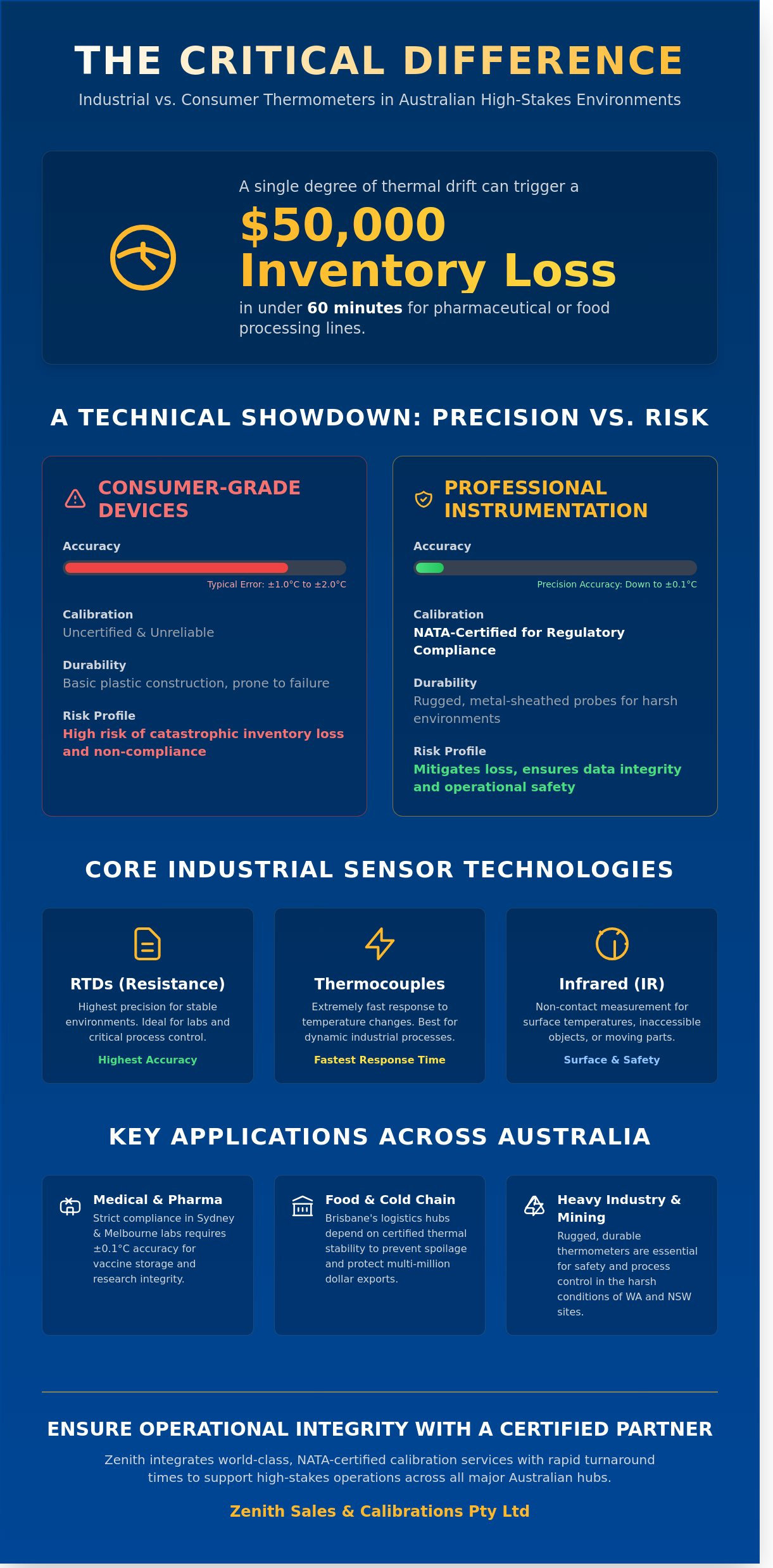
A single degree of thermal drift in a pharmaceutical cold chain or a high-output food processing line can trigger a $50,000 inventory loss in under 60 minutes. You already know that relying on consumer-grade equipment for industrial applications is a risk your bottom line can't afford. The distinction between a standard sensor and professional digital thermometers lies in their ability to maintain precision under rigorous Australian operating conditions. We recognize the pressure of maintaining zero-downtime environments while navigating the technical complexities of NATA compliance requirements.
This guide provides the technical clarity you need to master the nuances of high-precision instrumentation. We'll show you why NATA-certified accuracy is the gold standard for the Australian medical and industrial sectors in 2026. By the end of this article, you'll understand how to select the correct sensor technology for your specific application and why a local, certified calibration partner is essential for your operational integrity. We've structured this analysis to help you move from identifying a sensor gap to implementing a technical solution backed by international standards.
Key Takeaways
- Identify the technical trade-offs between probe, sensor, and infrared technologies to ensure peak performance in Sydney’s manufacturing and Melbourne’s medical sectors.
- Understand why NATA-certified calibration is non-negotiable for digital thermometers to maintain regulatory compliance and avoid the risks associated with uncertified retail instruments.
- Learn to distinguish between consumer-grade devices and industrial instrumentation that offers the precision accuracy (±0.1°C) required for critical temperature monitoring.
- Establish a robust maintenance and selection framework that accounts for Australian environmental conditions and specific industrial temperature ranges.
- Discover how Zenith Sales & Calibrations Pty Ltd integrates world-class calibration services with rapid turnaround times to support high-stakes operations across all major Australian hubs.
Table of Contents
- Understanding Digital Thermometers in the Australian Industrial Landscape
- Core Technologies: Probes, Sensors, and Infrared Measurement
- Consumer vs. Industrial Grade: Why Calibration is Non-Negotiable
- How to Choose and Maintain Digital Thermometers in AU Cities
- Professional Instrumentation Solutions with Zenith Instruments
Understanding Digital Thermometers in the Australian Industrial Landscape
Digital thermometers are precision instruments essential for critical temperature monitoring across the Australian industrial sector. In Sydney manufacturing plants and Melbourne medical labs, these devices provide the data integrity needed for strict regulatory compliance. We've observed a rapid shift away from analog mercury-in-glass thermometers toward electronic alternatives. This transition prioritizes workplace safety and eliminates the risks of chemical contamination associated with older glass hardware. Digital displays provide clear, unambiguous readings that integrate directly into broader instrumentation systems. This allows for automated record-keeping and rapid response to thermal deviations that could otherwise compromise production batches.
Modern industrial thermometers don't just display numbers; they serve as the front-end sensors for complex control loops. By replacing manual checks with digital monitoring, facilities reduce human error and improve the repeatability of their processes. Our clients in the engineering and pharmaceutical sectors require this level of exactness to maintain their competitive edge and meet international ISO standards. Reliability is the cornerstone of our approach at Zenith Instruments, where we ensure every device performs to its rated specifications.
The Evolution of Temperature Measurement
Measurement technology has moved far beyond simple liquid expansion. Modern systems utilize electronic resistance, thermocouples, and infrared detection to provide instantaneous results. Learning how thermometers measure temperature using these electronic components is the first step in optimizing your facility's thermal management. The 2013 Minamata Convention on Mercury accelerated the adoption of these electronic tools across Australia. Looking toward 2026, updated industry standards will require higher data logging capabilities and seamless wireless connectivity. We're currently helping our partners adopt smart sensors that feed directly into centralized control hubs, ensuring no temperature excursion goes unnoticed during a shift.
Key Applications Across Australian Sectors
Thermal stability is the backbone of cold chain logistics in Brisbane. In this sector, even a one-degree variance can compromise perishable exports worth millions of AUD. In the heavy industry environments of Western Australia and NSW, digital thermometers must be rugged and reliable to handle the harsh conditions of mining sites and smelting operations. Sydney's medical and pharmaceutical laboratories face the strictest compliance hurdles in the country. Our team provides comprehensive thermometer calibration services to guarantee that your equipment maintains NATA-accredited accuracy. This level of precision protects your product quality and ensures your facility remains fully certified under Australian law.
Core Technologies: Probes, Sensors, and Infrared Measurement
Industrial digital thermometers rely on specific sensor architectures to translate thermal energy into actionable data. The transition from raw physical phenomena to a digital readout involves sophisticated temperature measurement technologies. At the heart of these professional devices, digital circuitry processes analog signals through high-resolution converters. These microprocessors apply complex linearization algorithms to ensure the final output reflects the true thermal state of the medium. Selecting the correct probe for temperature measurement is the first step in ensuring process integrity and regulatory compliance.
- Accuracy: RTDs provide the highest precision, often maintaining tolerances within 0.1°C over long periods.
- Response Time: Thermocouples respond faster to rapid fluctuations due to their lower thermal mass and direct junction contact.
- Durability: Metal-sheathed probes protect sensitive internal sensors from corrosive chemicals, high pressures, and mechanical stress.
RTDs vs. Thermocouples: Which is Right for You?
Resistance Temperature Detectors (RTDs) are the gold standard for laboratory precision and high-stability applications. They operate on the principle that the electrical resistance of metals, usually platinum, increases predictably with temperature. While they offer superior repeatability, they're generally more fragile than other sensor types. Thermocouples are better suited for extreme industrial environments. They utilize the Seebeck effect, generating a small voltage at the junction of two dissimilar metals. This allows them to measure temperatures exceeding 1,200°C. In Melbourne manufacturing facilities, thermocouples are often preferred for large-scale deployments because they're more cost-effective and rugged. To maintain these tight tolerances, we recommend a regular thermometer calibration service to verify instrument performance against national standards.
Infrared and Non-Contact Thermometry
Infrared sensors detect the thermal radiation emitted by an object without making physical contact. This technology is essential for monitoring rotating machinery, energized electrical components, or moving conveyor belts where probes are impractical. The sensor focuses infrared energy onto a detector that converts it into an electrical signal. However, users must account for emissivity, which is the efficiency with which a surface emits thermal energy. Polished metals have low emissivity and reflect background heat; this can lead to significant measurement errors if the device isn't calibrated for the specific material. For applications requiring a visual heat map of entire systems, see our comprehensive guide to thermal imaging cameras. It's vital to understand these limitations before relying on non-contact data for safety-critical decisions.
Consumer vs. Industrial Grade: Why Calibration is Non-Negotiable
Many procurement officers mistakenly believe that brand-new digital thermometers provide absolute accuracy from the moment they're unboxed. This is a dangerous assumption in an industrial context. While a device from a retail outlet like Chemist Warehouse or Bunnings might suffice for home use, it lacks the verified precision required to pass a rigorous ISO 9001 or HACCP audit. Industrial environments demand a documented chain of traceability. Without it, a digital readout is just a number without a foundation.
Australian conditions are particularly unforgiving for sensitive electronics. In Western Sydney or the Pilbara, ambient temperatures can fluctuate by 20°C in a single day. These extremes accelerate electronic drift, a process where the internal components of digital thermometers lose their alignment with true temperature values. Regular intervals of verification ensure your data remains reliable despite these environmental stressors. We've seen uncalibrated sensors drift by as much as 2.0°C within six months of heavy field use.
The Anatomy of a NATA-Certified Calibration
We perform calibrations by comparing your instrument against reference standards with a known, higher accuracy in a strictly controlled laboratory. This process ensures your equipment meets ISO/IEC 17025 requirements, providing you with a certificate that stands up to regulatory scrutiny. Our thermometer calibration service establishes the necessary link to national standards. NATA accreditation is the highest tier of Australian measurement authority.
The Risks of Using Uncalibrated Instruments
The consequences of measurement failure are severe and expensive. We've documented cases where businesses faced losses exceeding A$50,000 due to single-point failures in unverified monitoring systems. Avoiding these risks requires a proactive maintenance schedule. Key risks include:
- Product Spoilage: In food manufacturing or pharmaceutical storage, a deviation of just 1.5°C can lead to bacterial growth or denatured proteins, forcing the disposal of entire batches.
- Safety Hazards: Chemical processing plants rely on precise thermal data to prevent exothermic reactions. An uncalibrated sensor could hide a looming pressure surge, putting staff at risk.
- Legal and Financial Liabilities: During workplace safety audits in Sydney, failing to produce valid calibration records can result in heavy fines under Work Health and Safety (WHS) regulations.
How to Choose and Maintain Digital Thermometers in AU Cities
Selecting the right digital thermometers requires a rigorous assessment of your operational environment. You must define the exact temperature range needed; a probe designed for -50°C cryogenic storage won't provide the same resolution as one optimized for 200°C industrial ovens. Accuracy is the next pillar. For medical laboratory applications, a tolerance of ±0.1°C is the benchmark, while general manufacturing might only require ±1.0°C. We recommend instruments with integrated data logging for any sector governed by strict compliance frameworks like HACCP or ISO 9001. These devices automate the record-keeping process, which reduces human error during audits.
Local Industry Considerations for Sydney and Melbourne
Environmental variables differ significantly across Australian hubs. In coastal Sydney, high humidity levels can lead to moisture ingress and corrosion in non-IP-rated instrumentation. Businesses operating near the harbor or Port Botany must prioritize sealed housings to prevent premature failure. You can access specialized calibration services in Sydney to ensure your sensors remain resilient against these salt-heavy conditions and maintain their technical integrity.
Melbourne presents a different challenge. The city's dense medical and research corridor, particularly within the Parkville precinct, demands ultra-precise thermal monitoring. Research facilities here often utilize NATA-accredited calibration to meet the stringent requirements of clinical trials and pharmaceutical storage. We provide rapid turnaround times to these sectors, ensuring that downtime doesn't compromise sensitive biological samples or expensive chemical reagents.
Maintenance and Handling Best Practices
Technical precision depends on how you treat the hardware. Store probes in protective cases to prevent mechanical shock; dropping a high-sensitivity sensor can shift its calibration curve instantly. Battery management is equally vital. Low voltage often causes "ghost" readings or significant drift in digital thermometers. Replace batteries when they hit 15% capacity to maintain reading integrity and prevent internal leak damage from aging cells.
Cleaning protocols must match the industry standards. For food-grade sensors, use 70% isopropyl alcohol wipes to prevent cross-contamination without damaging the probe material. Medical-grade sensors require similar sterilization but also need periodic checks for physical degradation of the cable insulation. If you notice any fraying or discoloration, it's time for a professional assessment.
Establish a recurring calibration schedule with a certified Australian partner to maintain your equipment's traceability and operational safety. Contact us today to schedule your NATA-traceable thermometer calibration.
Professional Instrumentation Solutions with Zenith Instruments
Zenith Instruments acts as Australia’s primary authority for temperature measurement and industrial instrumentation. We bridge the gap between high-end hardware procurement and ongoing technical compliance. We don't just supply digital thermometers; we provide the certified infrastructure required to ensure they function within strict tolerances. Our service model supports the rigorous demands of the biomedical, food processing, and heavy manufacturing sectors. We specialize in providing customized solutions for facilities that require absolute thermal stability and documented accuracy.
Our NATA-Accredited Calibration Laboratory
We operate state-of-the-art facilities in Sydney and Melbourne designed for high-precision testing. Our NATA accreditation isn't just a badge. It’s a guarantee that our calibration processes meet international ISO 17025 benchmarks for accuracy and reliability. We’ve optimized our internal workflows to deliver fast turnaround times, typically completing most calibrations within 3 to 5 business days. This speed helps prevent the 15% to 20% productivity loss often associated with critical equipment being offline for extended periods. You can explore our full thermometer calibration service online to see our specific capabilities across various thermal ranges and instrument types.
Our laboratory services include:
- Precision testing of digital thermometers and thermal probes.
- Detailed calibration certificates for audit and compliance purposes.
- Fast-track options for urgent industrial requirements.
- Equipment repair and adjustment by trained technicians.
Comprehensive Support Across Australia
Technical support at Zenith Instruments is delivered by qualified engineers who specialize in industrial measurement. We offer a proactive service model that includes onsite calibrations in major hubs. Our mobile teams are equipped to handle complex requirements at your facility, which eliminates the risks associated with transporting sensitive gear. This nationwide reach ensures that logistical hurdles don't compromise your maintenance schedule or safety protocols. We currently provide onsite services across:
- Sydney and the surrounding industrial corridors.
- Melbourne and regional Victorian manufacturing zones.
- Brisbane and South East Queensland.
- Canberra’s research and biomedical sectors.
For Victorian clients, our calibration service Melbourne offers localized expertise that keeps your operations running at peak efficiency. We focus on building long-term partnerships through meticulous attention to detail and a commitment to regulatory compliance. Whether you need a single unit verified or a thousand-point facility audit, we have the technical scale to assist.
Ensuring Thermal Accuracy for Australia’s Industrial Future
Maintaining the integrity of your thermal data requires more than just high-quality hardware. It demands a rigorous approach to calibration and compliance. As Australian industries move toward more stringent regulatory frameworks in 2026, the gap between consumer-grade devices and professional digital thermometers has never been more critical. Precision measurement isn't a luxury; it's a foundational requirement for safety and operational efficiency across the engineering, manufacturing, and medical sectors.
Since 2004, Zenith Instruments has provided the technical expertise needed to keep Australian operations running within exact tolerances. We operate a premier NATA-Accredited Laboratory and implement ISO-compliant processes to ensure every reading is legally defensible and technically sound. Our technicians provide Australia-wide onsite service, reaching major hubs from Sydney to Perth to minimize your downtime. You shouldn't leave your compliance to chance when expert technical support is readily available. We're ready to help you maintain your competitive edge through meticulous instrumentation standards and reliable data reporting.
Get a Quote for NATA-Certified Thermometer Calibration Today
We look forward to partnering with your team to achieve total measurement confidence across your entire facility.
Frequently Asked Questions
How often should a digital thermometer be calibrated in an industrial setting?
In most industrial settings, you should calibrate your digital thermometers every 12 months. This interval ensures compliance with standard ISO 9001 quality management systems and maintains instrument reliability across your operations. If your facility operates in extreme environments or handles critical food safety processes under HACCP guidelines, we recommend increasing this frequency to every 6 months to prevent measurement drift.
Can I calibrate my own digital thermometer at my facility?
You can perform basic verification checks using ice point or boiling water methods, but these don't replace formal certification. To meet Australian regulatory standards, a NATA accredited laboratory must perform the calibration. We provide the specialized equipment and controlled environments required to issue valid certificates that satisfy rigorous industrial audits and safety inspections.
What is the difference between NATA-certified and traceable calibration?
NATA certification provides formal recognition from the National Association of Testing Authorities, ensuring the highest level of technical competence in Australia. Traceable calibration means the results link back to national standards, but it lacks the independent oversight and international mutual recognition that NATA endorsement offers. We recommend NATA-certified reports for high-risk sectors like pharmaceuticals where precision is non-negotiable.
Why does my digital thermometer show different readings than an analog one?
Digital thermometers typically provide faster response times and higher resolution than analog liquid-in-glass or bimetal versions. An analog thermometer might take 60 seconds to stabilize, while a digital probe often registers a reading in under 10 seconds. These discrepancies often stem from different sensor placements and the inherent lag time found in mechanical components during thermal transfer.
Is an infrared thermometer as accurate as a probe thermometer?
Infrared thermometers are generally less accurate than probe thermometers because they only measure surface temperature rather than internal heat. Factors like emissivity and the distance-to-spot ratio can introduce errors of 2 degrees Celsius or more. For critical applications requiring 0.1 degree precision, we always advise using a calibrated digital thermometer with a physical immersion probe to ensure data integrity.
What should I do if my digital thermometer fails its calibration test?
You must immediately remove the instrument from service and tag it as out of calibration to prevent data errors. Our technicians will attempt to adjust the device to bring it back within its specified tolerances. If the sensor or electronics have failed beyond repair, we'll provide a detailed report so you can replace the unit and maintain your facility's compliance with Australian standards.
How do I choose between a Type K and a Type J thermocouple?
Choose a Type K thermocouple for general industrial use as it offers a wide temperature range from -200 to 1260 degrees Celsius. It's the most common choice for oxidizing environments. Type J is better suited for reducing atmospheres and has a narrower range of -40 to 750 degrees Celsius, making it less versatile but highly effective for specific vacuum applications.
Does Zenith Instruments provide onsite calibration for medical clinics in Sydney?
We provide comprehensive onsite calibration services for medical clinics across the Sydney metropolitan area and surrounding suburbs. Our mobile technicians visit your facility to calibrate vaccine fridges, autoclaves, and diagnostic tools, ensuring minimal disruption to your daily operations. This localized service extends to other major hubs including Melbourne, Brisbane, and Perth to support Australia's healthcare sector with rapid turnaround times.