

Precision isn't just a technical preference; it's a mandatory regulatory requirement for industrial safety across Australia. You understand that even a minor deviation in your Fluke multimeter's readings can lead to catastrophic safety failures or costly audit non-compliance. We recognize the pressure of maintaining accuracy while managing equipment downtime and shipping logistics. Our 2026 professional guide ensures your fluke multimeter calibration australia process aligns with the latest NATA-accredited standards and AS/NZS ISO/IEC 17025:2018 requirements.
By reading this guide, you'll learn how to secure recognized Australian certification and expert technical support without sacrificing operational efficiency. We'll examine the critical differences between standard traceable and NATA-endorsed certifications, explain how to minimize downtime through mobile service capabilities, and outline the technical benchmarks your equipment must meet to satisfy AS/NZS 3000:2018 Wiring Rules. We provide the meticulous oversight needed to keep your instruments precise and your facility safe. This structured approach helps you transition from identifying measurement drift to achieving a technical solution backed by formal certification.
Key Takeaways
- Understand the critical role of precision in high-stakes sectors like mining and medical, where minor measurement drift compromises safety and regulatory compliance.
- Discover why professional fluke multimeter calibration australia is essential for maintaining alignment with NATA-accredited standards and international ISO benchmarks.
- Identify the specific technical requirements for NATA-endorsed certification versus standard traceable calibration to optimize your facility's maintenance budget.
- Learn how meticulous lead inspection and controlled storage prevent "false" drift, ensuring your instruments remain reliable between scheduled service intervals.
- Reduce operational downtime by leveraging mobile on-site calibration or rapid turnaround services at our dedicated laboratories in Sydney and Melbourne.
Professional Fluke Multimeter Calibration in Australia: Why Accuracy Matters
Precision is the bedrock of industrial safety. To maintain this, we must first define what calibration means in a professional context. It's the technical verification of an instrument's measurement accuracy against a known, traceable standard. For fluke multimeter calibration australia, this process ensures the digital readings on your screen reflect the physical reality of the electrical circuit. In Australia’s high-stakes mining, medical, and manufacturing sectors, Fluke multimeters are the gold standard for reliability. However, reliability isn't a permanent state. While new tools arrive with factory settings, these are merely a baseline. They don't account for the rigorous demands of Australian industrial environments. Fine dust in the Pilbara or high coastal humidity in Queensland causes sensor drift over time. This makes regular verification a mandatory pillar of your maintenance strategy.
The Legal and Safety Implications of Drift
An uncalibrated multimeter is a liability. Inaccurate voltage readings can lead technicians to believe a circuit is de-energized when it isn't; this potentially triggers catastrophic arc flash incidents. Beyond physical safety, there's the matter of regulatory compliance. The AS/NZS 3000:2018 Wiring Rules mandate that test equipment must be maintained in good working order. If you're involved in an industrial accident and your records show you used uncalibrated tools, you face significant legal exposure. Insurance providers often scrutinize calibration certificates during claims. Using uncertified gear can result in the denial of a payout, leaving your business financially vulnerable. We provide the meticulous oversight needed to avoid these risks.
Understanding the Calibration Cycle
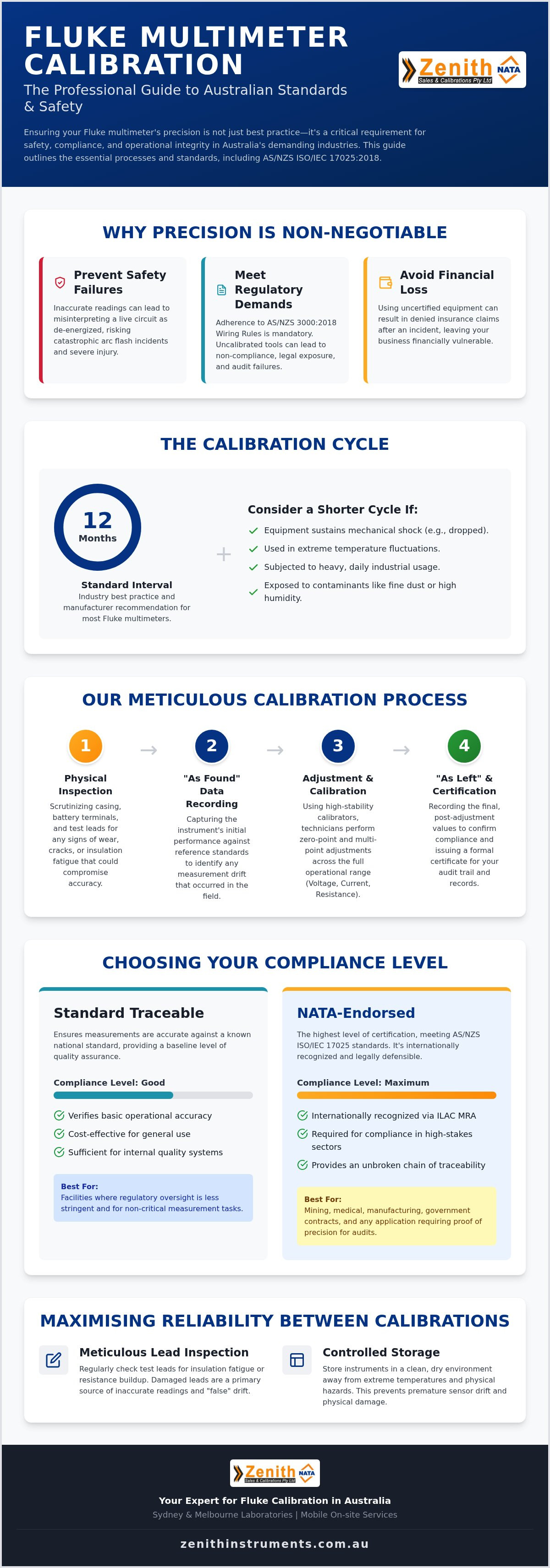
We recommend a standard 12-month calibration interval for most Fluke multimeters. This timeframe aligns with industry best practices and manufacturer suggestions. However, certain conditions necessitate a shorter cycle. If your equipment is subjected to mechanical shock, extreme temperature fluctuations, or heavy daily usage, we suggest more frequent testing. Maintaining a disciplined schedule prevents minor inaccuracies from compounding into major failures. For a deeper look at broader equipment standards, you can read our Instrument Calibrations in Australia: The 2026 Professional Guide. Adhering to these cycles ensures your fleet remains compliant with Australian WHS regulations and ISO 9001 quality management systems. Our laboratories in Sydney and Melbourne are equipped to handle these high-frequency requirements with precision.
The Technical Process: How Fluke Multimeters Are Calibrated
Our technical procedure for fluke multimeter calibration australia begins with a rigorous physical inspection. We don't just check the digital display; we scrutinize the casing for hairline cracks, verify battery terminal integrity, and examine test leads for insulation fatigue or resistance buildup. Once the physical state is verified, we perform zero-point adjustments using high-stability calibrators that provide a clean, noise-free reference signal. We then execute multi-point reference voltage testing across the full operational range. This includes checking AC/DC voltage, current, resistance, and continuity functions to ensure the internal analog-to-digital converters are processing signals within the manufacturer's specified tolerance limits.
Transparency remains vital for your audit trail and long-term asset management. We record "As Found" data to show exactly how the instrument performed upon arrival. This data is critical for identifying whether an instrument was drifting significantly during its time in the field. If the unit is out of tolerance, our technicians perform the necessary internal adjustments and record the "As Left" values. This documentation provides a clear, chronological history of the instrument’s stability. It's an essential requirement for compliance with Australian safety standards and rigorous internal quality audits.
Reference Standards and Traceability
We maintain an unbroken chain of traceability to the standards held by Australia's peak measurement body. This ensures every measurement we take is legally defensible and scientifically accurate. For True-RMS multimeters, a single-point check is insufficient because these devices are designed to measure complex, non-sinusoidal waveforms. We employ a multi-point testing approach at various frequencies and amplitudes to verify performance across the entire spectrum. This is particularly critical for professional models like the Fluke 87V and 289. These units require high-impedance testing to ensure the internal circuitry hasn't degraded under the stress of high-energy industrial environments.
Repair vs. Calibration: What Happens if it Fails?
Calibration sometimes reveals internal failures that a simple adjustment cannot fix. Common issues include blown high-energy fuses from transients or degraded internal resistors that cause consistent offset errors. Unlike standard laboratories that merely return a "fail" certificate and leave you with a useless tool, we offer integrated technical repairs. We can replace internal components and restore your tool to original manufacturer specifications. If your device requires more than just a standard check, our Electrical Equipment Calibration Services provide a comprehensive solution to get your equipment back in the field. You can rely on our experts for both precision and restoration.
NATA vs. Traceable Calibration: Choosing Your Compliance Level
Choosing the correct compliance level for fluke multimeter calibration australia depends entirely on your operational risk and contractual obligations. The hierarchy of measurement assurance begins with basic internal checks, moving up to traceable calibration, and culminating in NATA-endorsed certification. While every calibration we perform is precise, the level of formal recognition varies. Standard traceable calibration provides a certificate showing the instrument was tested against equipment with an unbroken chain of traceability to national standards. This is often the most cost-effective solution for general commercial electrical work and residential contractors who don't face high-stakes regulatory audits.
High-stakes environments demand a more rigorous tier of documentation. NATA-endorsed calibration is typically mandatory for government contracts, aerospace engineering, and medical laboratory equipment. NATA accreditation is the only way to prove a laboratory has been independently audited for technical competence, valid procedures, and rigorous quality control. Using an unaccredited laboratory for these sectors risks immediate disqualification during safety audits or tender processes. Identifying a valid service is straightforward; a compliant Australian calibration will include both a detailed certificate and a durable, tamper-evident sticker on the device showing the next service date.
Decoding the Calibration Certificate
A valid Australian calibration certificate must contain specific technical data to withstand a professional audit. You should always verify the unique serial number, the date of service, and the technician’s signature. Crucially, look for the "Uncertainty of Measurement" (UoM) value. This figure quantifies the margin of error in the testing process, providing the granular detail required for precision work. The presence of the NATA logo is the ultimate trust signal on Australian documentation. We frequently see DIY logs or basic "conformance" letters fail audits because they lack these essential technical benchmarks.
Industry-Specific Requirements in AU
Compliance needs fluctuate between regions and sectors. A Sydney-based construction contractor may only require traceable certification to satisfy site safety managers. Conversely, a Melbourne-based medical facility or a Brisbane-based mining operation often requires full NATA documentation to meet ISO 17025 standards for fluke multimeter calibration australia. We support these diverse needs through our Calibration Services Sydney and our Melbourne facility. By matching the certification level to your specific industry, we help you manage maintenance costs without compromising on safety or regulatory standing.
Maximising Equipment Reliability Between Calibrations
Australia’s environmental extremes demand a proactive approach to equipment maintenance. Whether your team is operating in the high humidity of tropical Queensland or the abrasive dust of the Pilbara, storage conditions directly impact your instrument's long-term accuracy. We recommend storing high-precision Fluke multimeters in hard-shell, foam-lined cases to mitigate mechanical shock and prevent moisture ingress. Dust accumulation inside battery compartments or input jacks can create parasitic resistance, leading to erratic readings. Maintaining a clean, temperature-controlled storage environment is the first step in ensuring your fluke multimeter calibration australia remains valid throughout the service year.
Technical accuracy often fails at the point of contact rather than within the meter itself. Worn or degraded test leads are the primary cause of "false" drift. Over time, the internal copper strands in the leads fracture from repetitive flexing, which increases lead resistance. We suggest a weekly inspection of all leads for insulation nicks and a monthly resistance check. If your leads show more than 0.5 ohms of resistance, they require immediate replacement. Additionally, battery management is critical. Alkaline leaks can corrode internal circuit boards, causing permanent damage. We advise using high-quality, leak-proof cells and removing them entirely if the tool will be stored for more than 30 days.
Identifying Signs of Drift
Technicians must remain vigilant for subtle indicators of measurement instability. If you notice inconsistent readings on a known stable circuit, your instrument may be drifting out of tolerance. Slow response times or a flickering display during steady-state measurements often signal internal component degradation or failing input protection. Physical indicators like compromised gaskets or cracked screens suggest that the internal environment of the meter is no longer sealed against contaminants. If these signs appear, you should schedule a check-up before your next 12-month interval to maintain compliance. You can book an electrical calibration service to verify your tool's performance immediately.
The Role of the Technician
Professional calibration is a partnership between the laboratory and the field technician. While we provide the formal certification, your staff serves as the first line of defense against inaccuracy. Training your team to perform daily confidence checks against a known stable source, such as a dedicated reference unit, helps identify issues before they impact project safety. For more information on maintaining your fleet, refer to our Multimeter Guide 2026: The Essential Tool for Sydney & Melbourne Professionals. We provide the technical support and expert repairs needed to keep your instruments in peak condition between scheduled visits to our facilities in Sydney and Melbourne.
Zenith Instruments: Australia’s Expert for Fluke Calibration
With the recent exit of major providers like PLUS ES from the external calibration market, Australian industries require a dependable partner that combines technical depth with rapid response. Zenith Instruments fills this critical void. We operate dedicated, high-performance laboratories in Sydney and Melbourne, specifically engineered to handle fluke multimeter calibration australia with precision. Our technical team possesses deep expertise across the entire Fluke catalogue. Whether you are maintaining a fleet of handheld 179 series multimeters or high-precision clamp meters, we provide the meticulous oversight required for industrial compliance. We prioritize reliability and safety, ensuring your equipment meets the most rigorous international standards.
Our localized service model offers a significant competitive advantage over global corporate structures that often suffer from bureaucratic delays and longer turnaround times. We maintain a proactive approach that moves efficiently from identifying your technical problem to providing a certified solution. Our commitment to NATA-endorsed standards and ISO-compliant processes ensures that your certification is recognized by all Australian regulatory bodies and international auditors. We don't just provide a sticker; we provide a partnership built on technical excellence and a deep understanding of regional industrial needs.
On-Site vs. Laboratory Calibration
We recognize that every facility has unique logistical requirements. Laboratory calibration remains the gold standard for complex, high-accuracy instruments that require a strictly controlled environment to achieve the lowest possible measurement uncertainty. However, for large fleets of electrical testers, our mobile service offers unmatched convenience. We deploy expert technicians directly to your facility to perform on-site calibration. This eliminates the risks associated with shipping and reduces equipment downtime from days to hours. For those in Victoria, our Calibration Service Melbourne provides a localized touch with national-level laboratory standards.
Getting Started with Zenith
Initiating your maintenance cycle for fluke multimeter calibration australia is a streamlined process designed for busy professionals. We provide comprehensive coverage across Sydney, Melbourne, Brisbane, and regional hubs including Newcastle and Canberra. From the moment you request a quotation to the final delivery of your digital certificates, we maintain a disciplined and highly organized workflow. This ensures your assets are back in service with minimal disruption to your operations. Contact Zenith Instruments for a Fluke Calibration Quote Today to secure your facility's safety and measurement precision.
Securing Your Industrial Precision for 2026
Maintaining measurement accuracy is a continuous commitment to safety and regulatory compliance. We've explored how professional fluke multimeter calibration australia ensures your instruments meet NATA-certified standards while protecting your facility from the legal and physical risks of measurement drift. By understanding the technical nuances of the calibration process and choosing the appropriate level of certification, you position your business as a leader in operational excellence. Proactive maintenance of your leads and storage environments further extends the reliability of your high-precision tools between scheduled laboratory visits.
Zenith Instruments serves as your dependable partner, offering specialized expertise in Fluke, Megger, and Keysight equipment. Our facilities in Sydney and Melbourne, combined with our Australia-wide mobile calibration capabilities, provide the flexibility you need to minimize downtime without compromising on precision. Whether you require a full NATA-endorsed audit trail or a standard traceable check, we deliver the technical support required for your specialized sector. We're ready to help you maintain the highest benchmarks of industrial safety and technical performance. Get a Quote for Fluke Multimeter Calibration and ensure your fleet remains compliant and accurate throughout the year.
Frequently Asked Questions
How often should I calibrate my Fluke multimeter in Australia?
You should calibrate your Fluke multimeter every 12 months to satisfy standard Australian industry requirements. This interval ensures your readings remain accurate and your documentation stays compliant with WHS regulations. If your equipment operates in extreme environments or suffers mechanical shock, we suggest a more frequent cycle. Adhering to this schedule prevents measurement drift from compromising your site safety or failing a regulatory audit.
What is the difference between NATA and traceable calibration?
NATA calibration is performed by a laboratory independently audited for technical competence, whereas traceable calibration is checked against standards without the same formal accreditation. You'll need NATA-endorsed certificates for government contracts, aerospace, or medical applications. Standard traceable certificates are typically sufficient for residential or general commercial electrical work. We help you determine the correct compliance level for your specific operational risks and contractual needs.
Can Zenith Instruments repair my Fluke multimeter if it fails calibration?
Yes, we perform technical repairs on Fluke multimeters that fail our initial accuracy assessments. Our technicians can replace blown high-energy fuses, repair degraded internal components, and restore your instrument to its original manufacturer specifications. This integrated approach saves you from the cost of replacing expensive hardware. Once repaired, the unit undergoes a full fluke multimeter calibration australia to ensure it meets all safety and precision benchmarks.
Do you provide on-site calibration services in Sydney and Melbourne?
We provide mobile on-site calibration services across Sydney, Melbourne, and major regional hubs including Brisbane and Canberra. This service allows our technicians to verify your equipment at your facility, which significantly reduces shipping risks and operational downtime. It’s an ideal solution for businesses managing large fleets of electrical testers that can’t be removed from service for extended periods. We prioritize efficiency to keep your projects moving.
How long does the calibration process usually take?
Our standard laboratory turnaround is designed for speed, while our on-site mobile service can complete checks in just a few hours. We recognize that equipment downtime directly impacts your bottom line. By utilizing our dedicated facilities in Sydney or Melbourne, you receive rapid service backed by formal certification. We move efficiently from receipt to delivery, ensuring your assets return to the field with minimal delay.
Is my old Fluke multimeter still worth calibrating?
Most Fluke multimeters are engineered for long-term industrial use and remain worth calibrating as long as the physical casing and internal circuitry are intact. Older models often maintain exceptional stability if they haven't suffered significant environmental damage or battery leaks. We assess the physical and technical state of your legacy tools before proceeding. If a tool is truly beyond repair, we'll provide expert advice on a suitable replacement.
What should I do if my multimeter calibration certificate has expired?
You should immediately remove the instrument from safety-critical service and book a professional fluke multimeter calibration australia. Using an expired tool for electrical testing violates AS/NZS 3000:2018 Wiring Rules and creates significant legal liability during insurance claims. We can prioritize your service to restore your compliance status quickly. Once the service is complete, you'll receive a new certificate and a tamper-evident sticker for your audit trail.
Are Zenith’s calibration standards compliant with ISO 17025?
Every calibration we perform follows meticulous ISO-compliant processes and aligns with AS/NZS ISO/IEC 17025:2018 standards. This ensures our laboratory maintains the highest levels of technical competence and measurement traceability. We utilize high-stability calibrators and validated procedures to provide you with legally defensible documentation. Our commitment to these international benchmarks guarantees that your equipment meets the rigorous safety requirements of the Australian industrial sector.