

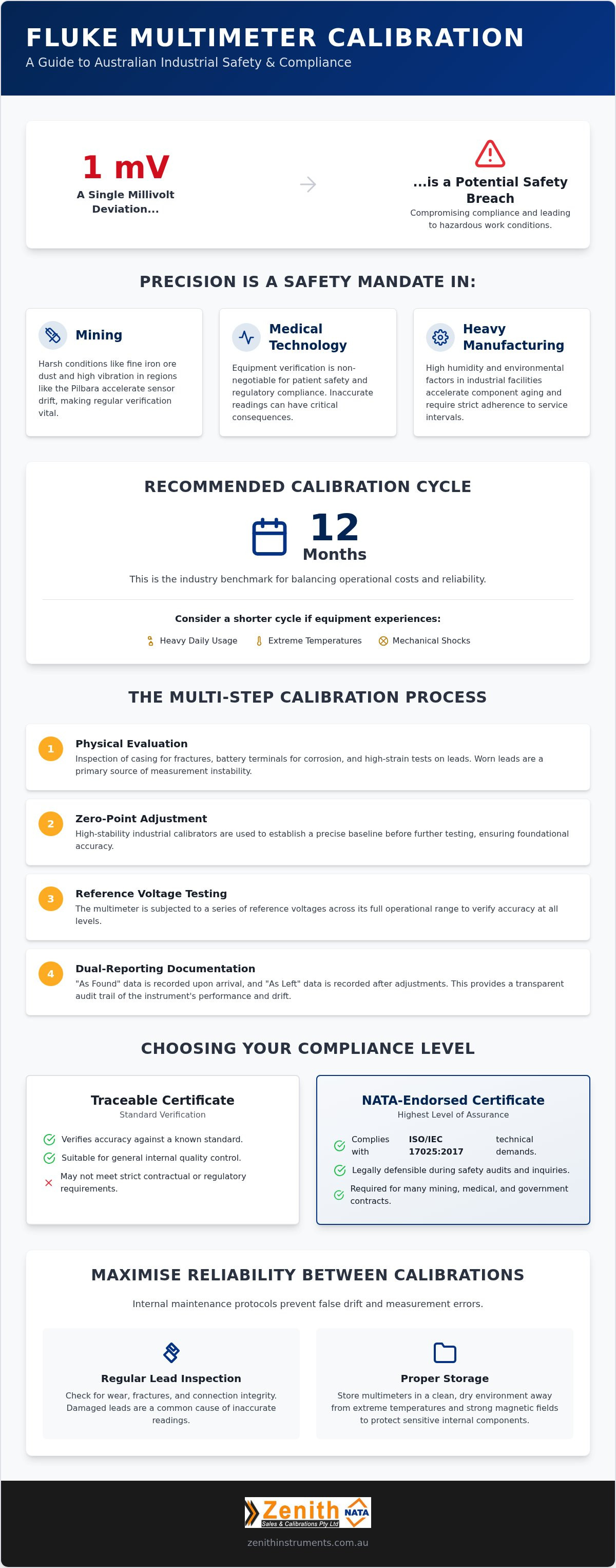
A single millivolt of deviation in your Fluke multimeter isn't just a technical glitch; it's a potential safety breach that could compromise your entire facility's compliance profile. We understand that maintaining precision is a non-negotiable requirement for Australian industrial safety. However, the risk of equipment downtime during shipping often makes scheduling fluke multimeter calibration australia feel like a logistical burden. You need equipment that performs to manufacturer specifications every time you're on site, ensuring that every measurement is defensible during a rigorous safety audit.
It's frustrating when a looming audit creates stress over non-compliance or when inaccurate readings lead to hazardous work conditions. We're here to bridge that gap by providing a clear roadmap to maintaining your testing fleet with expert technical support. This guide ensures your instruments meet rigorous Australian standards while prioritizing fast turnaround times. We'll explore the critical differences between NATA-endorsed certificates and standard traceability, the technical demands of ISO/IEC 17025:2017, and why a 12-month service interval remains the industry benchmark for professional reliability.
Key Takeaways
- Identify the specific regulatory requirements for Australian mining, medical, and manufacturing sectors that mandate high-precision equipment verification.
- Master the technical distinction between NATA-endorsed and traceable certificates to ensure your fluke multimeter calibration australia meets contract specifications.
- Learn the internal maintenance protocols, such as lead inspection and proper storage, that prevent false drift and measurement errors between service intervals.
- Explore how on-site mobile calibration and dedicated laboratory services in Sydney and Melbourne can significantly reduce operational downtime.
- Understand the rigorous multi-step calibration process, including zero-point adjustments and reference voltage testing using high-stability industrial calibrators.
Professional Fluke Multimeter Calibration in Australia: Why Accuracy Matters
Understanding What is Calibration? is essential for any technician responsible for electrical safety. It is the formal process of verifying measurement accuracy against a known, traceable standard. In the context of fluke multimeter calibration australia, this procedure ensures that your device provides readings within the manufacturer’s specified tolerances. While Fluke instruments are engineered for extreme durability, they aren't immune to the physics of drift. Internal components age, and circuits shift over time. Relying solely on factory settings for years is a dangerous oversight in industrial compliance that can lead to systemic errors.
In sectors like Australian mining, medical technology, and heavy manufacturing, precision is a safety mandate rather than a preference. Our local work sites often present harsh conditions that challenge sensitive electronics. High humidity in tropical regions or fine iron ore dust in the Pilbara can infiltrate even ruggedized casings. These environmental factors accelerate sensor drift, making regular verification vital for maintaining the integrity of your data. We provide specialized electrical calibration services designed to address these specific regional challenges.
The Legal and Safety Implications of Drift
Inaccurate voltage readings are more than just a technical error; they're a life-safety hazard. A multimeter that fails to detect a live circuit due to downward drift can lead to catastrophic arc flash incidents. Precision is not just a setting; it's a regulatory requirement for Australian industrial safety. Adherence to AS/NZS 3000, known as The Wiring Rules, requires that all testing and commissioning be performed with accurately calibrated gear. From a commercial perspective, using uncalibrated tools can void insurance claims following an electrical accident. Maintaining a valid calibration certificate serves as your primary defense during safety audits and legal inquiries.
Understanding the Calibration Cycle
The industry standard recommendation for Fluke tools is a 12-month calibration interval. This period balances operational costs with the statistical likelihood of a device falling out of tolerance. However, certain factors can necessitate a shorter cycle. Heavy daily usage, exposure to extreme temperatures, or significant mechanical shocks from drops can all compromise accuracy before the year is up. If your equipment operates in high-vibration environments, you should consider more frequent checks to ensure ongoing reliability.
For a deeper dive into national requirements and technical standards, refer to our Instrument Calibrations in Australia: The 2026 Professional Guide. To minimize operational downtime, we operate dedicated facilities for calibration service sydney and calibration service melbourne. These hubs allow for rapid turnaround, ensuring your fleet remains compliant without the delays associated with international shipping.
The Technical Process: How Fluke Multimeters Are Calibrated
Every professional fluke multimeter calibration australia begins with a meticulous physical evaluation. We don't just plug the device into a calibrator; we examine the casing for stress fractures, inspect the battery terminals for corrosion, and perform a high-strain test on the leads. Worn leads are a primary source of measurement instability, often masquerading as internal electronic drift. Once physical integrity is confirmed, the instrument moves to the laboratory bench for zero-point adjustment. We utilize high-stability calibrators to establish a baseline before subjecting the multimeter to reference voltage testing across its full operational range.
Transparency is a pillar of our service model. We document "As Found" data to show how the instrument performed upon arrival, followed by "As Left" data after any necessary adjustments. This dual-reporting provides a clear audit trail, allowing quality managers to assess the impact of any potential drift on previous industrial work. If you require a detailed assessment of your fleet's current accuracy, you can consult with our technical team for a comprehensive review of your testing equipment.
Reference Standards and Traceability
Our calibration protocols are strictly traceable to the standards maintained by the Australia's peak measurement body (NMI). For True-RMS multimeters, a single-point check is insufficient. We employ a multi-point testing approach to verify accuracy across various frequencies and waveforms. This is particularly critical for high-end models like the Fluke 87V and 289, where high-impedance testing ensures the meter doesn't "load" the circuit under test, which would otherwise result in false readings. We verify AC/DC voltage, current, resistance, and continuity to ensure the entire internal logic remains within tolerance.
Repair vs. Calibration: What Happens if it Fails?
Calibration often reveals underlying hardware issues that a simple user-check might miss. Blown high-energy fuses or degraded internal components can cause a device to fail its tolerance tests during the verification phase. Unlike laboratory-only providers, we possess the technical expertise to perform complex electrical equipment calibration services and repairs simultaneously. If a unit fails to meet specifications, we provide a detailed fault report and a technical repair estimate. This proactive service model ensures your equipment returns to service in peak condition rather than being decommissioned prematurely due to minor component failure.
NATA vs. Traceable Calibration: Choosing Your Compliance Level
Selecting the correct tier of fluke multimeter calibration australia depends entirely on your operational environment and regulatory exposure. While both NATA-endorsed and traceable calibrations provide accuracy, they serve different compliance functions. Traceable calibration is often the practical choice for standard commercial electrical work, offering a cost-effective path to technical reliability without the overhead of formal accreditation. However, NATA-endorsed calibration represents the highest level of the hierarchy, providing an additional layer of third-party oversight.
Laboratories holding NATA accreditation undergo rigorous peer review to ensure technical competence according to ISO/IEC 17025. This level of certification is typically mandatory for businesses involved in government contracts, aerospace engineering, and the medical sector. In these high-stakes fields, the legal defensibility of a measurement is just as important as its precision. Identifying a valid service is straightforward; look for the calibration sticker on the device and a corresponding certificate that clearly states the traceability path. If the documentation lacks a specific reference to NMI standards, it won't satisfy a professional auditor.
Decoding the Calibration Certificate
A professional certificate contains several non-negotiable elements. It must feature the unique serial number of your Fluke multimeter, the date of service, and the signature of the authorizing technician. The most critical technical detail is the "uncertainty of measurement." This figure quantifies the margin of error for each test point, providing the transparency needed for high-level safety audits. We've seen many businesses fail inspections because they relied on internal DIY logs that lacked these formal uncertainty calculations. Without a recognized logo or a NMI-traceable statement, a document is merely a piece of paper, not a compliance tool.
Industry-Specific Requirements in AU
Compliance needs vary significantly across the country. A Sydney-based construction contractor focusing on AS/NZS 3000 compliance has different documentation needs than a Melbourne-based medical laboratory maintaining life-critical equipment. We understand these regional nuances and provide tailored support across all major hubs. Whether you're managing a fleet in Brisbane or require specialized Calibration Services Sydney, our technical team aligns your certification level with your specific industry mandates. We ensure your documentation stands up to the scrutiny of both local regulators and international quality auditors.
Maximising Equipment Reliability Between Calibrations
Maintaining the integrity of your testing fleet requires more than just an annual certificate. Between scheduled sessions for fluke multimeter calibration australia, the responsibility for precision shifts to the daily operator. Australia's industrial environments are particularly demanding. High-precision Fluke tools stored in service vehicles during a Queensland summer or a Pilbara heatwave can experience thermal stress that impacts internal component stability. We recommend utilizing protective hard cases and climate-controlled storage whenever possible to mitigate these environmental risks and preserve the instrument's baseline accuracy.
Lead management is your first line of defense against measurement error. Worn or damaged test leads are the primary cause of "false" drift; this occurs when the meter appears inaccurate, but the fault actually lies in the high-resistance path of a frayed or oxidized cable. Technicians should perform a "lead-null" or continuity check at the start of every shift. Similarly, proactive battery management prevents catastrophic internal corrosion. Alkaline leaks can destroy a multimeter's main circuit board, turning a routine calibration into an expensive repair. Transitioning to high-quality cells and enforcing a strict replacement schedule before exhaustion is a prudent operational standard for any professional team.
Identifying Signs of Drift
Early detection of instrument failure prevents safety incidents and costly rework. Your team should be trained to identify the following technical red flags:
- Inconsistent readings: Fluctuating values when testing a known, stable circuit or a dedicated reference source.
- Sluggish response: Noticeable delays in the auto-ranging function or a flickering display during standard measurements.
- Physical degradation: Cracked screens, compromised gaskets, or loose input jacks that allow dust and moisture to bypass internal seals.
The Role of the Technician
We view professional calibration as a technical partnership rather than a simple transaction. It's essential to train staff to recognize when a tool needs an early check-up due to mechanical shock or extreme exposure. A multimeter that has survived a significant drop might still power on, but its internal reference standards could be compromised. For more detailed insights into maintaining your professional toolkit, see our Multimeter Guide 2026: The Essential Tool for Sydney & Melbourne Professionals.
Proactive maintenance ensures your equipment remains a reliable asset during high-stakes audits. If you notice any of the warning signs mentioned above, don't wait for your annual anniversary to verify your gear. You can book your next Multimeter Calibration Service today to secure your fleet's accuracy and ensure continued compliance with Australian safety standards.
Zenith Instruments: Australia’s Expert for Fluke Calibration
With recent shifts in the Australian landscape, including the fact that some major providers have exited external service work, professionals require a dependable partner who understands local regulatory demands. We fill this gap by offering meticulous technical expertise without the bureaucratic delays often found in global corporate structures. Our commitment to fluke multimeter calibration australia is backed by dedicated facilities in Sydney and Melbourne, ensuring your equipment stays within the rigorous tolerances required for industrial safety. We provide a proactive service model that prioritizes both precision and operational speed.
We strictly adhere to NATA-endorsed standards and ISO-compliant processes. This ensures that whether you're operating a basic handheld unit or a complex True-RMS model, your certification is defensible during a safety audit. Our technicians possess deep expertise across the entire Fluke range, including electrical equipment calibration services for clamp meters and insulation testers. We don't just verify numbers; we ensure your tools are fit for purpose in Australia's most demanding sectors.
On-Site vs. Laboratory Calibration
Choosing the right service environment is a matter of technical balance. Laboratory calibration provides the controlled climate and high-stability reference standards necessary for complex, high-accuracy instruments where even minor thermal fluctuations can impact results. Conversely, our mobile on-site calibration services offer unparalleled convenience for large fleets of electrical testers. We come directly to your facility to minimize downtime, allowing your team to remain productive while we certify your inventory. For businesses operating in Victoria, our Calibration Service Melbourne provides a rapid-response solution tailored to regional industrial needs.
Getting Started with Zenith
Our request process is engineered for efficiency, moving logically from a technical quotation to the final delivery of your certificates. We provide comprehensive coverage for Sydney, Melbourne, Brisbane, and regional Australia, positioning us as a national player with a localized service touch. We understand that in sectors like mining and manufacturing, every hour of equipment downtime represents a significant operational cost. By choosing a partner with a disciplined service model and dedicated regional hubs, you ensure your Fluke instruments meet Australian safety standards without unnecessary logistical friction.
Contact Zenith Instruments for a Fluke Calibration Quote Today to secure your facility's compliance and precision.
Securing Your Fleet’s Precision and Compliance
Maintaining your testing fleet is an ongoing commitment to industrial safety and operational integrity. By understanding the technical distinction between NATA-endorsed and traceable certifications, you ensure your documentation withstands the scrutiny of any safety audit. Regular fluke multimeter calibration australia remains the most effective defense against the risks of sensor drift and catastrophic arc flash incidents. We've established that precision is not merely a setting; it's a foundational pillar of Australian workplace health and safety standards like AS/NZS 3000.
As specialists in Fluke, Megger, and Keysight equipment, we provide the meticulous expertise required to keep your instruments within strict manufacturer tolerances. Our NATA-certified standards and ISO-compliant processes guarantee reliability for every measurement you take on site. Whether you require the controlled environment of our dedicated laboratories or the operational convenience of on-site mobile calibration available Australia-wide, our team is ready to support your facility’s specific technical needs. Don't leave your compliance to chance when expert verification is readily accessible.
Get a Quote for Fluke Multimeter Calibration today to secure your fleet's accuracy. We look forward to partnering with you to maintain the highest standards of industrial precision.
Frequently Asked Questions
How often should I calibrate my Fluke multimeter in Australia?
The standard interval for fluke multimeter calibration australia is 12 months. This frequency ensures your device remains within manufacturer specifications. However, if your equipment is used in extreme Australian environments like the Pilbara or high-vibration construction sites, you should consider six-month intervals. Regular verification is the only way to identify internal drift before it leads to a safety incident or a failed compliance audit in your facility.
What is the difference between NATA and traceable calibration?
NATA calibration is performed by laboratories accredited to ISO/IEC 17025, providing the highest level of technical validation required for government and medical contracts. Traceable calibration verifies accuracy against standards linked to the National Measurement Institute but lacks the formal NATA endorsement. While traceable certificates are suitable for most commercial electrical tasks, NATA-certified standards are essential for legal defensibility in high-risk industrial sectors across Sydney and Melbourne.
Can Zenith Instruments repair my Fluke multimeter if it fails calibration?
We provide comprehensive technical repair services for instruments that fail to meet accuracy tolerances. Our technicians diagnose hardware faults, such as blown high-energy fuses or degraded circuit components, in our specialized laboratories. This integrated approach means you don't have to send your equipment to multiple vendors. We restore your Fluke multimeter to peak operational condition and then perform a final calibration to issue a valid certificate of compliance.
Do you provide on-site calibration services in Sydney and Melbourne?
We operate mobile laboratory units that provide on-site calibration services throughout Sydney, Melbourne, Newcastle, Canberra, and Brisbane. This service is designed to minimize your operational downtime by certifying your entire inventory of electrical testers at your facility. It eliminates the logistical risks associated with shipping sensitive equipment and allows your team to return to work immediately with fully compliant, accurately calibrated instrumentation.
How long does the calibration process usually take?
We prioritize a rapid turnaround time to ensure your instruments are back in service as quickly as possible. While the exact duration depends on the size of your fleet and the specific certification level required, our disciplined workflow is engineered for efficiency. We utilize dedicated facilities in Sydney and Melbourne to process equipment quickly, ensuring that both lab-based and on-site services meet your deadline for upcoming safety audits or project commencements.
Is my old Fluke multimeter still worth calibrating?
Older Fluke models are often worth calibrating because they were engineered for extreme industrial durability. If the casing, input jacks, and internal seals remain intact, a professional calibration can confirm the device still performs to its original technical specifications. We evaluate the physical integrity of every legacy instrument before testing. If the multimeter passes our rigorous verification process, it remains a reliable asset for your professional toolkit in regional Australian industries.
What should I do if my multimeter calibration certificate has expired?
You should immediately remove the instrument from safety-critical service and schedule a professional calibration. Using equipment with an expired certificate can void your insurance coverage and lead to non-compliance during a regulatory audit. We recommend booking a session for fluke multimeter calibration australia as soon as the expiry date passes. This proactive step ensures your measurements remain legally defensible and your workplace remains compliant with Australian Wiring Rules and safety standards.
Are Zenith’s calibration standards compliant with ISO 17025?
Our calibration standards and internal laboratory processes are fully compliant with ISO/IEC 17025. We maintain NATA-certified standards to guarantee the highest level of accuracy and reliability for all electrical testers. This commitment to international quality frameworks ensures that every certificate we issue is recognized by auditors and regulatory bodies across Australia. We provide the technical support needed to help your business maintain its own ISO 9001 or specialized industry certifications.