

Could a single degree of error in your thermometer lead to a thousand-dollar council fine? While many businesses rely on basic ice-slurry checks, these DIY methods often fall short of the technical precision required for high-stakes compliance. Mastering food safety thermometer calibration nsw standards is about more than just checking a box; it's about protecting your reputation and ensuring every piece of hazardous food stays within the mandatory 5°C or 60°C safety zones.
We understand the pressure of preparing for a surprise audit and the frustration of equipment downtime. You need to know that your instruments are accurate to the ±1°C standard required by the NSW Food Authority. In this guide, we provide the technical roadmap to master your calibration frequency and record-keeping obligations. We examine the specific regulatory frameworks for 2026 and explain why professional NATA-accredited verification is the only way to guarantee 100% accuracy during your next inspection.
Key Takeaways
- Understand the mandatory ±1°C accuracy requirements under the Food Standards Code to ensure your business remains compliant during council audits.
- Master the technical steps for daily ice-point and boiling-point verification to maintain consistent temperature monitoring between professional services.
- Establish a certified food safety thermometer calibration nsw schedule that combines manual checks with NATA-accredited laboratory testing.
- Learn why professional calibration is essential for achieving the NIST and NMI traceability required for HACCP and ISO 9001:2008 standards.
- Minimize operational downtime by utilizing Sydney-based on-site calibration services designed for the fast-paced requirements of the NSW food industry.
Understanding Food Safety Thermometer Regulations in NSW
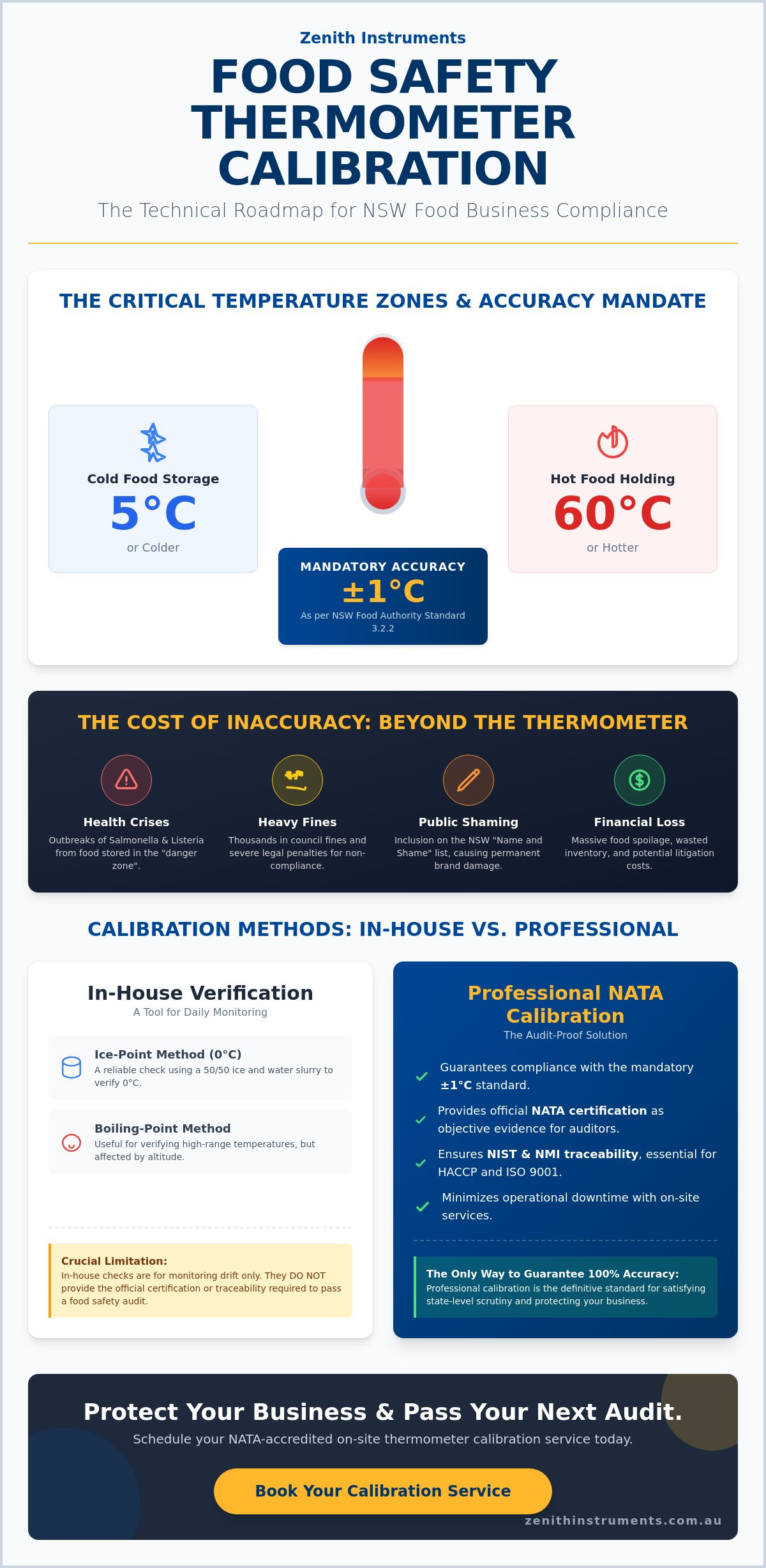
Compliance in the NSW food sector isn't optional. Standard 3.2.2 of the Australia New Zealand Food Standards Code dictates that any business handling potentially hazardous food must use a thermometer accurate to ±1°C. This specific threshold serves as a non-negotiable safety benchmark. If your device reads 4°C but the actual temperature is 6°C, you've already entered the "danger zone" where pathogens thrive. Achieving reliable food safety thermometer calibration nsw ensures that your readings reflect reality. Local council health inspectors prioritize these records during audits because they provide the only objective evidence that your cold chain and cooking processes remain under control.
We recognize that for many operators, the technical nuances of thermometer calibration principles can seem complex. However, the regulatory framework is clear. You must be able to prove your equipment's accuracy through documented verification or professional certification. Inspectors don't just look for the presence of a thermometer; they look for a history of precision. This means your logs must show regular checks and, crucially, the results of those checks compared against a known standard.
The Role of the NSW Food Authority
The NSW Food Authority oversees compliance across Sydney and regional hubs like Newcastle and Wollongong. They enforce strict guidelines for food storage (5°C or colder) and hot holding (60°C or hotter). High-risk businesses, such as those serving vulnerable populations or handling raw seafood, face more frequent inspections. Our thermometer calibration service helps these businesses maintain the rigorous logs required to satisfy state-level scrutiny. We provide the technical documentation that proves your instruments meet national standards, ensuring your business remains operational and compliant.
Consequences of Using Uncalibrated Equipment
Inaccurate readings lead to catastrophic failures. Salmonella and Listeria outbreaks often stem from poor temperature control during storage or transport. Beyond the immediate health risks, legal penalties in NSW are severe. Businesses found in breach may find themselves on the public "Name and Shame" list. This list is a public record of food safety offences that can permanently damage a brand's reputation. There's also the direct economic impact. A refrigeration unit running just three degrees too warm leads to massive food spoilage and wasted inventory. Precision isn't just about safety; it's about protecting your bottom line from avoidable waste and litigation.
DIY Calibration Methods: Ice Point and Boiling Point Procedures
Regular verification is the cornerstone of a robust food safety program. While professional laboratory services provide the highest level of assurance, daily in-house checks allow you to monitor instrument drift between certified service intervals. Establishing a consistent routine for food safety thermometer calibration nsw involves two primary verification techniques: the ice point method and the boiling point method. Following the NSW Food Authority guidelines ensures these tests are performed to a standard that satisfies local health inspectors.
To perform these tests accurately, you need minimal but specific equipment. Ensure you have access to a clean container, crushed ice, distilled or potable water, and a heat source for boiling. We recommend verifying high-use probes daily before the first shift begins. For secondary backup units, a weekly schedule is often sufficient, provided you maintain detailed logs of every variance discovered. Recording these results is just as vital as the test itself; without a paper trail, the verification didn't happen in the eyes of an auditor.
The Ice Slurry Technique for Cold Calibration
The ice point method is the most reliable DIY check because it's less affected by environmental variables. Start by creating a 50/50 slurry. Fill a container to the top with crushed ice and add just enough cold water to fill the gaps. If the ice floats, you have too much water; the mixture must be a dense, slushy consistency to maintain a stable 0°C environment. Insert the probe into the center of the slurry, ensuring it's submerged at least 5cm. Avoid touching the bottom or sides of the container, as this introduces thermal interference from the ambient room temperature. Wait for the reading to stabilize, typically about two minutes. Record the result. If the reading deviates by more than ±1°C, the unit requires professional adjustment.
Boiling Point Verification and Altitude Factors
Boiling point tests are useful for thermometers used in high-heat applications like rotisseries or sous-vide baths. However, physics dictates that water only boils at 100°C at sea level. In coastal hubs like Sydney or Newcastle, this benchmark is reliable. If your business operates in higher altitude regions like the Blue Mountains or the New England Highlands, water boils at a lower temperature. For example, in Katoomba, the boiling point is approximately 97°C. This variance must be calculated to avoid false failure readings. Submerge the probe in rolling boiling water for at least 30 seconds. Be aware that this method is often less reliable for high-precision digital probes, as steam and rapid evaporation can cause fluctuating readings. For instruments requiring absolute precision beyond these manual limits, our calibration services in Sydney provide the controlled laboratory environment needed for definitive accuracy.
The Limitations of Manual Calibration in Commercial Kitchens
While the previous section detailed how to perform basic verification, we must distinguish between a quick kitchen check and a certified laboratory process. Verification tells you if your tool is roughly accurate; calibration tells you exactly how much it deviates against a known standard. Many operators fall into a trap by assuming that a successful ice-slurry test equates to a legal certificate of compliance. In reality, DIY methods are limited by the environment and the user's perception. Analogue dials, for instance, are prone to parallax error, where the reading changes based on the angle of the observer's eye. Even digital displays provide false confidence if the internal battery is low, as voltage drops often result in erratic sensor output.
Infrared (IR) thermometers present a unique challenge for in-house teams. You cannot effectively calibrate an IR gun using an ice slurry or boiling water because these tools measure surface emissivity rather than internal core temperature. Attempting to DIY calibrate these leads to wildly inaccurate results that fail to meet food safety thermometer calibration nsw requirements. Without specialized blackbody calibration equipment, your IR readings remain mere estimates rather than actionable data. If your business relies on non-contact temperature checks, professional intervention is the only way to ensure your readings stay within the ±1°C legal limit.
Instrument Drift and Sensor Fatigue
Thermocouple and thermistor sensors aren't static components. They are subject to instrument drift, a phenomenon where the internal electronics lose accuracy due to age and usage. In the high-humidity and high-heat environments typical of NSW commercial kitchens, this degradation accelerates. A probe that passed an ice-slurry test in January might be out of spec by March due to sensor fatigue. Relying solely on inconsistent DIY checks creates a false sense of security. It leaves your business vulnerable to audit failures because you're monitoring the tool's performance under perfect conditions rather than its reliability across its entire operating range.
Accuracy Margins in DIY Environments
A standard mug of ice water is not a laboratory-grade reference point. Even when following the NSW Food Authority thermometer calibration guidelines, your DIY method has an inherent margin of error of approximately ±0.5°C. When you combine this with the ±0.5°C error margin of a standard commercial thermometer, you reach a cumulative error of 1°C. This means you're operating right on the edge of legal non-compliance without even knowing it. When your internal records show consistent variance or when you can't account for altitude and atmospheric pressure, you must stop DIY-ing. Seek a thermometer calibration service to restore the technical traceability required for HACCP compliance. We provide the precision that a kitchen sink simply cannot replicate.
Professional NATA Calibration vs. In-House Verification
NATA accreditation represents the absolute peak of technical competence in Australia. While we've discussed basic verification methods, food safety thermometer calibration nsw standards often require a higher tier of evidence for legal compliance. NATA-accredited laboratories undergo rigorous assessments to prove their technical proficiency and adherence to ISO 17025 standards. This isn't just about a sticker. It's about establishing NIST and NMI traceability. This ensures your measurements are linked back to the National Measurement Institute (NMI) or international standards (NIST), creating an unbroken chain of accuracy that survives the most intense regulatory scrutiny. Precision is non-negotiable.
The Benefits of Laboratory-Grade Precision
Laboratory dry-well calibrators offer a level of thermal stability that a kitchen ice bucket simply cannot match. In our facilities, we utilize professional thermometer calibration service protocols to perform multi-point testing. This involves checking your instrument's accuracy at several specific temperatures across its entire range, such as -20°C, 0°C, and +100°C. This comprehensive approach identifies non-linear errors that a single-point DIY test would miss. If we find your probe is out of spec, we don't just report the failure. Our technicians perform precise adjustments and repairs to restore the instrument to its required ±1°C tolerance. We fix the error.
Audit-Ready Documentation and Record Keeping
A formal Calibration Certificate is your primary defense during a HACCP or ISO audit. Auditors look for specific technical data, including the uncertainty of measurement and the environmental conditions during the test. For more details on these requirements, consult our instrument calibrations in Australia guide. One critical feature of a professional certificate is the correction factor. This data allows you to mathematically adjust your daily readings based on known laboratory variances, ensuring 100% accuracy in your cold chain records. Certificates build trust. Achieving certified food safety thermometer calibration nsw results is the only way to satisfy high-risk food handling requirements.
Protect your business from regulatory penalties by booking our calibration services in Sydney for guaranteed precision and audit-ready certification.
Zenith Instruments: NSW’s Partner for Certified Food Safety Calibration
We serve as the technical cornerstone for food businesses across New South Wales. Our Sydney-based laboratory provides the precise food safety thermometer calibration nsw services required to maintain absolute compliance with the 2026 standards. We specialize in more than just simple probe verification. Our technicians possess the specialized equipment and expertise to calibrate complex infrared thermometers, coolroom temperature sensors, and high-accuracy immersion probes. By partnering with us, you eliminate the uncertainty of DIY methods and replace it with certified precision that satisfies both council inspectors and international auditors.
Operational efficiency is a priority for our team. We understand that your kitchen or processing facility cannot afford to operate 'blind' without accurate monitoring tools. To prevent this, we prioritize fast turnaround times at our Sydney facility. We also maintain a fleet of mobile laboratory units that bring our expertise directly to your facility floor. Our calibration services in Sydney and Newcastle are designed to minimize downtime, allowing for immediate testing and certification of your entire inventory in a single visit. This proactive service model ensures your records remain audit-ready without interrupting your production schedule or cold chain integrity.
On-Site Calibration Services for Sydney and Newcastle
Large-scale food processors face unique logistical challenges when it comes to equipment maintenance. Sending dozens of thermometers to a lab can halt production for days. Our on-site service solves this by deploying certified technicians to your location. We bring the laboratory to you, performing NATA-traceable calibrations on your warehouse floor or in your commercial kitchen. This localized approach is why we're the preferred partner for businesses across the Sydney basin and regional Newcastle. We provide the technical documentation you need right then and there, ensuring your equipment never leaves your sight.
Comprehensive Instrumentation Solutions
Our capabilities extend beyond temperature monitoring. Food safety is a multi-faceted discipline that requires accuracy across various measurement parameters. We provide comprehensive weight and scale calibration to ensure portion control and ingredient accuracy, alongside specialized pressure gauge testing for industrial processing equipment and autoclaves. For a deeper dive into the technical specifications of modern monitoring tools, see our digital thermometers guide. We are committed to supporting the NSW manufacturing and hospitality sectors with meticulous attention to detail and unwavering reliability.
We pride ourselves on being a dependable expert for local industry. Whether you're a small restaurant in Parramatta or a large-scale manufacturer in the Hunter Valley, our services are tailored to your specific logistical needs. We provide the NATA-traceable documentation that serves as your primary trust signal during food safety inspections. Don't leave your compliance to chance. Contact Zenith Instruments today for a NATA-traceable quote and secure the professional certification your food business requires to stay safe and operational.
Securing Your Compliance for 2026 and Beyond
Maintaining a compliant food business in New South Wales requires more than just occasional ice-slurry checks. You've seen that while daily DIY verification is essential for monitoring drift, it doesn't replace the technical certainty of a certified laboratory process. Standard 3.2.2 mandates a ±1°C accuracy threshold that only professional equipment can guarantee through NIST and NMI traceability. This level of precision is what keeps your business safe during surprise council audits and ensures the highest standards of public safety.
Our team at Zenith Instruments provides the industrial expertise you need to navigate these regulatory demands. As a NATA Accredited Laboratory with ISO 9001 compliant processes, we ensure your instruments meet every legal benchmark. We offer fast turnaround times in Sydney and Melbourne to keep your operations running without interruption. Securing professional food safety thermometer calibration nsw is the final step in protecting your brand from audit failures and safety risks.
Book Your NATA-Traceable Thermometer Calibration Now to ensure your equipment remains precise and compliant. We look forward to being your dependable partner in technical excellence and food safety.
Frequently Asked Questions
How often should I calibrate my food thermometer in NSW?
You should calibrate your food thermometer at least once every six months to remain compliant with NSW Food Authority recommendations. High-volume commercial kitchens often benefit from quarterly professional testing to account for instrument drift caused by constant use. We suggest supplementing these professional services with daily in-house verification to ensure your readings stay within the required ±1°C tolerance between certified service intervals.
Is a DIY ice-point test enough to pass a food safety audit?
An ice-point test serves as daily verification but is rarely sufficient on its own for high-risk food businesses during a formal audit. Auditors typically look for a NATA-traceable calibration certificate to prove your instrument's accuracy across its full operating range. While daily DIY checks demonstrate good practice and proactive monitoring, they lack the technical traceability provided by a professional laboratory.
What is the difference between a probe thermometer and an infrared thermometer calibration?
Probe thermometer calibration involves immersion in a stable thermal medium like a dry-well or liquid bath to test internal sensor accuracy. In contrast, infrared thermometer calibration requires specialized blackbody radiation sources to verify non-contact surface temperature readings. Because IR tools depend on emissivity settings and atmospheric conditions, they cannot be accurately calibrated using the DIY ice-slurry or boiling water methods used for probes.
Can I calibrate my own digital food thermometer if it is reading incorrectly?
You cannot usually adjust the internal circuitry of a digital food thermometer yourself if it displays an incorrect reading. While some advanced models have a "cal" or "reset" function, these often provide a temporary fix rather than a true technical adjustment. If your food safety thermometer calibration nsw check reveals a persistent error, the unit requires professional servicing or replacement to ensure legal compliance.
What should I do if my thermometer is off by more than 1°C?
You must immediately stop using any thermometer that displays a variance greater than ±1°C, as it no longer meets the requirements of Standard 3.2.2. Continuing to use an inaccurate device puts your business at risk of council fines and food-borne illness outbreaks. We recommend sending the unit to a certified laboratory for adjustment or replacing it with a NATA-calibrated instrument to restore your safety margins.
How much does professional thermometer calibration cost in Sydney?
The cost for professional calibration in Sydney depends on several technical factors, including the number of temperature points tested and the type of instrument. We don't provide a flat-rate price because each service is tailored to specific compliance needs, such as NATA accreditation or ISO 9001 requirements. You should request a direct quote from our Sydney laboratory to receive accurate pricing for your specific equipment list.
What are the specific temperature requirements for hazardous foods in NSW?
Potentially hazardous foods in NSW must be stored at 5°C or colder, or held at 60°C or hotter, to prevent rapid bacterial growth. These specific thresholds are defined under the Food Standards Code. Maintaining food safety thermometer calibration nsw ensures that your equipment accurately reflects these critical limits, protecting your inventory from spoilage and your customers from health risks associated with the danger zone.
Does Zenith Instruments provide on-site calibration for restaurants in Newcastle?
We provide comprehensive on-site calibration services across the Newcastle region for hospitality and manufacturing clients. Our mobile units are equipped to handle large inventories of thermometers, pressure gauges, and scales in a single visit. This service eliminates the need for shipping sensitive equipment and minimizes operational downtime for busy commercial kitchens and food production facilities that cannot afford to operate without their primary monitoring tools.