

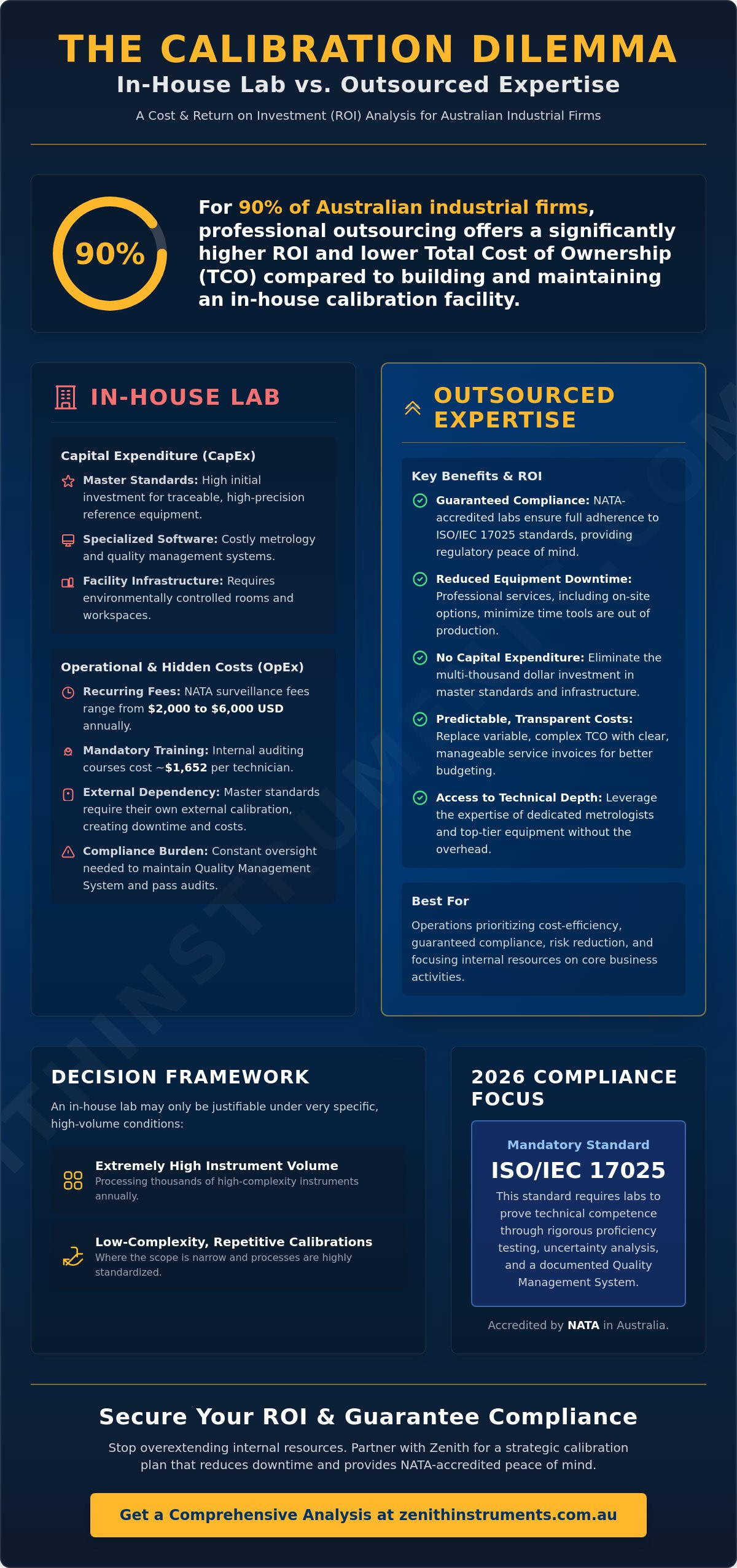
While building an internal lab feels like the ultimate move for operational control, the total cost of ownership for a NATA-compliant facility often exceeds the expense of professional outsourcing for 90% of Australian industrial firms. You've likely seen your annual calibration invoices climb while production schedules suffer from tools being off-site for weeks. It's a common frustration to manage complex compliance documentation while trying to maintain technical precision. We understand that choosing the right path requires a rigorous in-house vs outsourced calibration cost analysis that accounts for more than just the sticker price of equipment.
This guide provides a comprehensive financial and operational breakdown to help you secure a clear ROI for your measurement strategy. We'll examine the 2026 landscape of ISO 17025 requirements, including the $1,652 training costs for internal auditing and the recurring surveillance fees that can range between USD 2,000 and 6,000 annually. By the end of this analysis, you'll have a structured framework to reduce equipment downtime and guarantee regulatory compliance without overextending your internal resources.
Key Takeaways
- Evaluate the technical and regulatory requirements of ISO/IEC 17025 to determine if internal accreditation aligns with your current operational scale and compliance goals.
- Perform a rigorous in-house vs outsourced calibration cost analysis by weighing the capital expenditure of master standards against the predictable ROI of professional service models.
- Identify hidden operational expenses, including NATA training mandates and ongoing surveillance fees, that often inflate the total cost of ownership for internal laboratories.
- Apply a structured two-step framework to audit your instrument inventory based on measurement complexity and the maintenance requirements of secondary standards.
- Discover how strategic partnerships and regional support in Sydney and Melbourne can reduce equipment downtime through NATA-accredited laboratory and on-site services.
The Calibration Dilemma: In-House Control vs. Outsourced Expertise
The choice between maintaining an internal metrology department or engaging an external partner isn't just a logistical decision. It's a strategic financial pivot. In 2026, Australian industrial leaders face two primary models: the "make" model, where a company builds its own laboratory infrastructure, and the "buy" model, where they leverage specialized providers like Zenith Sales & Calibrations Pty Ltd. To understand the stakes, we must first define the core process. What is Calibration? At its most fundamental level, it's the comparison of a measurement device against a traceable standard to ensure accuracy and safety.
Initial drivers for building an in-house lab usually center on the perceived speed of tool availability and the desire to eliminate external service invoices. Managers often believe that having a technician on-site will reduce production bottlenecks. Conversely, the drive toward outsourcing is fueled by a need for technical depth and regulatory peace of mind. A rigorous in-house vs outsourced calibration cost analysis reveals that the "make" option carries heavy hidden burdens that often outweigh the convenience of immediate access. We see many firms underestimate the complexity of maintaining the technical standards required for modern industrial safety.
The Evolution of Calibration Standards in Australia
Under current 2026 standards, the baseline for industrial safety has shifted significantly. NATA-certified results are no longer a luxury; they're a requirement for many Australian supply chains. We've seen a transition from simple verification to complex uncertainty analysis. Modern ISO/IEC 17025 regulations demand that laboratories prove their technical competence through rigorous proficiency testing and environmental controls. This means that a 2026 internal lab requires more than just traceable master blocks. It needs a documented Quality Management System capable of defending measurement results during high-stakes audits. These systems require constant oversight to remain valid under scrutiny.
Defining Total Cost of Ownership (TCO) in Metrology
Calculating the true impact of your calibration strategy requires looking beyond the per-unit price. Total Cost of Ownership accounts for the entire lifecycle of your measurement assets. For an in-house lab, this includes the capital expenditure of purchasing master standards and the ongoing operational costs of technician training and accreditation maintenance. We also factor in the cost of downtime. If an internal master standard fails or requires its own external calibration, your entire production line can stall. Identifying the break-even point is critical. Unless your facility processes thousands of high-complexity instruments annually, the overhead of a NATA-compliant internal lab rarely justifies the investment. Most firms find higher ROI by utilizing established calibration services in Sydney or Melbourne, where the costs of infrastructure and compliance are shared across a broader client base. This shared model provides access to top-tier standards without the heavy CapEx burden.
The True Cost of Establishing an In-House Calibration Lab
Setting up an internal metrology lab involves more than just purchasing high-precision equipment. It requires a fundamental shift in your facility's infrastructure and financial planning. A thorough in-house vs outsourced calibration cost analysis must account for both Capital Expenditure (CapEx) and the long-term Operational Expenditure (OpEx) required to maintain NATA-compliant standards. Initial investments typically include master standards, environmental chambers, and specialized metrology software. These assets aren't "set and forget" items. They require their own rigorous maintenance schedules and frequent software updates to handle modern data requirements.
The financial commitment extends to the hidden costs of an internal lab, such as the "calibration of the calibrators." Your internal master standards must be sent to an external, higher-level laboratory annually. This creates a cycle of external dependency even within an "in-house" model. If a master standard fails its check, every measurement taken with that tool since its last calibration becomes suspect, potentially triggering a massive product recall or audit failure.
Infrastructure and Environmental Requirements
Precision calibrations can't occur in a standard warehouse environment. You must install climate-controlled rooms with strict temperature and humidity tolerances to prevent thermal expansion from skewing results. Vibration isolation and dust filtration systems are also essential for high-accuracy metrology. These environmental controls represent a significant portion of the overhead. Maintaining these specialized systems requires dedicated HVAC servicing and constant monitoring to ensure compliance with ISO/IEC 17025 standards.
The Human Capital Challenge
Recruiting and retaining qualified technicians is a primary hurdle in the Australian market. To maintain competency for electrical equipment calibration, staff must undergo continuous training. As of June 2026, NATA training courses like "Understanding ISO/IEC 17025" cost $919.00, while specialized courses like "The Art of Internal Auditing" are priced at $1,652.00 per person. Using general maintenance staff for these tasks usually leads to productivity losses and increased measurement errors. Professional lab equipment calibration services mitigate this risk by providing access to experts who specialize solely in measurement science.
The liability risks are equally substantial. If your internal lab fails a NATA surveillance visit, the cost of rectification is high. Initial ISO 17025 accreditation is estimated to cost between USD 6,000 and 12,000, with ongoing annual surveillance fees adding another USD 2,000 to 6,000. For many firms, these mounting costs make a strategic partnership with a dedicated provider the most viable financial path. If these overheads seem prohibitive, exploring professional contract calibration services may provide a more predictable financial path for your organization.
Outsourcing Calibration: Analyzing the ROI of Professional Services
Strategic outsourcing shifts calibration from a volatile capital investment to a predictable operational expense. While an internal lab requires constant reinvestment in hardware and personnel, professional services offer a fixed pricing structure. This transparency allows for more accurate budgeting through per-unit rates and established hourly repair fees. We provide the technical depth of a Dependable Expert, identifying emerging tool failures before they result in production halts. This proactive approach ensures your equipment stays within tolerance without the administrative burden of managing an internal metrology department.
A thorough in-house vs outsourced calibration cost analysis reveals that the value of an external partner extends beyond simple measurement. Most internal labs lack the specialized components or training to perform complex repairs. If a tool fails verification in an in-house setting, it must still be sent to an external specialist, doubling the transit time and administrative effort. By outsourcing, you consolidate these steps. We calibrate and, if necessary, repair your instrumentation in a single workflow, significantly shortening the equipment's return-to-service window.
Compliance and Liability Mitigation
Transferring the risk of non-compliance to a certified third-party provider is a primary driver for industrial leaders. Professional laboratories maintain the highest accreditation and compliance standards, ensuring that every certificate is defensible during legal or insurance audits. We utilize automated record-keeping and recall systems that alert you well before an instrument's calibration expires. This systematic oversight eliminates the human error often associated with manual spreadsheets in internal facilities, providing a robust paper trail for NATA and ISO audits.
Operational Efficiency and On-Site Capabilities
The common objection that outsourcing creates excessive downtime is outdated. Modern service models prioritize on-site call-outs to eliminate transit delays. We deploy mobile laboratories that bring NATA-certified expertise directly to your facility. This is particularly effective for multi-discipline requirements where a single visit can cover pressure, electrical, and temperature instruments. For example, performing on-site pressure gauge calibration for an entire manufacturing line allows your team to resume operations in hours rather than weeks. This operational agility is a key component of a modern, cost-effective calibration strategy.
Decision Framework: When to Outsource vs. Keep In-House
Determining the most efficient path for your metrology needs requires a structured approach that moves beyond simple invoice comparisons. We recommend a five-step evaluation process to ensure your strategy aligns with both your balance sheet and your compliance obligations. This framework helps you conduct a definitive in-house vs outsourced calibration cost analysis by quantifying variables that are often overlooked in standard accounting.
- Audit your instrument inventory: Categorize every tool by measurement complexity and its criticality to your production line.
- Calculate master standard maintenance: Account for the annual cost of sending your internal reference tools to a higher-tier lab for NATA-certified verification.
- Factor in the "Downtime Tax": Quantify the lost revenue for every hour a tool is unavailable, whether it is sitting in an internal queue or transit.
- Evaluate the hybrid model: Consider performing basic functional checks in-house while outsourcing critical, high-precision calibrations to specialists.
- Perform a 3-year NPV comparison: Use a Net Present Value calculation to compare the long-term capital costs of lab infrastructure against the predictable rates of professional service contracts.
The Complexity Threshold
Technical depth is the primary divider between a simple check and a metrological calibration. While basic tools might seem easy to verify, sophisticated instruments like multimeters and electrical testers often require specialized signal generators and environmental controls that are cost-prohibitive for most firms. We must distinguish between "functional checks," which confirm a tool is working, and "metrological calibration," which provides a documented uncertainty analysis. Attempting DIY calibration on safety-critical equipment, such as gas monitors or insulation testers, introduces unacceptable liability risks that far outweigh any perceived savings.
Volume vs. Variety
A common financial trap for Australian industrial leaders is the "variety burden." If your facility has a high volume of identical tools, an internal lab might seem logical. However, if you possess a high variety of instruments, you must purchase and maintain a unique master standard for every measurement category. Specialized tools like torque wrenches require dedicated transducers and loading benches that rarely see enough use to justify their footprint in an internal lab. Outsourcing these specific categories allows you to leverage our economies of scale, providing access to top-tier standards without the associated overhead.
If your current in-house vs outsourced calibration cost analysis suggests that your internal lab is underperforming, we can help you transition to a more efficient model. Contact our technical team today to request a professional calibration audit for your facility.
Zenith Sales & Calibrations Pty Ltd: Maximising Calibration ROI in Australia
Choosing Zenith Sales & Calibrations Pty Ltd transforms your calibration strategy from a logistical burden into a competitive advantage. We act as an extension of your quality department, providing the technical oversight required to maintain NATA-compliant standards across your entire inventory. Our flexible service models cater to diverse industrial needs, offering high-precision laboratory services through our Sydney and Melbourne hubs alongside comprehensive Australia-wide on-site support. This multifaceted approach ensures that your in-house vs outsourced calibration cost analysis remains focused on long-term value rather than just initial savings. By consolidating your pressure, electrical, thermal, and dimensional needs under one partner, you eliminate the administrative complexity of managing multiple vendors.
We provide total transparency through clear, audit-ready certification and reporting that simplifies your regulatory compliance. Every measurement we take is backed by the meticulous discipline expected in high-stakes industrial environments. Our goal is to provide a no-nonsense, high-performance service that values technical excellence above all else, ensuring your equipment remains a reliable asset rather than a liability risk. We bridge the gap between complex ISO requirements and your daily operational needs.
Minimising Downtime with Mobile Laboratories
We address the off-site downtime challenge by deploying fully equipped mobile laboratories directly to your facility. Our service call-outs are designed for rapid mobilisation, allowing our technicians to perform critical calibrations on the production line. This strategy maintains 100% uptime for your most essential assets. While laboratory-bound competitors require shipping and wait times, we provide localized service with a national reach. Our coverage extends beyond major metros to vital regional hubs, including Newcastle, Canberra, and Brisbane, ensuring consistent measurement accuracy regardless of your location. This on-site model provides the middle ground many firms need to balance immediate tool availability with professional accreditation.
Expert Technical Support and Repair
Professional calibration should offer more than a simple pass or fail status. Our technical experts diagnose emerging tool failures and perform necessary repairs during the same visit. This integrated workflow prevents the secondary downtime associated with sending failed tools to a third-party repairer. If an instrument is beyond economical repair, we provide immediate access to a wide inventory of new pressure gauges and other measurement tools to keep your operations moving. This capability-driven approach ensures that a failed calibration doesn't lead to a prolonged production halt. To finalise your in-house vs outsourced calibration cost analysis, we recommend requesting a custom site audit from a Zenith Sales & Calibrations Pty Ltd technician to identify your specific ROI opportunities and technical requirements.
Optimising Your Industrial Metrology Strategy
Refining your calibration strategy is a critical step toward operational excellence in 2026. We've analyzed how the true cost of an internal lab extends far beyond the initial equipment purchase, encompassing NATA training, surveillance fees, and the risk of production-halting audit failures. A data-driven in-house vs outsourced calibration cost analysis demonstrates that leveraging a specialized partner provides predictable budgeting and technical peace of mind. By transferring the complexity of ISO/IEC 17025 compliance to experts, you focus your internal resources on your core manufacturing goals.
We offer a partnership built on over 20 years of Australian industrial expertise and a commitment to meticulous precision. Zenith Sales & Calibrations Pty Ltd maintains NATA-accredited laboratories in Sydney and Melbourne that serve as national hubs for technical excellence. Our comprehensive on-site mobile service capabilities bring that expertise directly to your production line, ensuring your tools remain in service without the logistical delays of laboratory transit.
Request a Professional Calibration Cost Analysis from Zenith Sales & Calibrations Pty Ltd to determine the most efficient path for your business. Let's ensure your measurement assets remain reliable, compliant, and cost-effective for years to come.
Frequently Asked Questions
Is in-house calibration allowed under ISO 9001 standards?
Yes, in-house calibration is permitted under ISO 9001, provided your organization can demonstrate measurement traceability to national or international standards. You must maintain rigorous documentation of the calibration method, the environment, and the technical competence of the personnel performing the work. Many auditors now require evidence that internal procedures mirror the technical requirements of ISO/IEC 17025 to ensure valid results.
How much does it cost to maintain NATA accreditation for an internal lab?
Maintaining NATA accreditation involves significant recurring expenses that often surprise industrial leaders. Beyond the initial ISO 17025 setup cost of USD 6,000 to 12,000, labs typically set aside USD 2,000 to 6,000 annually for surveillance fees and assessor visits. Mandatory NATA training courses for staff add further costs, with internal auditing and competence training priced at $1,652 per course as of June 2026.
What are the risks of using traceable standards without NATA endorsement?
Using traceable standards without NATA endorsement carries substantial regulatory and insurance risks. While "traceable" means a comparison was made to a higher standard, only NATA endorsement proves the technical competence of the lab and the validity of their uncertainty calculations. Without this badge of honor, your calibration certificates may be rejected during high-stakes compliance audits or legal proceedings.
Can Zenith perform on-site calibration for all types of instruments?
We provide extensive on-site calibration for a broad range of industrial categories, including pressure, electrical, thermal, and dimensional instruments. Our mobile laboratories bring NATA-certified expertise directly to your production floor to eliminate transit downtime. Some highly specialized laboratory equipment requiring extreme environmental stability may still be best served at our Sydney or Melbourne facilities.
What is the typical turnaround time for outsourced calibration in Sydney?
Outsourced calibration at our Sydney facility typically features a turnaround time of 3 to 5 business days. We prioritize efficiency to minimize the time your tools are off-site. For firms that cannot afford any equipment absence, our on-site service model provides immediate results with certificates issued shortly after the technician completes the verification.
How do I calculate the ROI of switching from in-house to outsourced calibration?
To calculate the ROI, perform a detailed in-house vs outsourced calibration cost analysis that compares internal technician wages, master standard recalibration fees, and accreditation overhead against our fixed service rates. You must also quantify the "Downtime Tax" incurred when tools sit in an internal queue rather than being serviced by a rapid-response external partner.
Does Zenith provide calibration recall reminders for our equipment?
Yes, we maintain a proactive recall system that tracks your entire instrument inventory and sends automated reminders before calibrations expire. This system ensures you never miss a compliance deadline. It allows your quality department to schedule services during planned maintenance windows, preventing the chaos of last-minute emergency certifications.
What happens if an instrument fails calibration during an on-site visit?
If an instrument fails verification, our technicians can often perform immediate repairs to bring the tool back into tolerance during the same visit. This integrated approach is a core part of our in-house vs outsourced calibration cost analysis advantage. If a repair isn't viable, we provide access to a wide inventory of new instruments, such as pressure gauges, to ensure your production continues without delay.