

In Australian industry, an industrial digital thermometer is only as reliable as its most recent NATA-traceable calibration. We understand that failing an ISO audit or suffering production downtime because of a drift in measurement isn't just an inconvenience; it's a direct threat to your operational integrity. Whether you're managing a high-output mining site or a precision pharmaceutical facility, you've likely experienced the frustration of hardware failures in harsh environments or the logistical headache of sending tools away for weeks. It's a risk that professional operators can no longer afford to take in a tightening regulatory environment.
This guide provides the technical roadmap you need to master the selection and maintenance of the industrial digital thermometers australia requires for 2026. We'll examine the critical updates in the ISO/IEC 17025:2025 standard, published in September 2025, and the specific 1°C accuracy mandates required by Standard 3.2.2 of the Food Standards Code. You'll learn how to implement a proactive calibration model that prioritizes NATA certification and local service to ensure your equipment remains rugged and compliant. We've structured this information to help you eliminate measurement uncertainty and achieve total regulatory confidence through meticulous technical standards.
Key Takeaways
- Identify the engineering differences that separate industrial-grade hardware from consumer devices, specifically regarding ingress protection and long-term sensor stability.
- Learn to select the optimal sensor technology by comparing RTD and thermocouple performance in high-stakes manufacturing and mining environments.
- Review the technical specifications of the industrial digital thermometers australia utilizes for high-stakes applications, focusing on data logging and Bluetooth connectivity.
- Master the technical requirements for NATA-endorsed calibration to ensure your equipment meets the highest international standards for measurement traceability.
- Discover how a proactive service model involving Sydney and Melbourne hubs can secure your supply chain and eliminate the costs of equipment downtime.
What Defines an Industrial Digital Thermometer in the AU Market?
Industrial digital thermometers are high-precision electronic instruments engineered to maintain measurement integrity in extreme environments. Unlike consumer-grade devices designed for domestic use, these professional tools must withstand the rigorous demands of Australian manufacturing and resource sectors. We define these instruments by their ability to provide repeatable, exact data while exposed to mechanical vibration, chemical exposure, and temperature extremes. Selecting the correct industrial digital thermometers australia requires an understanding of both the hardware's physical build and its underlying principles of thermometry.
In the Australian market, the distinction between industrial and consumer hardware lies in certification and durability. A consumer thermometer might offer a basic reading, but it lacks the NATA traceability required for ISO compliance or HACCP food safety standards. We provide thermometer calibration services that bridge this gap, ensuring your hardware meets the exact standards needed for HVAC systems in Sydney or deep-pit mining operations in Western Australia. Compliance isn't just a checkbox; it's a safeguard against audit failures and product spoilage. Our approach prioritizes precision to support your operational continuity and safety protocols.
Ingress Protection (IP) Ratings for Harsh Environments
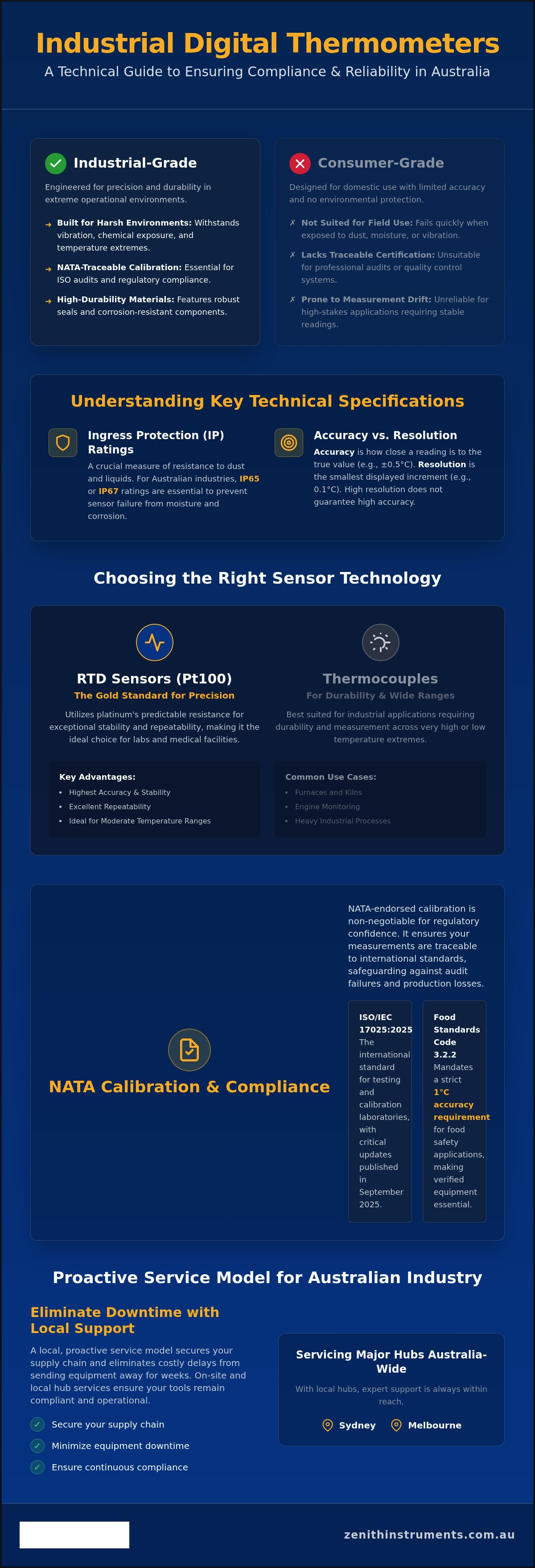
An Ingress Protection rating is a standardized measure of a device's resistance to the intrusion of solid objects and liquids. For Australian industries, IP65 or IP67 ratings are essential to combat high humidity and fine dust. Without these seals, moisture ingress leads to internal corrosion and sensor failure, causing measurement drift. High-grade seals ensure that internal electronics remain isolated, extending the tool's service life in harsh field environments. We've seen unrated equipment fail within weeks in coastal environments due to salt-air corrosion, proving that IP ratings are a primary pillar of hardware reliability.
Accuracy vs. Resolution: Knowing the Difference
Technical specialists often confuse resolution with accuracy. Resolution refers to the smallest increment a display shows, while accuracy is the closeness of that reading to the true temperature. A display showing 0.1°C increments might still have an accuracy tolerance of ±1.0°C. Investing in high-quality industrial digital thermometers australia ensures your data remains defensible during regulatory inspections. Standard tolerances typically require accuracy within ±0.5°C, but regular verification is required to account for inevitable electronic drift. Understanding this distinction prevents the common error of assuming a precise-looking display equates to an accurate measurement.
Choosing the Right Sensor Technology: RTD vs. Thermocouple
Selecting the core sensor technology for your industrial digital thermometers australia fleet isn't merely a technical preference; it's a decision that dictates your long-term measurement reliability. The choice between Resistance Temperature Detectors (RTD) and thermocouples hinges on your specific operational environment and the required precision levels. We find that many Australian procurement managers struggle with this balance, often opting for lower-cost sensors that fail to meet the rigorous standards established by Australia's peak body for measurement. Each technology has distinct mechanical and electrical properties that impact your calibration frequency and overall data integrity.
RTD Sensors: The Choice for High Precision
RTD sensors, specifically Pt100 and Pt1000 configurations, represent the gold standard for stability and repeatability. These sensors utilize the predictable electrical resistance changes of platinum to deliver exceptional accuracy across a moderate temperature range. In laboratories and medical storage facilities across Melbourne, where a variance of half a degree can compromise millions of dollars in specialized inventory, RTDs are the logical choice. Their primary advantage is long-term stability; they don't drift as quickly as thermocouples under normal operating conditions. While they're more physically fragile and sensitive to vibration, their precision ensures you remain compliant with strict ISO standards.
Thermocouples: Speed and Range for Heavy Industry
Thermocouples operate on the Seebeck effect, using the voltage generated at the junction of two dissimilar metals. These are the rugged workhorses of heavy industry. Type K and Type J thermocouples are ubiquitous in high-heat furnace monitoring and smelting operations due to their vast temperature range, which can exceed 1200°C. They offer rapid response times, which is critical for real-time process control and safety-shutoff systems.
However, thermocouples require careful management of cold junction compensation. This is the process where the instrument accounts for the ambient temperature at the connection point to ensure the reading remains accurate. Type T thermocouples are often the preferred choice for cryogenic applications or sub-zero food storage in the outback, where extreme cold is the primary environmental factor and moisture resistance is paramount.
Cost-Benefit Analysis for Procurement
Procurement managers must weigh the higher initial cost of RTDs against the frequent maintenance needs of thermocouples. Thermocouples are prone to decalibration or sensor drift when exposed to extreme heat cycles or corrosive atmospheres. This drift often necessitates a more frequent thermometer calibration service schedule to prevent audit failures. Conversely, RTDs provide a lower total cost of ownership in stable environments because they maintain their accuracy for longer periods. We recommend evaluating your specific environmental stressors, such as vibration and chemical exposure, before committing to a sensor type. If your facility requires high-volume throughput with minimal downtime, our team can help you establish a NATA-compliant thermometer calibration service plan for the industrial digital thermometers australia relies on for safety.
Selection Criteria for Industrial Digital Thermometers Australia
Selecting the right industrial digital thermometers australia involves evaluating the physical interface and connectivity options that support your specific operational workflow. We prioritize hardware that integrates seamlessly into a technician's daily routine while meeting the unique demands of remote Australian sites. Key features like dual-probe inputs allow for simultaneous monitoring of two distinct points, such as the inlet and outlet temperatures of a heat exchanger. This capability significantly improves diagnostic efficiency and reduces the time spent on-site.
For technicians operating in the outback or regional industrial hubs, ergonomic design is a primary safety requirement. Large, backlit displays are essential for visibility in high-glare environments or dimly lit plant rooms. We recommend units with high-capacity lithium batteries or USB-rechargeable options to ensure continuous operation during multi-day field deployments where power access is limited. Ruggedized housing with non-slip grips further ensures the tool remains functional even when handled with industrial gloves or in wet conditions.
Data Logging and Smart Connectivity
Modern measurement protocols demand digital traceability to maintain high-level compliance. Automated data logging eliminates the human error associated with manual recording, providing a tamper-proof record of temperature fluctuations over long durations. For large-scale facilities, cloud-based temperature monitoring via Bluetooth allows for real-time data transmission to a central management system. This connectivity is vital for maintaining compliance with HACCP and food safety audits, as it provides the granular data required to prove consistent temperature control. You can explore more about these systems in our Digital Thermometers: A Professional Guide for Australian Industry (2026).
Probe Variety and Interchangeability
The versatility of your fleet depends on probe interchangeability and the use of standardized connectors. Utilizing universal Mini-plug connectors allows a single instrument to serve multiple functions by switching between penetration, surface, and air probes. Penetration probes are standard for food and chemical processing, while surface probes are essential for monitoring motor casing temperatures or pipework. To extend probe life, we advise regular cleaning with specialized wipes and avoiding excessive cable strain, which is a leading cause of intermittent signal failure. Proper maintenance ensures that your industrial digital thermometers australia remain functional and precise between scheduled calibration intervals.
The Critical Role of NATA Calibration and Compliance
In high-stakes industrial environments, a calibration certificate serves as your primary legal defense during an ISO or HACCP audit. It provides documented proof that your industrial digital thermometers australia operate within their specified tolerances. We emphasize that measurement drift is a physical certainty, not a possibility. Without a formal calibration record, your temperature data is technically indefensible, which can lead to immediate audit failures or costly product recalls in the food and pharmaceutical sectors. We provide the technical rigour required to transform a simple tool into a compliant measurement instrument.
Many procurement managers confuse 'traceable' calibration with 'NATA-endorsed' calibration. While traceable calibration suggests an instrument was checked against a master device, a NATA-endorsed certificate ensures the entire laboratory process meets the stringent requirements of ISO/IEC 17025. This includes the validation of software, the technical competence of staff, and the environmental controls of the facility. You can maintain this level of precision for your equipment through our Professional Calibration Services Sydney, ensuring every reading is backed by national standards.
Establishing the correct calibration interval is essential for maintaining compliance. For general industrial applications under ISO 9001, we recommend a 12-month interval. However, critical sectors like food processing or pharmaceutical manufacturing require a 6-month frequency to mitigate the risks of measurement drift. Regular testing ensures that your hardware remains rugged and accurate in the field, preventing the downtime associated with unexpected equipment failure.
Understanding ISO 17025 Standards
The ISO/IEC 17025:2025 standard, published on September 27, 2025, represents the latest benchmark for laboratory competence. This update introduces rigorous requirements for digital data validation and electronic record integrity. We maintain these standards across our facilities to ensure your industrial digital thermometers australia deliver globally recognized results. The National Measurement Institute (NMI) sits at the apex of the measurement hierarchy, providing the primary standards that underpin all NATA-accredited calibrations in Australia. Adherence to these frameworks ensures your data remains accurate throughout the transition period ending in 2028.
How to Read a Calibration Report
A professional calibration report contains two vital datasets: 'As Found' and 'As Left' data. The 'As Found' results reveal how the instrument performed upon arrival, which is critical for identifying potential past non-compliance. The 'As Left' data confirms the instrument's accuracy after any necessary adjustments. You must also evaluate the Uncertainty of Measurement (UoM) values, as these define the statistical margin of error for each reading. For a deeper technical analysis of these reports, consult our guide on Instrument Calibrations in Australia: The 2026 Professional Guide.
Don't risk your operational integrity with unverified equipment; secure your compliance by booking our thermometer calibration service to ensure your fleet meets current Australian standards.
Zenith Instruments: Australia-Wide Sales and On-Site Service
Zenith Instruments operates as a wide-reaching partner for the specialized measurement needs of the Australian industrial sector. We maintain dedicated facilities in Sydney and Melbourne, serving as strategic hubs for the sale and NATA-traceable calibration of industrial digital thermometers australia requires for high-stakes compliance. Our dual-hub strategy ensures that regional industries have access to meticulous technical expertise without the logistical delays associated with international or lab-bound competitors. We provide a proactive service model that prioritizes your operational efficiency and long-term hardware reliability.
Managing large industrial fleets requires more than just high-quality hardware; it demands a structured maintenance approach that eliminates measurement uncertainty. We design customized maintenance plans that align with your specific audit cycles and regulatory frameworks. By centralizing your procurement and calibration with a single expert partner, you reduce administrative overhead and ensure every instrument in your facility meets a uniform standard of precision. Our technical support team assists in selecting the optimal sensor technology for your specific sector, whether you're managing complex chemical processes or cold-chain logistics.
Mobile Calibration Labs: Bringing the Lab to You
Our mobile laboratory equipment allows us to deliver high-precision testing directly to your site in Brisbane, Newcastle, and Canberra. We recognize that transporting sensitive equipment introduces risks of mechanical shock or environmental stress that can affect sensor performance. By conducting on-site calibration service melbourne and regional hubs rely on, we test your instruments within their actual operating environment. This approach accounts for local ambient conditions and installation variables that a remote laboratory cannot replicate. It's the most efficient method for minimizing downtime and ensuring your fleet remains in the field where it's needed most.
Comprehensive Repair and Maintenance
Reliability extends beyond the initial purchase. We offer expert repair services designed to extend the operational life of high-end thermometers, making repair a more sustainable and cost-effective choice than total replacement. Our technicians possess the specialized skills required to diagnose and rectify electronic drift or physical damage in ruggedized hardware. We view every repair as a commitment to Australian industry and technical excellence. By restoring your equipment to its original specifications, we help you maintain long-term measurement stability and maximize your return on investment in professional-grade industrial digital thermometers australia.
Securing Your Industrial Measurement Integrity for 2026
Precision in temperature measurement is the foundation of industrial safety and regulatory compliance. We've explored how selecting the right sensor technology and adhering to the updated ISO/IEC 17025:2025 standards protects your facility from audit failures. Implementing a proactive maintenance strategy ensures that your industrial digital thermometers australia fleet remains accurate in the most demanding environments. By utilizing mobile laboratory services, you can maintain these rigorous standards without the logistical burden of equipment transport.
Our commitment to technical excellence is supported by our NATA Accredited Laboratory and ISO 9001 compliant processes. We provide the expertise needed to manage your measurement risks while offering on-site service available nationwide. Whether you're upgrading your hardware or scheduling essential calibration, we'll partner with you to ensure your equipment delivers reliable, defensible data every day. It's time to optimize your facility's performance with tools that are as rugged as they are precise.
Get a Quote for Industrial Digital Thermometers and Calibration
Frequently Asked Questions
How often should industrial digital thermometers be calibrated in Australia?
Digital thermometers in general industrial applications should be calibrated every 12 months to maintain ISO 9001 quality management compliance. However, critical sectors such as food processing under HACCP guidelines or pharmaceutical manufacturing require a more frequent interval of every 6 months to prevent measurement drift. We recommend establishing a fixed schedule based on your specific risk assessment and the harshness of your operating environment to ensure ongoing accuracy.
What is the difference between a Type K and a Type T thermocouple?
Type K thermocouples are general-purpose sensors with a wide temperature range, often exceeding 1200°C, making them suitable for high-heat industrial furnaces. In contrast, Type T thermocouples utilize copper and constantan, offering superior accuracy in sub-zero and cryogenic applications. Type T is also highly resistant to moisture, which is why it's the preferred choice for cold-chain logistics and food storage facilities across regional Australia.
Is NATA calibration mandatory for food safety in Sydney?
While the Food Standards Code mandates that businesses have a thermometer accurate to within 1°C, NATA-endorsed calibration is the most reliable way to prove this accuracy during a formal audit in Sydney. Regulatory bodies and third-party auditors often require NATA-certified documentation to verify that measurement equipment meets national standards. We provide these certifications to ensure your business remains compliant with both local health regulations and international quality frameworks.
Can I calibrate my own industrial digital thermometer?
You can perform basic ice-point or boiling-point checks to verify if your instrument is drifting, but these don't constitute a formal calibration for regulatory compliance. Professional calibration requires specialized laboratory equipment and a traceable path to national standards held by the National Measurement Institute. For ISO or NATA compliance, you must use an accredited facility that can issue a formal certificate of accuracy and calculate the uncertainty of measurement.
What happens if my thermometer fails its calibration test?
If an instrument fails its "As Found" test, our technicians will first attempt to adjust or repair the unit to bring it back within the manufacturer’s specified tolerances. If the device cannot be adjusted due to sensor degradation or electronic failure, we'll provide a detailed report and recommend a suitable replacement. We prioritize extending the life of your industrial digital thermometers australia through expert repair before suggesting new hardware procurement.
What are the benefits of on-site calibration vs. laboratory calibration?
On-site calibration eliminates the downtime caused by shipping equipment away for service, as our mobile laboratories perform testing directly at your facility in Brisbane or Newcastle. This method also allows us to verify instrument performance within its actual operating environment, accounting for local ambient factors. Laboratory calibration, however, is often preferred for high-precision instruments that require the strictly controlled environmental conditions of our Sydney or Melbourne facilities.
Does Zenith Instruments provide certificates for all thermometer sales?
We provide comprehensive documentation for all new equipment sales to ensure your fleet is ready for immediate deployment. Depending on your specific industry requirements, we can supply either NATA-endorsed or traceable calibration certificates. This ensures that every thermometer we sell is verified against known standards from day one, giving you a defensible measurement record for your quality management system and future regulatory audits.
What is the standard turnaround time for thermometer calibration in Melbourne?
We prioritize efficiency through our dedicated Melbourne facility to ensure minimal disruption to your operations. While exact times depend on the volume of equipment, we typically offer rapid turnaround for standard industrial digital thermometers australia. For businesses with large fleets, we recommend our on-site service model, which provides immediate results and eliminates the transit time between your facility and our specialized calibration laboratory.