

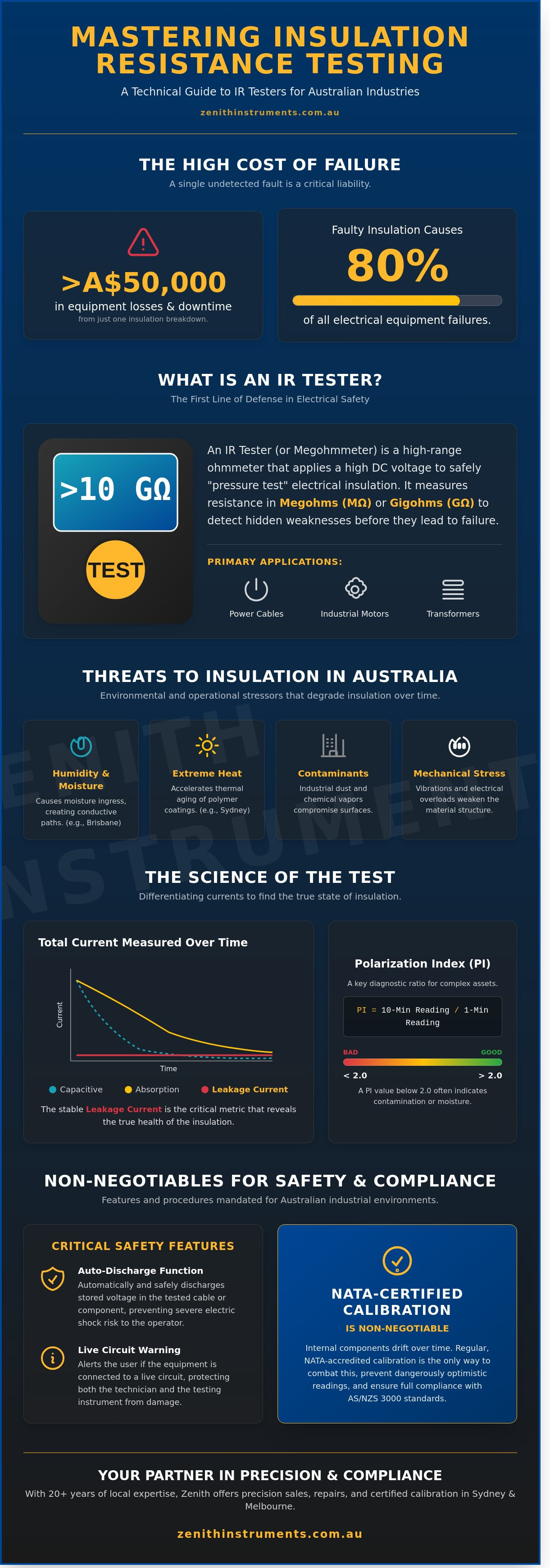
A single undetected insulation fault in a high-voltage system can result in catastrophic equipment losses exceeding A$50,000 and weeks of unscheduled downtime. We know that for engineers and facility managers across Sydney, Melbourne, and Brisbane, the pressure to maintain zero-fail environments is constant. You recognize that inconsistent readings aren't just a technical nuisance; they're a significant liability that threatens both operational continuity and personnel safety. Relying on unverified data puts your entire infrastructure at risk.
This guide ensures you master the technical essentials of using an ir tester while clarifying the complex voltage requirements mandated by AS/NZS 3000. We'll show you why precise calibration is the backbone of electrical safety in Australia and how NATA-accredited verification eliminates the risks of equipment failure. We'll examine specific testing mechanics, mandatory compliance intervals, and the proactive service models that keep Australian industries running at peak performance. By the end of this article, you'll have a clear roadmap for maintaining certified accuracy across all your measurement assets.
Key Takeaways
- Define the technical role of an ir tester as a specialized ohmmeter designed to detect critical insulation breakdown in cables, motors, and transformers.
- Master the "Pressure Test" methodology to accurately differentiate between capacitive charging, absorption, and leakage current during high-voltage applications.
- Evaluate essential features for Australian industrial environments, including auto-discharge and live circuit warnings, to ensure maximum operator safety and equipment longevity.
- Understand why NATA-certified calibration is mandatory to combat internal component drift and prevent dangerously optimistic resistance readings that compromise site compliance.
- Leverage our 20 years of local expertise in Sydney and Melbourne for a comprehensive partnership covering precision sales, repairs, and certified calibration services.
What is an IR Tester? Understanding Insulation Resistance
An ir tester is a high-range ohmmeter designed specifically to measure the integrity of electrical insulation. Unlike a standard multimeter that utilizes low voltage to check continuity, this device applies a high DC voltage to determine the resistance of an insulator. It's a critical diagnostic tool for identifying insulation breakdown in power cables, industrial motors, and high-voltage transformers before catastrophic failure occurs. By injecting a controlled voltage, the device measures the leakage current and calculates the resistance in megohms or gigohms.
In industrial hubs like Sydney and Melbourne, professionals often refer to these devices as "Meggers," a term derived from the legacy brand name that became synonymous with the Megohmmeter (or insulation resistance tester). Regardless of the label used on-site, the primary function remains the same: ensuring the safety and reliability of electrical systems. Faulty insulation accounts for approximately 80% of electrical equipment failures. These failures lead to significant fire risks and potential electrocution hazards in Australian workplaces. Using a reliable ir tester allows technicians to transition from reactive repairs to a proactive, safety-first maintenance model.
The Core Components of an IR Tester
Modern units typically feature an internal electronic power supply or, in older models, a hand-cranked DC generator to produce the necessary test voltage. This voltage can range from 250V up to 10kV depending on the specific industrial application. The display features an infinity mark to indicate perfect insulation where no detectable leakage current flows. High-quality test leads are non-negotiable; these leads must possess superior insulation properties to prevent parasitic leakage from skewing high-resistance readings. We recommend regular electrical equipment calibration services to ensure these internal components maintain their rated accuracy and NATA-traceable precision.
Why Insulation Resistance Decays Over Time
Insulation resistance is the measure of an insulator’s ability to resist current leakage when subjected to high DC voltage. Environmental factors common across Australia accelerate the degradation of these materials. Brisbane's high humidity levels often lead to moisture ingress, while the extreme heat in Sydney and inland regions causes thermal aging of polymer coatings. Industrial dust in manufacturing zones and chemical vapours in processing plants also create conductive paths on the surface of insulators. Mechanical stress from motor vibrations or frequent electrical overloads further compromises the molecular structure of the insulation. Regular testing identifies these issues before they result in costly downtime or personnel injury.
The Science of Insulation Resistance Testing
Understanding how an ir tester functions requires viewing the electrical system through the lens of a "pressure test." When we apply high DC voltage to a conductor, we're essentially pumping electrical pressure into the system to see if the insulation can contain it. If the insulation is compromised by moisture ingress, physical degradation, or carbon tracking, current leaks out. This leakage reveals hidden weaknesses that standard continuity checks cannot detect.
The total current measured during a test consists of three distinct components. First is the capacitive charging current, which starts high and falls to zero as the insulation charges. Second is the absorption current, caused by the molecular polarization of the dielectric material. Finally, the leakage current represents the steady flow through or over the insulation. This third component is the critical metric for determining the safety and longevity of the asset.
Because capacitive and absorption currents take time to dissipate, a spot reading taken immediately will be inaccurately low. We utilize the 1-minute test as an industry standard to allow these transient currents to settle. For more complex assessments, technicians calculate the Polarization Index (PI) and the Dielectric Absorption Ratio (DAR). The PI is the ratio of the 10-minute reading to the 1-minute reading. A PI value below 2.0 often indicates contamination or moisture absorption, while higher values suggest healthy, dry insulation.
Voltage Levels and Test Applications
Selecting the appropriate output on your ir tester is vital for equipment safety and data accuracy. Standard test voltages typically include:
- 250V: Used for sensitive low-voltage electronics and communication cabling.
- 500V: The standard for general building wiring and low-voltage industrial equipment.
- 1000V: Applied to motors and transformers rated up to 600V.
- 2500V to 5kV: Required for high-voltage industrial motors and heavy power distribution assets.
Selecting a voltage that is too high can cause permanent dielectric breakdown, while a voltage that is too low may fail to reveal existing insulation cracks. We recommend regular electrical equipment calibration services to ensure your high-voltage gear maintains the precision required for these critical measurements across all ranges.
Interpreting IR Tester Readings
The "1 Megohm Rule" has historically served as a baseline, suggesting a minimum of 1 MΩ of resistance for every 1000V of operating voltage. However, modern industrial standards often demand much higher thresholds to ensure operational reliability. Technicians must also account for temperature, as resistance drops significantly as heat rises. For every 10-degree Celsius increase, insulation resistance can drop by 50%. It's essential to apply correction factors to normalize readings to a standard 20°C or 40°C for accurate historical comparison.
These measurements differ fundamentally from the resistance tests performed on a standard multimeter. While a multimeter uses very low voltage to check for continuity, an IR tester provides a genuine stress test by applying high potential to the dielectric material. If you need assistance with instrument selection, our team can help you find a Major Tech solution tailored to your specific industrial requirements.
Selecting an IR Tester for Australian Industrial Applications
Choosing the right ir tester involves a technical evaluation of power requirements against specific operational environments. Hand-cranked models remain a niche but reliable choice for remote regional sites where battery charging is impossible. However, most modern Australian technicians prefer battery-operated units for their speed and portability. For high-voltage diagnostics within a controlled facility, mains-powered testers provide the consistent energy output needed for long-duration polarization index (PI) and dielectric absorption ratio (DAR) tests. Safety features define the quality of professional equipment. We prioritize instruments equipped with auto-discharge functions to safely bleed off residual capacitive charges after a test. Live circuit warnings are equally vital, providing a visual or audible alert if the ir tester is connected to an energized system, preventing equipment damage and technician injury.
Environmental resilience is a critical factor for onsite work. Technicians operating in the humid coastal environments of Newcastle or the dusty, temperature-variable regions of Canberra require high Ingress Protection (IP) ratings. An IP67 rating ensures the internal circuitry remains sealed against moisture and fine particulates. At Zenith, we stock brands like Major Tech because their hardware is engineered for these exact Australian conditions. These units feature ruggedised housings and heavy-duty leads that maintain integrity during intensive industrial use. Data logging has also become a standard requirement for 2026, allowing for the digital storage and export of results to support comprehensive maintenance logs and audit trails.
Compliance with AS/NZS 3000 Standards
The AS/NZS 3000 Wiring Rules mandate insulation resistance testing for all new installations and significant alterations before they are energized. Under Australian law, a standard low-voltage circuit must demonstrate a minimum insulation resistance of 1MΩ. For specialized infrastructure, including high-speed data hubs, we integrate telecommunication networking calibration to ensure the testing equipment meets the precision levels required for sensitive signal environments. Precise measurement prevents leakage currents that lead to nuisance RCD tripping or hazardous fire risks.
Handheld vs. Benchtop IR Testers
Portability is the primary driver for field electricians in Melbourne who must navigate tight switchboards and vertical assets. Handheld testers typically offer voltage ranges up to 1kV or 2.5kV, which is sufficient for most commercial applications. Laboratory technicians, however, often require benchtop models that provide 10kV or 15kV outputs with superior measurement resolution for characterising advanced insulation materials. Selecting an IR tester requires balancing the maximum required test voltage with the need for on-site portability and ruggedness. We ensure every unit, regardless of format, is calibrated to NATA-traceable standards to guarantee accuracy across its entire range.
Why Calibration is Non-Negotiable for IR Testers
A common misconception among electrical contractors is that a brand-new ir tester is ready for field use immediately after purchase. Factory presets can fluctuate during international shipping or prolonged storage. We've observed that approximately 15% of new instruments require adjustment before they meet the strict tolerances required by Australian industry standards. Relying on an unverified device from day one introduces unnecessary risk into your safety protocols.
Internal component drift is a silent threat to electrical safety. Over time, the resistors and voltage regulators inside your equipment lose their precision. This drift often leads to "optimistic" readings where the device displays a high resistance value despite the insulation being compromised. In high-risk environments such as the Hunter Valley mining sector or Tier 1 medical facilities, an error of just 5% can result in a failure to detect a pending short circuit. Using uncalibrated gear isn't just a technical oversight; it's a breach of the AS/NZS 3000:2018 Wiring Rules. This can void your professional indemnity insurance and lead to significant legal liability if an incident occurs.
NATA accreditation represents the gold standard for measurement in Australia. It provides a chain of traceability to national standards that non-accredited labs cannot match. When your equipment carries a NATA-endorsed certificate, you possess definitive proof of compliance that withstands the scrutiny of WorkSafe auditors and ISO inspectors. It's the only way to guarantee that your measurements are accurate, repeatable, and legally defensible.
The NATA Calibration Process at Zenith
Our laboratory technicians follow a rigorous protocol to verify that your ir tester delivers the exact DC voltage it claims while measuring resistance accurately across its entire scale. We don't just "check" the numbers; we validate the instrument's performance under simulated load conditions. This meticulous approach ensures your gear meets the requirements of ISO 9001 quality management systems. To streamline your facility maintenance, we also offer pressure gauge calibration, allowing you to consolidate your compliance needs with a single expert partner.
On-Site vs. In-Lab Calibration Services
We understand that downtime is a major cost driver for Australian businesses. To combat this, we offer on-site calibration in Sydney and Melbourne, allowing your technicians to remain productive while we verify their gear. For specialized high-voltage equipment that requires a vibration-free or temperature-controlled environment, our laboratory provides the necessary precision. You can view our full range of scheduling options through our calibration services in Sydney portal to book your next service call.
Zenith Instruments: Your Local IR Tester Experts in Sydney & Melbourne
Zenith Instruments has spent over 20 years establishing itself as a cornerstone of the Australian instrumentation sector. We provide more than just equipment; we deliver a full-lifecycle partnership that covers sales, expert repairs, and NATA-certified calibration. Our national footprint ensures local support for industrial hubs in Sydney, Melbourne, Newcastle, Canberra, and Brisbane. This geographic reach allows us to maintain strict adherence to AS/NZS 3000 standards while ensuring your workforce remains safe and compliant. We prioritize precision because in high-voltage environments, even a minor measurement error can lead to catastrophic system failure.
Our commitment to industrial safety is backed by a team of meticulous technicians who understand the rigorous demands of the engineering and manufacturing sectors. We operate with a proactive service model, ensuring that every piece of equipment leaving our laboratory meets both international standards and specific Australian regulatory frameworks. By choosing a local expert, you eliminate the logistical delays associated with international servicing while gaining access to a wealth of technical knowledge tailored to our local grid conditions.
Comprehensive Support for Australian Electricians
Managing a fleet of electrical tools requires a logistical partner that understands the high cost of downtime. We offer fast turnaround times for electrical tool calibration, typically completing services within 3 to 5 business days to keep your projects on schedule. Our technicians assist with complex diagnostics for advanced equipment, including thermal imaging cameras and power quality analysers. Whether you're troubleshooting a commercial switchboard or performing routine maintenance on industrial motors, our team provides the technical depth required for accurate results. To streamline your operations, you can request a quote or book a service directly through our electrical equipment calibration services portal.
Contact Zenith for Your Next IR Tester
Selecting the right ir tester involves more than comparing spec sheets; it requires an understanding of your specific testing environment. Whether you're working on high-humidity mining sites or precision manufacturing floors, the right tool makes the difference between a passed inspection and a safety hazard. Visit our Sydney or Melbourne facilities to speak with experts who understand the nuances of global brands and local regulatory demands. Our inventory features leading instrumentation from around the world, backed by a technical support team that stays with you long after the initial purchase. We ensure your ir tester remains a reliable asset through scheduled NATA-accredited maintenance and onsite support. For professional advice and industry-leading equipment, Contact Zenith Instruments for Professional IR Tester Sales and Calibration today.
Secure Your Industrial Infrastructure with Precision Testing
Maintaining electrical safety across Australian industrial sites requires a rigorous approach to insulation resistance. Accurate data depends on selecting the right ir tester and ensuring it meets strict regulatory frameworks. Precision isn't optional when equipment failure leads to significant downtime or safety hazards. We've seen how routine testing prevents catastrophic failures in high-voltage environments.
Zenith Instruments brings 20+ years of expertise in Australian industrial instrumentation to every calibration project. Our NATA-certified standards provide the maximum reliability your operations demand, ensuring every measurement is traceable and precise. We deliver fast turnaround times and comprehensive on-site service in major hubs like Sydney, Melbourne, Brisbane, and Perth to keep your projects on schedule. You'll receive technical excellence that aligns with international ISO standards, ensuring your business remains compliant and efficient. Our team understands the specific logistical needs of local sectors, from medical manufacturing to heavy engineering, providing the meticulous service required for high-stakes environments.
Ensure Your Safety with Zenith’s NATA-Certified Calibration Services
We're ready to help you maintain the highest standards of accuracy and safety for your facility.
Frequently Asked Questions
What is the standard insulation resistance value for a 240V circuit in Australia?
The minimum acceptable insulation resistance for a 240V circuit is 1 MΩ as specified by AS/NZS 3000:2018, also known as the Wiring Rules. This threshold ensures the integrity of the insulation under standard operating conditions. We recommend maintaining values significantly higher than this minimum to account for environmental degradation. If your reading drops below 1 MΩ, the circuit requires immediate investigation to prevent leakage currents or fire hazards.
How often should an IR tester be calibrated to remain compliant?
You must calibrate your ir tester every 12 months to maintain compliance with Australian Standards and ISO 9001 requirements. Regular intervals ensure the precision of your measurements remains within the manufacturer's specified tolerances. We provide detailed calibration certificates that track instrument drift over time. High-use equipment in harsh industrial environments may require 6-month cycles to guarantee safety and regulatory alignment.
Can I use an IR tester on a live circuit?
Never use an IR tester on a live circuit because this will likely damage the instrument and pose a severe safety risk to the operator. Insulation resistance testing requires the circuit to be completely de-energized and isolated from the power supply. We emphasize that applying the high DC voltage from the tester to an active AC line can cause internal component failure. Always verify the circuit is dead using a calibrated voltmeter before connecting your test leads.
What is the difference between an IR tester and a standard ohmmeter?
An ir tester differs from a standard ohmmeter by applying a high DC voltage, typically 500V or 1000V, to stress the insulation. Standard ohmmeters use low voltages, often below 9V, which cannot detect leakage paths that only appear under electrical stress. This high-voltage capability allows the tester to measure resistance in the Megohm (MΩ) or Gigohm (GΩ) range. We use these specialized instruments to identify microscopic cracks or moisture ingress that standard multimeters miss.
Why do IR tester readings change with temperature?
Insulation resistance readings decrease as temperature rises because heat increases the mobility of electrons within the insulating material. A 10-degree Celsius increase in temperature can reduce the resistance value by 50 percent. To ensure accuracy, we normalize all readings to a base temperature of 20 or 40 degrees Celsius using standard correction factors. This practice prevents seasonal temperature fluctuations from being misinterpreted as insulation failure.
Is NATA accreditation required for all insulation resistance testing in AU?
NATA accreditation isn't legally mandatory for all general electrical work, but it's a strict requirement for high-risk sectors like mining, aviation, and medical facilities. Many Tier 1 contractors and government bodies demand NATA-certified reports to satisfy rigorous safety audits and ISO compliance. We maintain full NATA accreditation to provide the highest level of technical assurance and legal defensibility for your testing data.
What does a "zero" reading on an IR tester indicate?
A zero reading on your display indicates a dead short or a direct path between the conductor and earth. This result signifies a total failure of the insulation material or a physical connection that must be rectified before re-energizing. We see this often in cables with severe mechanical damage or waterlogged conduits. You should immediately isolate the faulty section and inspect for charred insulation or crushed wiring.
Can Zenith Instruments provide on-site IR tester calibration in Brisbane or Canberra?
We provide comprehensive on-site calibration services across Australia, including dedicated mobile teams in Brisbane and Canberra. Our technicians arrive at your facility to calibrate your equipment, which eliminates the downtime associated with shipping instruments to a laboratory. We understand that industrial projects in the ACT and Queensland operate on tight schedules. Our on-site model ensures your fleet remains compliant without disrupting your operational workflow.