

Failing to meet the AS/NZS 3760 standard isn't just a technical oversight; it's a liability that could cost your Sydney or Melbourne business up to A$3 million in corporate fines under current WorkSafe regulations. We recognize the pressure of managing complex electrical assets while trying to interpret the technical nuances of national safety protocols. It's a common challenge for facility managers who need to balance operational efficiency with the absolute requirement for precision. You need to know that every pat testing test performed on your site is accurate, reliable, and fully compliant with Australian law.
Zenith Instruments is committed to providing the technical clarity you need to maintain a rigorous safety schedule. This guide will help you master the essentials of Portable Appliance Testing and establish a reliable compliance framework that eliminates uncertainty. You'll learn how to identify correct testing frequencies for your specific industry, understand the latest 2022 amendments to the standards, and implement the meticulous record-keeping practices required for audit-ready safety logs. We'll show you how to move from confusion to complete confidence in your electrical maintenance strategy.
Key Takeaways
- Understand the mandatory requirements for a professional pat testing test to mitigate electrical risks and ensure workplace safety across Sydney and Melbourne.
- Identify the core technical components of a compliant inspection, including visual fault detection and earth continuity testing, to maintain rigorous industrial standards.
- Navigate the complexities of AS/NZS 3760 to ensure your tagging and documentation meet the stringent regulatory criteria required for national compliance.
- Establish accurate testing intervals for your specific facility by evaluating the differences between hostile and non-hostile environments under Australian safety guidelines.
- Learn why regular calibration of your testing equipment is essential to prevent electronic drift and safeguard your safety program against legal and technical inaccuracies.
What is a PAT Testing Test and Why is it Mandatory in Australia?
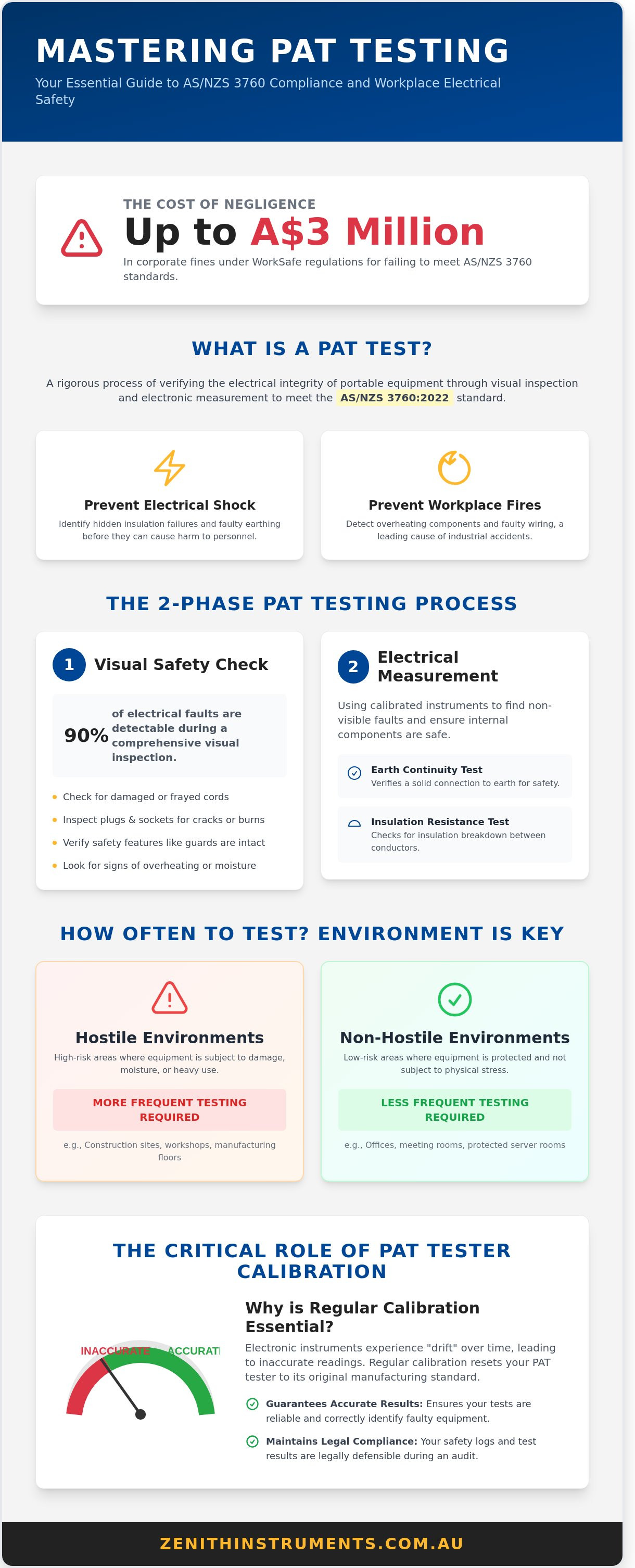
Portable appliance testing (PAT) is the rigorous process of verifying the electrical integrity of portable equipment through visual and electronic assessment. In the Australian industrial sector, we rely on this procedure to identify faults that aren't visible to the naked eye. A recurring pat testing test is essential for any business operating plug-in equipment, particularly in high-traffic commercial hubs like Sydney and Melbourne. Our primary objective is the total prevention of electrical shock and workplace fires. Data from fire and rescue services indicate that faulty electrical equipment remains a leading cause of preventable industrial accidents in 2024. Adhering to the AS/NZS 3760:2022 standard ensures your facility operates within the legal framework established for Australian workplaces.
The 2022 update to the Australian standards emphasizes a proactive approach to safety. We don't just look for frayed wires; we use calibrated instruments to measure earth continuity and insulation resistance. This precision is vital for maintaining a safe environment in dense urban centres where electrical loads are high. Regular testing identifies degradation before it leads to equipment failure or operator injury. By implementing a consistent testing schedule, we help businesses maintain operational continuity and protect their most valuable assets: their employees.
The Legal Landscape in Sydney and Melbourne
SafeWork NSW applies stringent regulations to Sydney’s construction and manufacturing sectors, where harsh environments accelerate equipment wear. In Melbourne, WorkSafe Victoria monitors compliance across office and factory settings to reduce workplace injuries. Failing to meet these standards results in significant financial repercussions. Fines under the Work Health and Safety Act can reach A$600,000 for corporations in extreme cases of negligence. We emphasize the necessity of a safety logbook, which must record test dates, results, and the identity of the person performing the test. This record is your primary defense during a safety audit.
Identifying What Needs Testing
We distinguish between equipment classes to apply the correct testing methodology. Class I appliances include earthed equipment like commercial refrigerators and industrial lathes. Class II appliances, such as double-insulated power tools often found on Brisbane work sites, require different insulation resistance checks. We also prioritize the testing of RCDs and power boards. These components often fail due to mechanical stress or environmental factors. Utilizing a professional pat testing test ensures that every asset, from a simple lead to complex machinery, is certified for safe operation. For precision in your own diagnostic kits, we provide electrical equipment calibration services to maintain the accuracy of your testing instruments.
The Core Components of a Professional PAT Testing Test
A professional pat testing test involves more than just a quick glance at a power cord. It's a systematic diagnostic process designed to verify the integrity of electrical insulation and the effectiveness of earthing systems. In industrial hubs like Sydney and Melbourne, where high-output machinery and office equipment run 24/7, these tests provide the technical assurance that your workplace remains compliant. Adhering to Compliance Standards: AS/NZS 3760 ensures that your business meets the rigorous safety benchmarks required under Australian law.
The process is divided into two primary phases: physical verification and electrical measurement. While the technical data provides the final verdict, the initial human assessment is where the majority of hazards are identified. We prioritize a meticulous approach to ensure the pat testing test results are legally defensible and technically accurate.
Step 1: The Visual Safety Check
Data from safety audits indicates that approximately 90% of electrical faults are detectable during a comprehensive visual inspection. This phase identifies external damage that electrical meters might miss. Our technicians focus on three critical areas:
- The Plug: We examine pins for bending or corrosion. Discolouration on the plug face is a primary indicator of overheating, often caused by loose internal connections or overloaded circuits.
- The Cord: We check the entire length of the cable for fraying, nicks, or "milking," where the internal copper becomes exposed. Any sign of makeshift repairs with electrical tape results in an immediate failure.
- The Casing: The appliance body must be intact. We look for cracks, missing screws, or signs of moisture ingress that could compromise the internal circuitry.
Step 2: Electrical Parameter Testing
Once the visual integrity is confirmed, we move to the quantitative phase. This requires a calibrated PAT tester to measure variables that the human eye cannot see. We test the earth continuity to ensure the protective earth path has a resistance low enough to trigger a circuit breaker during a fault. This resistance typically shouldn't exceed 1.0 ohm for most Australian appliances.
We then perform an insulation resistance test. This involves applying a high voltage, usually 500V DC, to ensure current doesn't leak from live parts to the user. The logic behind these readings mirrors the precision found in multimeter calibration principles, where accuracy is non-negotiable for safety. Finally, a polarity check verifies that the active and neutral wires are correctly connected. Incorrect polarity is a silent killer; it leaves the appliance "live" even when the switch is in the off position.
Maintaining these standards requires tools that are themselves verified for accuracy. You can ensure your diagnostic equipment stays precise through our electrical equipment calibration services, providing the reliability your safety team demands.
Compliance Standards: AS/NZS 3760 in Newcastle, Canberra, and Brisbane
Compliance with AS/NZS 3760:2022 represents the minimum legal requirement for workplace safety across Newcastle, Canberra, and Brisbane. Every pat testing test we conduct adheres strictly to these benchmarks to eliminate electrical hazards before they cause injury. This standard aligns with the Safe Work Australia electrical safety guidelines, ensuring that businesses meet their Duty of Care under the Work Health and Safety (WHS) Act. We've seen that failing to maintain these records leaves a company vulnerable during a safety audit, often resulting in significant fines or liability issues.
Understanding Pass/Fail Criteria
The Australian standard sets rigid thresholds for electrical integrity that every device must meet. For Class I (earthed) appliances, the maximum allowable resistance for earth continuity is 1.0 Ω. If your equipment exceeds this value, it poses a direct shock risk to the operator. Insulation resistance must measure at least 1.0 MΩ for Class I and Class II appliances to pass the pat testing test. When an appliance fails, we immediately implement Lock-out/Tag-out (LOTO) procedures. This involves physically isolating the device and applying a "DANGER: DO NOT OPERATE" tag. It's a critical step that prevents accidental use until the unit is professionally repaired or decommissioned.
Tagging and Documentation Requirements
Every successful inspection culminates in the application of a durable, high-visibility tag. This tag must display the test date, the next scheduled re-test date, and the identity of the technician. We use the Australian standard colour-coding system to provide visual clarity on busy sites. For instance, red tags signify a December to February test window in construction environments, while blue is used for the June to August period. To maintain the integrity of these results, we provide electrical equipment calibration services to ensure your testing gear produces accurate data. This ensures your tags aren't just stickers; they're legally defensible safety certifications.
Regulatory requirements vary significantly by sector and geography. In the Queensland mining sector, equipment must often meet the more stringent requirements of the Coal Mining Safety and Health Act 1999, which demands 3-month or 6-month testing intervals for portable gear. Contrast this with government offices in Canberra, where low-risk environments might only require testing every 5 years for certain equipment. We help clients navigate these differences by maintaining digital logs that track every asset across multiple locations. These logs serve as a primary defense during a SafeWork NSW or Workplace Health and Safety Queensland inspection. Digital record-keeping is more efficient than paper logs because it allows for instant retrieval of test history during an unannounced audit.
How Often Should You Conduct a PAT Testing Test?
Determining the frequency of a pat testing test depends on the specific environment where your equipment operates. AS/NZS 3760:2022 classifies work areas into hostile and non-hostile categories. A hostile environment involves conditions like moisture, heat, dust, or vibration that accelerate equipment degradation. For instance, a Sydney construction site demands a rigorous 3-month testing cycle due to heavy usage and exposure to the elements. Conversely, a corporate office in Melbourne presents lower physical risks, allowing for extended intervals of up to five years for certain fixed appliances.
We see many businesses confuse compliance with a "one size fits all" approach. This mistake leads to either safety gaps or unnecessary costs. The goal is to match the testing frequency to the actual risk level of the equipment's location. Failure to adhere to these intervals can result in non-compliance with Work Health and Safety (WHS) regulations, potentially leading to fines exceeding A$30,000 for corporate entities in some Australian jurisdictions.
Industry-Specific Intervals
The Australian standards provide a clear framework for different sectors. These intervals ensure that high-risk tools receive more frequent attention than stationary office equipment. Our technicians follow these established cycles to maintain site safety:
- Construction and Demolition: Tools, leads, and power boards must be tested every 3 months. This is a strict requirement under AS/NZS 3012.
- Factories and Workshops: Equipment in these production environments typically requires a 6-month or 12-month pat testing test cycle depending on the level of "hostility."
- Offices and Schools: These are generally non-hostile environments. While some equipment needs annual checks, items that aren't subject to flex, such as a desktop computer, may only require testing every 5 years.
- Commercial Kitchens: Due to high moisture and heat, a 6-month interval is the standard for most portable appliances.
The Role of the 'Competent Person'
A "Competent Person" must perform these safety checks. Under Australian standards, competency is defined by a combination of technical knowledge and practical experience. This individual must understand how to operate testing equipment and interpret the data accurately to ensure a "pass" or "fail" result is valid. While the law doesn't mandate that a tester be a licensed electrician for basic PAT procedures, they must have completed a certified training course to meet legal requirements.
Precision is vital during these checks. Using a clamp meter for auxiliary checks or leakage current testing requires a higher level of expertise. Our team ensures that every tester is fully trained to handle sophisticated diagnostic tools, providing a level of accuracy that basic "pass/fail" testers cannot match. This technical rigor is what differentiates a standard check from a professional safety audit.
Ensure your facility meets the latest AS/NZS 3760:2022 standards with our expert team. Book your professional electrical safety audit today.
The Critical Need for PAT Tester Calibration
An uncalibrated PAT tester renders your entire electrical safety program legally vulnerable. If an incident occurs and your records show the pat testing test was conducted with an instrument lacking a current certificate, your business faces significant liability risks. Precision is the foundation of electrical safety. Without regular verification, you cannot prove that your equipment is providing the protection required by Australian standards.
Electronic components are sensitive to environmental factors. In Sydney, where relative humidity often exceeds 65%, internal circuitry can experience significant drift over a 12-month period. This drift compromises the accuracy of earth bond and insulation resistance readings. Even a minor deviation can lead to a "pass" result for a dangerous appliance, creating a hidden hazard in your workplace. Zenith Instruments provides the technical oversight needed to eliminate these uncertainties through rigorous, NATA-traceable calibration protocols.
Why Calibration is Non-Negotiable
Calibration is the comparison of an instrument's readings against a known standard to ensure accuracy. In industrial and medical sectors, precision is a regulatory mandate rather than a suggestion. Measurements must be accurate to the milliohm to detect deteriorating insulation or poor earthing before they cause equipment failure or injury. Our technicians ensure your equipment meets ISO 9001 and NATA requirements, providing the documented evidence necessary for high-stakes audits. We verify that every pat testing test your team performs in 2026 is backed by a certified, reliable instrument.
Zenith's Expert Calibration Services
We understand that equipment downtime disrupts your operations. To address this, we offer fast turnaround times and on-site calibration services in Sydney and Melbourne. Our state-of-the-art laboratories are equipped to handle the complex circuitry of all major brands, including Seaward, Metrel, and Wavecom testers. We don't just provide a sticker; we provide a comprehensive performance analysis of your hardware.
Our proactive service model is designed for the fast-paced Australian market. By choosing Zenith, you partner with a dependable expert that prioritizes technical excellence and regulatory compliance. Don't let your safety certification lapse. Book your annual appliance tester calibration today to ensure your business remains compliant and your workforce stays protected throughout 2026.
Securing Your Workplace Compliance Through 2026
Maintaining strict adherence to AS/NZS 3760 is a non-negotiable requirement for Australian businesses. Every pat testing test conducted in your facility relies entirely on the accuracy of your hardware. If your tester hasn't been verified by a NATA Accredited Laboratory within the last 12 months, your safety data could be compromised. We deliver ISO 9001 compliant processes that ensure your equipment remains precise and legally defensible. Our technicians provide on-site calibration in Sydney and Melbourne, which reduces your operational downtime to just a few hours. We prioritize technical excellence so you can focus on your core operations without the threat of regulatory penalties. By scheduling your 12 month calibration cycle today, you eliminate the risks associated with equipment drift and documentation gaps. It's vital to remember that a certified tester is your first line of defense against electrical hazards. We're ready to help you uphold the highest safety standards in the industry.
Ensure your PAT tester is accurate. Book your NATA-traceable calibration with Zenith today
Frequently Asked Questions
Is PAT testing a legal requirement for all Australian businesses?
Australian law requires businesses to maintain safe electrical equipment under the WHS Act 2011. While the Act doesn't explicitly name the process, it mandates compliance with AS/NZS 3760:2022 for risk management. In high-risk environments like construction or demolition, testing every 3 months is a strict regulatory requirement. Failure to comply can result in fines exceeding A$30,000 for individuals and A$3 million for corporations.
Can I perform my own PAT testing test if I buy a tester?
You can perform a pat testing test only if you're deemed a competent person under AS/NZS 3760:2022 standards. This status requires the necessary knowledge, skills, and experience, typically gained through a certified one-day training course. We recommend professional calibration for your equipment every 12 months to ensure your readings remain accurate. Without verified competency, your internal safety records won't hold up during a SafeWork NSW or WorkSafe Victoria audit.
What is the difference between a visual inspection and a full PAT test?
A visual inspection identifies external damage like frayed cords or cracked casings, while a full test uses specialized instruments to detect internal electrical faults. Statistics show that 90% of defects are found during the visual phase. However, the full test measures critical metrics like earth continuity and insulation resistance. You need both components to achieve full compliance and ensure the safety of your Sydney or Melbourne workforce.
How often does my PAT tester instrument need to be calibrated?
Your PAT tester requires professional calibration every 12 months to maintain its accuracy and validity. Zenith Instruments provides NATA accredited calibration services across Australia to ensure your device meets ISO 9001 standards. Using an uncalibrated instrument voids your safety certifications and risks the lives of your employees. We offer a 3 to 5 day turnaround to minimize your operational downtime.
What happens if an appliance fails its PAT testing test?
Any appliance that fails a pat testing test must be immediately withdrawn from service and labeled with a "DANGER - DO NOT OPERATE" tag. You must either repair the item by a licensed electrician or dispose of it permanently. Records of the failure must be kept in your safety logbook for at least 7 years. This proactive approach prevents electrical shocks and potential workplace fires in industrial settings.
Do new electrical appliances need to be tested and tagged immediately?
New electrical appliances don't require testing before their first use, but they must be visually inspected and fitted with a New to Service tag. This tag identifies the date the item entered the workplace and when its first scheduled test is due. Once the initial period expires, usually 12 to 60 months depending on the environment, the item enters the regular testing cycle defined by AS/NZS 3760:2022.
What are the common causes of a PAT test failure in industrial settings?
Physical damage to cables and moisture ingress account for 75% of failures in industrial environments like Melbourne factories. High-vibration machinery often causes internal wires to loosen, leading to earth continuity failures. Dust accumulation in heavy-duty power tools also triggers insulation resistance errors. Regular onsite inspections help identify these issues before they cause a total system shutdown or an electrical accident.
How do I choose the right PAT tester for my Sydney-based business?
Select a tester that fully complies with AS/NZS 3760:2022 and offers battery portability for large Sydney warehouse inspections. If you manage over 500 assets, choose a model with internal memory and data logging capabilities to streamline your record-keeping. We suggest instruments with RCD testing functions to provide a comprehensive safety solution. Zenith Instruments stocks various models and provides the technical support needed for your specific industry requirements.