

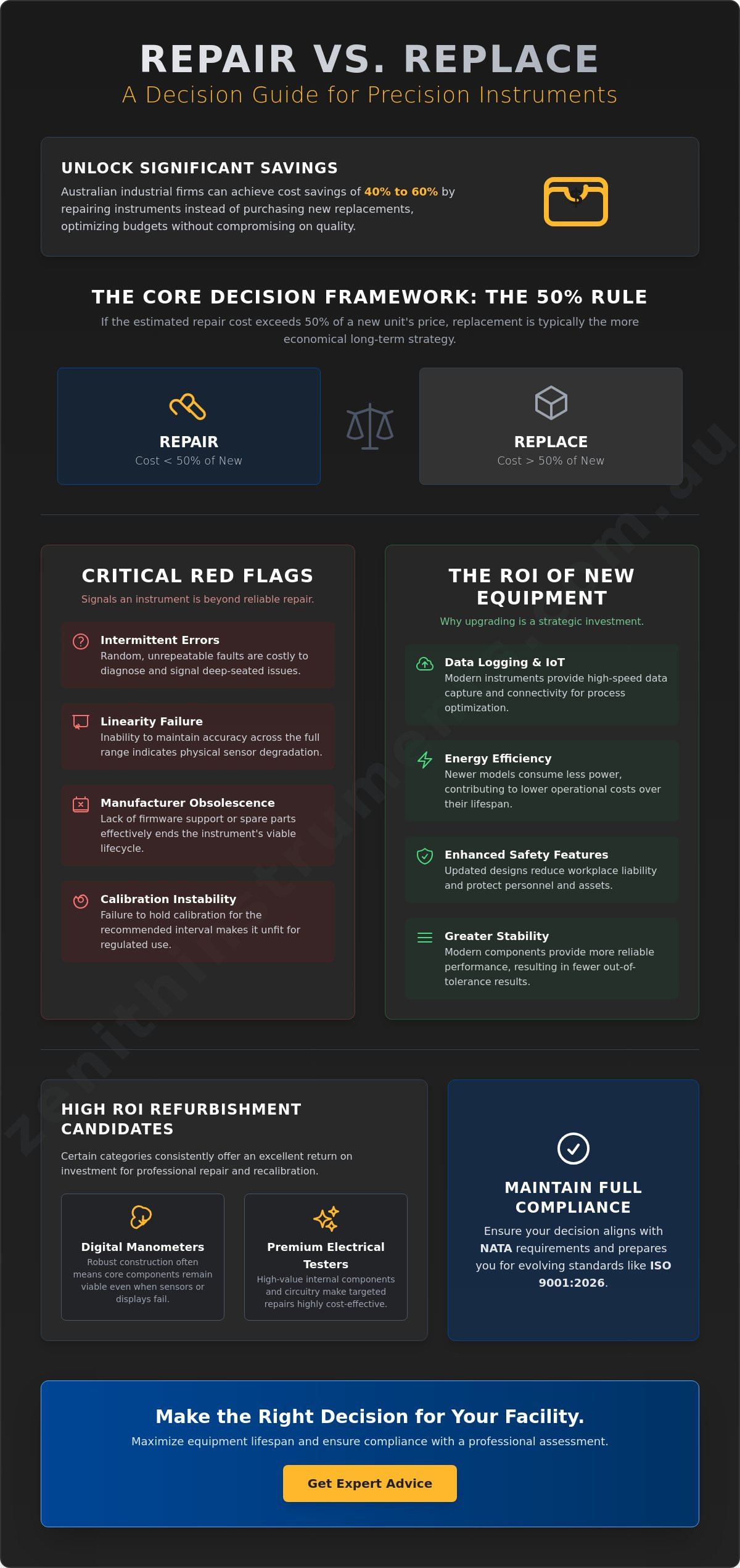
Did you know that Australian industrial firms can achieve cost savings between 40% and 60% by repairing precision instruments instead of purchasing brand-new replacements? When a critical pressure gauge or insulation tester fails, the immediate pressure of unplanned downtime often leads to rushed procurement decisions that strain your capital expenditure. We recognise the challenge of balancing strict maintenance budgets against the non-negotiable requirement for NATA-certified accuracy. This repair vs replace test equipment guide provides the technical clarity you need to avoid overspending while protecting your operational integrity.
You're likely already preparing for the ISO 9001:2026 revision and its heightened focus on data integrity and quality culture. We've developed this framework to ensure your decision-making process aligns with these evolving standards and the "50% Rule" used by technical experts across the country. We'll break down the financial formulas and technical benchmarks that determine whether to refurbish your current hardware or invest in new, software-defined instruments. This guide ensures your chosen path maintains total compliance and keeps your testing schedules running without disruption.
Key Takeaways
- Apply the 50% Rule to determine if refurbishment is financially viable or if investing in new hardware is the superior long-term strategy for your facility.
- Identify critical technical red flags, such as sensor degradation and intermittent errors, that signal an instrument is beyond reliable repair.
- Use this repair vs replace test equipment guide to navigate NATA uncertainty requirements and avoid the "certification trap" during regulatory audits.
- Learn which instrument categories, such as digital manometers and premium electrical testers, offer the highest return on investment for professional refurbishment.
- Minimise production downtime by leveraging on-site assessments and rapid response services in major regional hubs like Sydney and Melbourne.
The Economics of Metrology: The 50% Rule and Beyond
Deciding whether to invest in refurbishment or new hardware requires a disciplined look at the numbers. The "50% Rule" remains the industry benchmark; if the estimated cost of a repair exceeds 50% of the price of a brand-new unit, replacement is usually the more economical path. This threshold isn't arbitrary. It accounts for the reality that older components are more likely to fail again, potentially leading to cascading downtime. The science of metrology relies on predictable performance, and this repair vs replace test equipment guide helps you quantify that predictability.
Australian businesses often face maintenance costs between 3.5% and 4.5% of their total replacement asset value. To stay within these benchmarks, you must look past the initial repair quote. Hidden costs such as courier fees, the expense of hiring temporary equipment, and the mandatory recalibration after a major service can quickly inflate the total. There's also an opportunity cost to consider. Older instruments lack the high-speed data logging and IoT connectivity found in 2026-model hardware, which can significantly slow down your production or testing schedules.
Calculating the Real Cost of Repair
When you assess hourly technical repair and maintenance rates, compare them against the current market price for a replacement. Major repairs aren't complete without a new NATA-endorsed certificate to verify the instrument's accuracy. You should also consider lead times. If parts for an obsolete model take weeks to arrive from overseas, the cost of a new, locally stocked unit becomes much more attractive. A meticulous Total Cost of Ownership (TCO) analysis over a five-year period often reveals that the cheaper short-term fix is the more expensive long-term burden.
When Replacement Offers Better ROI
Modern instruments are designed for the rigorous demands of the 2026 regulatory environment. Newer electrical calibration services often highlight that 2026-model testers offer improved energy efficiency and enhanced safety features that can reduce workplace liability. These modern units provide greater stability, which results in fewer out-of-tolerance results during your annual pressure gauge calibration or thermometer checks. By upgrading, you aren't just buying a tool; you're investing in a higher standard of data integrity and operational speed.
Technical Red Flags: When Your Equipment is Beyond Help
Identifying the point of no return for precision instruments is essential for maintaining operational safety. While some faults are easily rectified, others signal a fundamental breakdown in the unit's ability to provide reliable data. This repair vs replace test equipment guide highlights that technical failures often manifest as subtle shifts in performance before a total breakdown occurs. We've identified four critical red flags that typically indicate an instrument is beyond help.
- Intermittent Errors: Faults that appear randomly and cannot be replicated in a controlled lab environment are notoriously difficult and expensive to diagnose.
- Linearity Failure: Physical degradation of transducers or sensors often affects fundamental linearity; if the instrument can't maintain accuracy across its entire range, it's a liability.
- Manufacturer Obsolescence: When manufacturers cease firmware support or stop supplying critical gaskets and proprietary circuitry, the unit's lifecycle has effectively ended.
- Calibration Instability: If an instrument fails to hold its calibration for the duration of the recommended interval, it's no longer fit for purpose in a NATA-regulated environment.
Data Integrity and Accuracy Drift
Accuracy drift that consistently exceeds the manufacturer’s original specifications is a major warning sign. In high-precision multimeters, erratic readings often signal irreversible internal component failure or PCB contamination that cleaning can't resolve. We've seen how aged, insensitive sensors can produce "false pass" results in manufacturing. This creates a significant risk of non-compliant products reaching the market. If your data integrity is in question, the cost of a potential recall far outweighs the price of a new unit.
Safety and Physical Integrity
Physical condition is just as important as electronic accuracy. We frequently inspect units for hairline fractures in high-pressure gauge casings during our pressure gauge calibration procedures; these fractures pose severe explosion risks under load. Similarly, insulation breakdown in high-voltage testers endangers the operator and violates basic safety protocols. We define an unrepairable safety failure as any fault that violates AS/NZS standards and cannot be rectified through standard component replacement. If you're unsure about your unit's status, our experts can provide a technical assessment to confirm its viability.
NATA Compliance: The Ultimate Australian Decision Driver
In the Australian regulatory environment, the decision to refurbish or retire an instrument isn't merely a financial one; it's a matter of legal and operational compliance. For professionals in the mining, medical, and environmental sectors, NATA accreditation serves as the primary trust signal. This repair vs replace test equipment guide emphasizes that as of May 1, 2026, NATA reporting standards for specific categories like air sampling have become even more stringent. If your repaired instrument cannot meet the updated uncertainty requirements for a NATA-endorsed Certificate of Analysis (COA), the unit effectively becomes a liability rather than an asset.
We often see clients fall into the "Certification Trap." This occurs when a technical repair is successful, but the aged internal components have drifted so far that they no longer meet the tight uncertainty budgets required by ISO 17025 standards. In these instances, the instrument might still function, but it cannot be certified for use in high-stakes environments. The upcoming ISO 9001:2026 revision introduces more rigorous requirements for data integrity and quality culture. This shift places a greater emphasis on the detailed interpretation of calibration results, making it harder to justify the use of legacy hardware that barely skims the edge of compliance. Zenith Sales & Calibrations Pty Ltd provides a structured path forward, offering both expert refurbishment and new, NATA-certified hardware to ensure your facility remains audit-ready.
Traceability and Audit Risks
Using repaired equipment that contains non-traceable components is a significant risk during an audit. Australian standards frequently require specific "Type Test" data that older or inconsistently patched equipment simply lacks. A new, certified instrument simplifies the audit trail by providing a clean slate of documentation from day one. When we perform electrical calibration services, we prioritise the traceability of every component to ensure your records withstand the most meticulous scrutiny.
NATA vs. Traceable Calibration
It's vital to decide whether your specific application requires a full NATA-endorsed certificate or a standard traceable calibration. While traceable calibration indicates that reference equipment is accurate, it doesn't offer the same level of procedural guarantee as a NATA-endorsed result. Certain pressure gauge calibration tasks must be followed by NATA verification to remain legal for trade in Australia. For a deeper look at these requirements, read our instrument calibrations in Australia guide. Choosing the right certification level is a key factor in determining if a repair is worth the investment.
Category Guide: Repair vs. Replace for Specific Instruments
The decision to refurbish or retire an instrument isn't uniform across all measurement categories. While the 50% Rule discussed earlier provides a financial baseline, the specific hardware architecture of each instrument type plays a significant role in its long-term viability. This repair vs replace test equipment guide breaks down the most common instrument categories to help you allocate your 2026 maintenance budget effectively and maintain operational precision.
High-end electrical testers from reputable brands are engineered for serviceability. These units often justify the cost of internal component replacement because their chassis and primary circuitry are built to last decades. Conversely, "no-name" budget units are essentially disposable; the technical labor required for a professional assessment often exceeds the purchase price of a new unit. For gas monitors, the decision usually hinges on the sensor lifecycle. If the main circuit board fails, the unit is typically beyond economical repair. However, if only the sensors are depleted, replacing those specific components is a standard and cost-effective maintenance task.
Pressure and Temperature Instruments
When you evaluate thermometer calibration costs, consider the physical state of your digital probes. If you notice "dead band" issues where the reading fails to respond to small temperature fluctuations, the sensor has likely reached its end-of-life. Standard mechanical pressure gauges are often cheaper to replace than to overhaul, particularly in high-vibration process environments. However, high-accuracy digital manometers represent a larger capital investment. These units are almost always worth repairing, especially when the alternative is upgrading to a 2026-standard digital model that offers superior data logging and NATA-compliant reporting.
Electrical and Torque Tools
Mechanical torque wrenches require a proactive maintenance approach. Frequent torque wrench calibration and spring replacement are standard practices to maintain tension accuracy and prevent workplace safety incidents. If the internal ratcheting mechanism is worn beyond adjustment, the safety risk necessitates a new purchase. For electronic tools, pay close attention to the physical interface. As detailed in our multimeter guide 2026, screen fade or significant input port wear usually signals that the unit's internal reliability is compromised. Managing fleets of portable appliance testers (PAT) for Sydney-based industrial sites requires a structured rotation; we recommend replacing units that show consistent accuracy drift to avoid non-compliance during audits. If your fleet is aging, you can request a professional assessment to determine which units are still viable for field use.
Zenith’s Hybrid Approach: Maximising Your Equipment Lifespan
We provide a structured hybrid model that bridges the gap between laboratory precision and operational efficiency. By integrating mobile service capabilities in Sydney and Melbourne, Zenith Sales & Calibrations Pty Ltd directly addresses the downtime cost that often makes repairs seem unviable. This repair vs replace test equipment guide advocates for a proactive maintenance strategy where every decision is backed by technical data and a clear understanding of your facility's logistical needs. We don't just fix tools; we partner with you to manage the entire lifecycle of your measurement assets.
Our "Pre-Repair Assessment" ensures you don't waste budget on instruments that are technically unviable. Before you commit to significant expenditure, Zenith Sales & Calibrations Pty Ltd evaluates the unit's ability to hold calibration and meet modern NATA uncertainty requirements. This meticulous approach mirrors the exactness of the services we provide across all industrial sectors. If a unit is nearing the end of its useful life, we help you implement strategic fleet management. This involves rotating older, still-accurate units to less critical testing tasks while investing in new, high-performance hardware for your primary production lines. We remain committed to NATA standards and ISO compliance, ensuring that whether you choose to refurbish or replace, your audit trail remains unbroken and your facility stays audit-ready.
Leveraging On-Site Calibration
Engaging on-site service calls allows our technicians to identify minor faults before they escalate into replacement-level failures. Zenith Sales & Calibrations Pty Ltd offers the convenience of evaluating your entire Sydney or Melbourne workshop in a single visit, which significantly reduces the logistical burden of shipping sensitive instruments. By bundling repair assessments with your annual calibration schedule, we help you reduce mobilisation fees and keep your testing schedules on track. This localized service touch ensures that regional industries receive the same level of meticulous expertise as those in major metropolitan hubs.
Seamless Transition to New Hardware
When our technical assessment determines that a repair is impossible or economically unsound, Zenith Sales & Calibrations Pty Ltd facilitates a direct transition to new hardware. We provide access to leading global brands, ensuring you receive the latest 2026-standard technology with enhanced data logging and safety features. Your new purchase is delivered pre-calibrated and ready for immediate NATA-compliant use, eliminating any gap in your compliance records or production schedules. This streamlined process removes the friction of procurement and ensures your team always has access to reliable, high-performance tools. Contact Zenith Sales & Calibrations Pty Ltd for a professional repair vs replace assessment today.
Securing Your Operational Precision for 2026
The decision to refurbish or retire your precision instruments shouldn't be based on guesswork. As this repair vs replace test equipment guide has detailed, success requires a careful balance of the 50% Rule, technical red flags, and the non-negotiable demands of NATA compliance. We've seen how the upcoming ISO 9001:2026 revision and updated air sampling standards make data integrity more critical than ever. Whether you're managing a fleet of electrical testers or high-precision pressure gauges, your choice must prioritise safety and regulatory alignment.
Zenith Sales & Calibrations Pty Ltd offers a disciplined path forward through our NATA-certified laboratories in Sydney and Melbourne. We leverage over 20 years of Australian industrial expertise to provide the technical clarity needed to avoid unnecessary capital expenditure. As authorised distributors for Major Tech and PT Global, we ensure that if replacement is required, you receive hardware that is ready for immediate, compliant use. Don't let aging equipment compromise your production schedules or audit results.
Get an Expert Assessment on Your Test Equipment Today and ensure your facility remains at the forefront of technical excellence.
Frequently Asked Questions
Is it worth repairing a 10-year-old multimeter if it still turns on?
Generally, a 10-year-old multimeter is nearing the end of its reliable service life. Even if it powers on, internal component aging often leads to accuracy drift that exceeds manufacturer specifications. This repair vs replace test equipment guide suggests that for instruments this old, the cost of a professional overhaul and recalibration often exceeds the price of a more efficient 2026 model with enhanced safety features and data logging capabilities.
How does NATA accreditation affect the cost of repairing test equipment?
NATA accreditation ensures technical competence, which necessitates more rigorous testing procedures and higher-tier reference standards. While this increases the initial cost of the repair and subsequent verification, it provides the legal and technical assurance required for high-risk sectors. A NATA-endorsed certificate is often mandatory in Australian mining and medical industries, where non-traceable repairs could lead to significant audit failures or safety risks.
What is the average turnaround time for a technical repair in Sydney or Melbourne?
Our standard turnaround time for technical repairs at our Sydney and Melbourne laboratories typically ranges from three to five business days. This timeframe depends on part availability and the complexity of the instrument's fault. We offer rapid-response on-site calibration and assessment services to minimise production downtime, allowing technicians to evaluate equipment directly at your facility rather than requiring lengthy shipping cycles.
Can Zenith provide a loaner instrument while mine is being repaired?
We understand that equipment downtime can stall critical projects. While we prioritise rapid repair cycles to return your hardware quickly, we can discuss equipment hire options or temporary solutions through our network of authorised distributors. Managing your fleet effectively often involves keeping backup units for primary lines, a strategy we help our clients implement to ensure continuous operational compliance and minimal disruption.
Does a new instrument always come with a NATA calibration certificate?
Not automatically. Most new instruments are supplied with a manufacturer's factory calibration certificate, which may not meet Australian NATA requirements. For regulated industries, we recommend having your new purchase verified by our NATA-certified laboratories before it enters service. This ensures the unit meets specific local uncertainty budgets and is delivered ready for immediate use in high-stakes environments like medical or environmental testing.
What happens if my equipment fails calibration after a repair has been paid for?
Our "Pre-Repair Assessment" is designed specifically to prevent this scenario by identifying unviable instruments before you commit to significant costs. If an instrument fails calibration after a justified repair, we provide a detailed technical report explaining the drift. In these cases, we typically work with you to find a suitable replacement, ensuring your investment is transitioned toward a reliable, compliant measurement solution that meets current standards.
Are there specific Australian industries where repairing old equipment is prohibited?
While Australian law doesn't strictly prohibit repairing old equipment, specific industry standards make it practically impossible to use legacy hardware in certain sectors. For instance, the 2026 NATA reporting changes for air sampling effectively retire older volume-based concentration tools that cannot meet new accreditation rules. Similarly, equipment that fails to meet mandatory AS/NZS safety standards must be decommissioned rather than patched to ensure operator safety.
How do I document the decision to replace equipment for ISO 9001 compliance?
To maintain ISO 9001:2026 compliance, you should document the technical rationale behind the decision to replace rather than repair. This includes recording the instrument's accuracy drift, the estimated repair cost against the replacement value, and a risk assessment regarding data integrity. Keeping these records ensures a clear audit trail and demonstrates a proactive commitment to maintaining a high-quality culture within your facility's technical operations.