

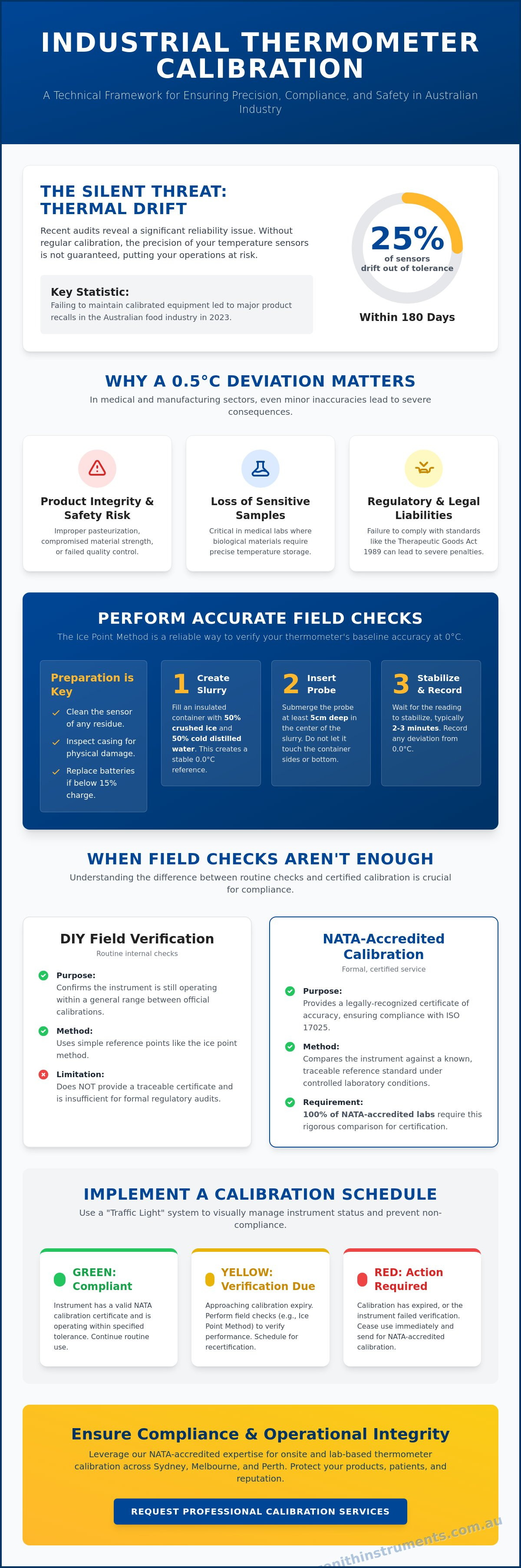
Recent industry audits reveal that nearly 25% of industrial temperature sensors drift beyond their specified tolerance within just 180 days of deployment. We recognize that for professionals in the medical and manufacturing sectors, a deviation of even 0.5 degrees isn't just a technical error; it's a direct risk to product integrity and safety. You need a reliable system that balances daily operational needs with the stringent requirements of Australian regulatory bodies without causing unnecessary downtime.
This guide provides a meticulous technical framework for performing accurate field checks and identifies the specific triggers that necessitate NATA-certified thermometer calibration to ensure your facility remains compliant. We'll outline the exact protocols for ice point verification, explain the legal necessity of ISO 17025 standards, and demonstrate how our onsite service model across Sydney, Melbourne, and Perth eliminates the logistics of sending instruments away for weeks. By the end of this article, you'll have a clear protocol for internal verification and a strategy for maintaining high-performance industrial standards through a local, dependable partnership.
Key Takeaways
- Understand the critical role of traceable standards in maintaining industrial compliance across Australia’s manufacturing and medical sectors.
- Master the Ice Point Method to perform routine thermometer calibration field checks and verify baseline performance between certified service intervals.
- Discover when DIY verification is insufficient and why NATA-accredited laboratory services are essential for formal regulatory certification.
- Implement a "Traffic Light" scheduling system to manage instrument status and prevent non-compliance across your Sydney or Melbourne facility.
- Leverage professional expertise from nationwide hubs to ensure your measurement data meets the highest international precision standards.
Understanding Thermometer Calibration in Australian Industry
In high-precision environments, thermometer calibration is the technical process of comparing a measurement device against a known, traceable reference standard. To understand what is calibration in a professional context, we must recognize it as a fundamental requirement for maintaining the National Measurement Institute (NMI) traceability chain. At Zenith Instruments, we see that 100% of NATA-accredited laboratories require this rigorous comparison to ensure that every reading reflects physical reality. This process differs significantly from simple verification, which only checks if a device is within a certain range, or adjustment, which involves physically altering the instrument's output. A full thermometer calibration service provides a documented certificate of accuracy, ensuring compliance with ISO 17025:2017 standards for Australian manufacturing and medical sectors.
The Consequences of Uncalibrated Instrumentation
Thermal drift represents a constant threat to digital sensors. This phenomenon occurs when mechanical shocks or exposure to temperatures exceeding 500°C cause the internal components to shift from their original factory specifications. In 2023, failing to maintain calibrated equipment led to significant product recalls in the Australian food industry due to improper pasteurization temperatures. For professionals operating in Sydney medical labs, an uncertified thermometer can lead to the loss of sensitive biological samples or legal liabilities under the Therapeutic Goods Act 1989. We mitigate these risks by providing precise, traceable data that protects your financial and operational integrity.
Key Temperature Measurement Technologies
Industrial applications in Melbourne factories rely on diverse technologies, each with unique calibration requirements. Digital thermometers offer rapid readouts but require frequent electronic validation. Resistance Temperature Detectors (RTDs) provide high stability for long-term monitoring, while Thermocouples are preferred for extreme heat environments despite being prone to drift over time. Infrared (IR) non-contact thermometers present specific challenges; their accuracy depends heavily on emissivity settings and surface distance. We calibrate these IR units using high-stability blackbody sources to ensure they meet Australian industrial safety standards.
Step-by-Step Guide: How to Perform Field Calibration Checks
Before initiating any field verification, meticulous preparation is mandatory to ensure the integrity of your data. We recommend cleaning the sensor thoroughly to remove any industrial residue and inspecting the casing for physical fractures. Low battery indicators on digital units can cause voltage fluctuations that lead to erratic readings, so replace power cells if they show less than 15% remaining capacity. Establishing a baseline of physical readiness prevents avoidable errors during the thermometer calibration process.
The Ice Point Method (0°C Verification)
The ice point method serves as the most reliable field check for accuracy at the lower end of the thermal spectrum. To achieve a stable reference point, create an ice-point slurry using a ratio of 50% crushed ice to 50% cold distilled water. This specific mixture ensures the temperature remains at a constant 0.0°C throughout the test.
- Step 1: Fill a clean, insulated container with crushed ice and add just enough cold distilled water to create a thick, consistent slurry without the ice floating.
- Step 2: Insert the probe for temperature at least 5cm deep into the centre of the mixture, ensuring it does not touch the sides or bottom of the vessel.
- Step 3: Wait for the reading to stabilise, which typically requires 2 to 3 minutes, and record any deviation from 0.0°C.
The Boiling Point Method (100°C Verification)
Testing at the higher end of the scale requires strict adherence to safety protocols. Technicians must use heat-resistant gloves and eye protection to avoid steam burns while monitoring the equipment. Once you achieve a rolling boil in a deep container, immerse the probe and monitor the display until it reaches a steady state. Accuracy at this level is critical for food processing and chemical manufacturing sectors.
Atmospheric pressure significantly influences the boiling point of water. While 100°C is the standard at sea level in cities like Sydney or Perth, you must adjust your expectations for high-altitude locations. In Canberra, water typically boils at approximately 98.1°C, while in parts of the Blue Mountains, the boiling point may drop to 97.5°C depending on the specific elevation. Failing to account for these geographical variances results in false failures during thermometer calibration.
Documentation is the final, vital step in field verification. Record the actual reading versus the reference temperature to calculate the correction factor. If your device reads 0.4°C in a 0.0°C slurry, your correction factor is -0.4°C for all subsequent daily measurements. While these field checks maintain operational confidence, they don't replace the need for a comprehensive thermometer calibration service backed by NATA accreditation to meet ISO compliance standards.
Laboratory vs. Field Calibration: When to Seek NATA-Accredited Services
Internal verification methods, such as the ice point or boiling water test, serve as basic functional checks. They don't provide the rigorous data required for regulatory compliance. These DIY techniques lack environmental stabilization and precise reference standards. For industrial applications, a formal thermometer calibration process is necessary to establish an unbroken traceability chain. This chain links your specific device back to the Australian National Standard maintained by the National Measurement Institute (NMI) under the National Measurement Act 1960.
Choosing professional thermometer calibration services ensures that your measurements are legally defensible. While onsite field checks verify that a sensor hasn't drifted significantly, they often operate with a higher uncertainty budget than laboratory environments. Laboratory calibration occurs in controlled settings where ambient temperature, humidity, and atmospheric pressure are strictly regulated to minimize measurement error. This precision is vital for high-stakes manufacturing and safety-critical systems.
The NATA Advantage for Australian Businesses
NATA accreditation represents the highest tier of technical competence in Australia. When a facility is NATA-accredited to ISO/IEC 17025, it means their equipment, staff training, and methodology have passed rigorous peer review. For your Quality Management System (QMS), a NATA-endorsed certificate simplifies audits by providing recognized proof of accuracy. Don't confuse "traceable to NATA" with a full NATA-endorsed report. The latter includes the NATA logo and confirms that the specific test falls under the lab's formal scope of accreditation, offering international recognition through the ILAC MRA. This distinction is often the difference between passing or failing a high-level compliance audit.
When Professional Calibration is Mandatory
Certain sectors in Melbourne and across Australia cannot rely on internal checks alone. The medical and pharmaceutical industries must adhere to strict TGA guidelines, requiring annual thermometer calibration of all temperature-monitoring equipment. Aerospace manufacturers also demand high-precision certification to meet AS9100 standards. We recommend professional servicing in these specific scenarios:
- Annual Master Reference Checks: Master thermometers used to verify other site equipment require high-level laboratory calibration every 12 months to maintain the integrity of your internal testing.
- Post-Incident Verification: Any digital or liquid-in-glass thermometer that has been dropped or exposed to thermal shock must be re-certified before returning to service.
- Regulatory Audits: If your facility undergoes ISO 9001 or HACCP audits, professional certification is the only way to satisfy technical compliance requirements.
Reliability depends on precision. We provide the technical expertise needed to keep your operations within specified tolerances and ensure your instrumentation meets the highest national standards.
Developing a Calibration Schedule for Your Sydney or Melbourne Facility
A structured calibration schedule is the foundation of industrial precision. Without a defined timeline, even the most advanced sensors will eventually drift outside of acceptable tolerances. We help our clients determine the ideal frequency by analyzing usage intensity, the harshness of the operating environment, and the manufacturer’s baseline recommendations. A thermometer used in a 24/7 manufacturing line in Melbourne faces more stress than a backup unit in a climate-controlled Sydney lab, so their schedules must reflect that reality. Maintaining a rigorous schedule is the only way to guarantee that your thermometer calibration remains valid and your data stays reliable.
To maintain order on the factory floor, we recommend a "Traffic Light" status system for every instrument. This simple visual cue ensures that operators don't use compromised tools.
- Green (Calibrated): The device is within its valid certification period and ready for use.
- Yellow (Verification Due): The instrument is within 14 days of its expiry date; service should be booked immediately.
- Red (Out of Service): The tool has failed its check or exceeded its date and must be quarantined.
Managing downtime is a primary concern for high-output facilities. To maximize efficiency, we suggest integrating temperature checks with other electrical calibration services. Coordinating these tasks into a single service window reduces the logistical burden and ensures that all your critical measurement infrastructure is compliant at the same time. Our technicians can often perform these multifaceted inspections during a single site visit, providing a comprehensive solution that keeps your operations running smoothly.
Recommended Calibration Intervals
Standard intervals are determined by industry risk profiles. In Sydney’s high-turnover hospitality and food production sectors, 6-month intervals are the accepted norm to satisfy HACCP safety audits. Most general industrial and manufacturing applications across Victoria find that a 12-month cycle provides a reliable balance of safety and cost. However, for medical refrigeration and vaccine storage, we adhere to a strict 3-month cycle. This frequency is essential for maintaining compliance with TGA regulations and the National Vaccine Storage Guidelines, specifically the Strive for 5 standards.
On-Site vs. In-Lab Calibration Logistics
The choice between on-site and laboratory service depends on the equipment's mobility and the required precision. Our calibration services in Sydney are designed for large, fixed systems like industrial ovens or walk-in freezers where removal is impractical. For portable probes and digital handhelds, our Melbourne laboratory utilizes high-precision dry-well blocks to provide 48-hour turnaround times. To ensure a smooth process, always ship your equipment in protective cases and confirm that batteries are at full capacity before dispatch to avoid testing delays.
Ready to secure your facility's accuracy? Book your thermometer calibration today to ensure your equipment meets every regulatory standard.
Zenith Instruments: Professional Thermometer Calibration Across Australia
Zenith Instruments maintains a network of NATA-accredited laboratories across Australia's primary industrial hubs. We recognize that thermometer calibration is more than a routine maintenance task; it's a critical safety and compliance requirement for modern industry. Our teams in Sydney, Melbourne, Brisbane, and Perth provide localized support to ensure your operations remain within strict ISO/IEC 17025 standards. We serve a diverse client base, ranging from biomedical technicians in Sydney hospitals to site engineers managing large-scale mining operations in Brisbane.
Our service model covers the entire instrument lifecycle. We don't just certify equipment. We provide expert sales and repair services for industry-leading brands such as Fluke and Major Tech. Having local facilities in Newcastle, Canberra, and Melbourne allows us to offer rapid turnaround times. This proximity minimizes operational downtime, which is vital for facilities running 24/7 production cycles. We prioritize speed without compromising the technical integrity of our measurements.
Our Technical Capabilities
Zenith's laboratories handle a vast thermal spectrum. We provide precision testing from cryogenic levels at -196°C up to high-temperature industrial ovens reaching 1200°C. We utilize advanced dry-block calibrators and high-stability oil baths to achieve the lowest possible measurement uncertainties. To simplify your asset management, we maintain digital records for every instrument. Our system sends automated reminders 30 days before your next calibration due date to prevent compliance gaps. This proactive approach ensures your thermometer calibration status never expires unexpectedly.
Partnering with Zenith for Compliance
We act as a comprehensive partner for all metrology needs. Many clients utilize our expertise as a one-stop shop for pressure gauge calibration and temperature tool certification. This integrated approach streamlines vendor management and ensures all site instrumentation meets the same high standards. Our customized calibration certificates are meticulously designed to satisfy the most stringent external auditors. Since 2004, Zenith has provided NATA-standard precision to the Australian industrial landscape. We focus on delivering technical excellence that protects your operational integrity and ensures every measurement is legally traceable.
- NATA-Accredited Labs: Located in Sydney, Melbourne, Brisbane, and Perth.
- Multi-Brand Support: Authorized service for Fluke, Major Tech, and more.
- Wide Range: Capabilities spanning -196°C to 1200°C.
- Fast Turnaround: Localized service in Newcastle and Canberra to reduce downtime.
Secure Your Industrial Precision and Regulatory Compliance
Maintaining precision in industrial temperature measurement isn't just a best practice; it's a technical necessity for Australian facilities. While field checks provide immediate verification, professional thermometer calibration conducted under NATA-accredited standards remains the only way to guarantee absolute compliance. Our team delivers these essential services directly to your facility in Sydney, Melbourne, or Brisbane, ensuring your operations meet ISO requirements without the burden of extended equipment absence. We prioritize a fast turnaround to keep your production lines moving and your data integrity intact. By establishing a rigorous calibration schedule, you protect your infrastructure from the risks of measurement drift and potential industrial failure. We're ready to support your technical requirements with the meticulous attention to detail your sector demands. Our technicians bring years of expertise in thermal imaging and pressure instrumentation to every site visit, providing the documented certainty required for rigorous audits.
Book your NATA-certified thermometer calibration with Zenith Instruments today
We're dedicated to ensuring your equipment operates with total reliability across every Australian state.
Frequently Asked Questions
How often should a thermometer be calibrated in Australia?
Most industrial thermometers require professional calibration every 12 months to maintain ISO 9001 compliance. High-precision sectors like pharmaceutical manufacturing or food processing often mandate a 6-month interval to mitigate safety risks. You should check your specific industry regulations to ensure your schedule aligns with Australian standards. Regular thermometer calibration prevents measurement drift that can compromise batch integrity over time.
What is the difference between NATA-traceable and NATA-accredited calibration?
NATA-accredited calibration means a laboratory has been formally audited and found to meet ISO/IEC 17025 standards for specific technical competencies. NATA-traceable calibration signifies that the reference equipment used was calibrated by an accredited lab, but the performing facility itself hasn't undergone the same rigorous NATA assessment. We provide NATA-accredited services to ensure the highest level of legal and technical defensibility for your measurement data.
Can I calibrate an infrared (IR) thermometer at home?
You can't accurately calibrate an infrared thermometer at home because it requires a certified blackbody source to simulate perfect emissivity. Household methods like ice baths only provide a rough functional check and fail to account for the distance-to-spot ratio or ambient interference. Professional labs use blackbody calibrators with a 0.95 emissivity setting to verify accuracy within 0.1 degree Celsius across a wide temperature range.
What should I do if my thermometer fails a field verification check?
If your device fails a field verification check by more than 1 degree Celsius, you must remove it from service immediately. Tag the instrument as "Out of Calibration" to prevent unauthorized use in production areas. Send the unit to our technicians for a comprehensive thermometer calibration and adjustment. We'll identify if the deviation results from sensor drift, physical damage, or electronic failure to restore its precision.
Is a boiling point check accurate in high-altitude areas like Canberra?
A boiling point check is inaccurate in Canberra because water boils at approximately 98 degrees Celsius at an altitude of 580 meters. Standard sea-level calculations don't apply here because atmospheric pressure decreases as you move inland and upward. You must use a pressure-compensated formula or stick to an ice point check at 0 degrees Celsius for more reliable field verification in high-altitude Australian regions.
Does Zenith Instruments provide on-site thermometer calibration in Melbourne?
Zenith Instruments provides comprehensive on-site services across the Melbourne metropolitan area and regional Victoria. Our mobile technicians arrive at your facility equipped with portable dry-block calibrators and liquid baths to minimize your equipment downtime. This service is ideal for large-scale manufacturing plants in Dandenong or Campbellfield that can't afford to ship 20 or more instruments to a central laboratory for testing.
How long does a professional thermometer calibration typically take?
Professional calibration typically takes 24 to 48 hours when performed at one of our Australian laboratories. If you require faster results, our on-site service provides immediate certification upon completion of the testing process. We prioritize efficiency to ensure your operations remain compliant without long delays. Our 4-step process includes intake, testing, adjustment, and final certification to guarantee the highest level of precision.
What information is included in a Zenith calibration certificate?
Every Zenith calibration certificate includes the unique asset ID, the specific test results "as found" and "as left," and the estimated measurement uncertainty. It also features the date of service, the environmental conditions during testing, and the signatures of our qualified technicians. These documents provide the 100 percent audit trail required for ISO compliance and regulatory inspections by Australian authorities and industry bodies.