

Is your facility paying for a high-level NATA endorsement when a standard traceable certificate would suffice for your specific audit requirements? Many Melbourne manufacturers and scientific labs understand that precision is non-negotiable, yet the lack of transparency regarding calibration costs often leads to budget overruns or compliance gaps. It's frustrating to face hidden fees or production delays while waiting for equipment to return from a lab. We recognise that maintaining your thermal measurement accuracy shouldn't compromise your operational schedule or your bottom line. This guide clarifies the variables affecting the thermometer calibration price in Melbourne, helping you secure ISO/IEC 17025 compliance without paying for unnecessary extras.
We'll provide a detailed breakdown of how the number of test points, instrument complexity, and the choice between laboratory and on-site mobile services impact your final quote. You'll learn to distinguish between different certification levels to ensure you meet regulatory standards while minimising equipment downtime. By the end of this guide, you'll have a clear framework for evaluating service providers and selecting a calibration strategy that aligns with your technical needs and budgetary constraints for 2026.
Key Takeaways
- Identify how instrument complexity and specialised temperature ranges, such as those requiring precision furnaces, influence technical labour requirements and total costs.
- Determine whether your specific industry compliance requires NATA-endorsed certification or if cost-effective traceable standards are sufficient for your non-critical gear.
- Evaluate the logistical advantages of on-site mobile calibration against traditional laboratory services to mitigate transit risks and eliminate production downtime.
- Understand the primary variables that determine the thermometer calibration price in Melbourne, including the number of required test points and instrument adjustments.
- Learn how to improve service efficiency and reduce per-unit costs by bundling thermometer calibration with other essential equipment like pressure gauges or multimeters.
Understanding Thermometer Calibration Costs in Melbourne
Professional thermometer calibration involves more than simply comparing a device against a known reference. It requires a disciplined, technical methodology to determine what calibration means in a regulatory context. For Melbourne industries, the distinction between a simple verification and a formal calibration is critical. While verification might confirm an instrument is functional, only professional calibration provides the documented evidence of accuracy required for ISO compliance and safety audits. We ensure that every measurement is validated against established benchmarks to maintain the highest levels of precision.
The thermometer calibration price in Melbourne reflects the technical rigour and traceability involved in the process. Traceability ensures your measurement results can be related to national or international standards through an unbroken chain of comparisons. This technical validation is a cornerstone of industrial reliability. Without it, your data lacks the legal and scientific standing necessary for high-stakes manufacturing or healthcare environments. We see many Victorian businesses prioritising this certification to mitigate the significant risks associated with measurement uncertainty and potential equipment failure.
The Real Cost of Equipment Inaccuracy
Inaccurate thermal data represents a severe financial risk for Victorian food and medical sectors. A single degree of variance can lead to an entire batch of pharmaceutical products being discarded or a food processing facility failing a health audit. We often observe that the initial savings from skipped maintenance are quickly erased by inventory loss or regulatory fines. You can explore this further in our guide on The Real Cost of Using Uncalibrated Tools. Precise measurement isn't just a technical requirement; it's a fundamental safeguard for your operational continuity.
Why "Cheap" Calibrations Can Be Expensive
Selecting a provider based solely on the lowest quote often introduces hidden liabilities. Non-certified providers in the Melbourne market may offer "checks" that lack traceability to national standards. These informal tests provide no legal standing during an audit and fail to meet the requirements of most quality management systems. An ISO-compliant certificate provides essential liability protection by documenting that your measurement equipment meets rigorous international performance standards. Cutting corners on certification levels often results in the need for re-calibration by a qualified laboratory; this effectively doubles your expenditure and increases production downtime.
Key Factors Determining Thermometer Calibration Prices
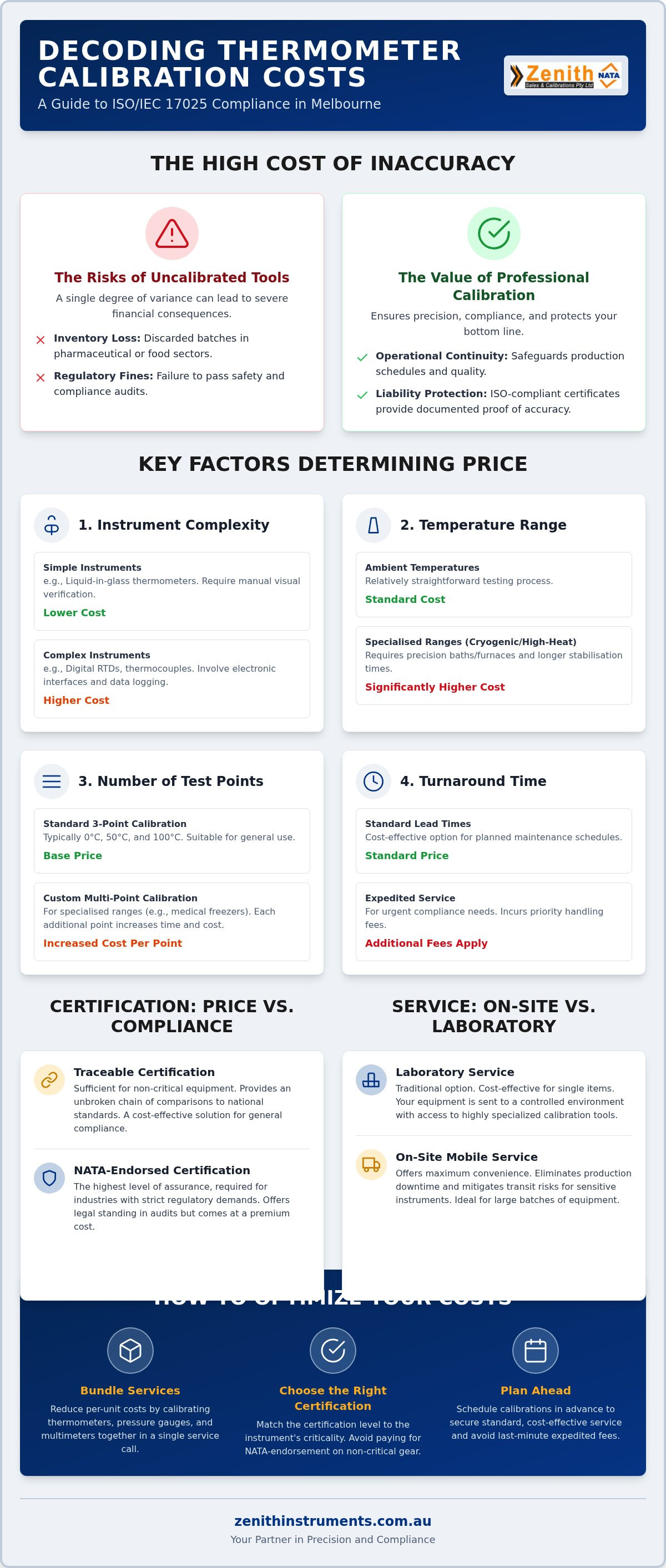
The thermometer calibration price in Melbourne isn't a fixed fee across every device. It's a technical calculation based on laboratory time, equipment wear, and the precision required for your specific sector. Simple liquid-in-glass thermometers typically require manual visual verification against a reference standard. In contrast, digital RTDs or thermocouples involve complex electronic interfaces and multi-point data logging. The more sophisticated the sensor, the more time our technicians spend ensuring the signal conversion remains linear across the entire scale.
Temperature range also dictates the final cost. Testing at ambient temperatures is relatively straightforward. However, cryogenic applications or high-heat furnace work requires specialised baths and precision furnaces. These environments take significantly longer to stabilise. Increased stabilisation time directly impacts the technical labour required to produce a single, accurate certificate. We also consider turnaround times; while standard lead times are cost-effective, expedited services for urgent compliance needs often incur additional priority handling fees.
The "Per-Point" Pricing Model Explained
Standard industry procedures usually involve a 3-point calibration at 0°C, 50°C, and 100°C. These benchmarks provide a reliable performance profile for general-purpose instruments. If your facility operates specialised industrial ovens or medical-grade freezers, these standard points won't meet your audit requirements. Custom ranges require extra time in precision furnaces to achieve thermal equilibrium. We suggest choosing points that match your specific operational range to ensure the highest measurement confidence without paying for irrelevant data points.
Instrument Type and Technical Requirements
Different technologies demand specific laboratory environments. Infrared thermometers require blackbody sources to manage emissivity, while contact probes need precise immersion in stirred liquid baths. Dataloggers add another layer of complexity because we must synchronise multiple channels for consistent time-stamped data. When we find an instrument is out-of-tolerance, we perform physical adjustments or electronic offset corrections. This additional technical labour is vital for maintaining the integrity of your quality system. You can find more information about our technical capabilities on our thermometer calibration service page.
NATA-Endorsed vs. Traceable Certification: Price vs. Compliance
Choosing between a NATA-endorsed certificate and a standard traceable report is a primary factor in the thermometer calibration price in Melbourne. NATA (National Association of Testing Authorities) accreditation is the peak benchmark for technical competence in Australia. It signifies that a laboratory operates according to ISO/IEC 17025 standards and has undergone rigorous peer review. This level of certification carries higher costs due to the extensive administrative overhead, regular proficiency testing, and the meticulous maintenance of high-accuracy reference standards required to maintain accreditation. We invest in these systems to provide you with the highest level of measurement confidence.
Standard traceable calibration offers a more cost-effective pathway for equipment that doesn't face strict regulatory mandates. While these certificates don't bear the NATA logo, they demonstrate that the instrument has been compared against standards with a documented link to national measurement benchmarks. For many Victorian businesses, this provides sufficient quality assurance for internal process monitoring without the premium price of a formal endorsement. We ensure that every traceable service is performed with the same technical precision as our accredited work.
When to Invest in NATA Accreditation
Specific sectors in Melbourne operate under legal or contractual frameworks that make NATA accreditation mandatory. If your facility manages medical storage, aerospace manufacturing, or government-regulated food production, a NATA-endorsed certificate is often a non-negotiable requirement for compliance. This documentation ensures that your measurement data is recognised internationally, meeting the stringent demands of high-stakes manufacturing environments. NATA certification is essential for:
- Medical and pharmaceutical storage facilities requiring TGA compliance.
- Aerospace and defence contractors under strict ISO/IEC 17025 mandates.
- Government-regulated food processing plants during formal health audits.
- Laboratories participating in international trade where reciprocal recognition is required.
We provide comprehensive thermometer calibration service options that include NATA-endorsed reporting for these critical applications.
Traceable Calibration for General Industrial Use
Traceable certification is ideal for general industrial applications where internal quality control is the priority rather than third-party regulatory audits. It's an excellent choice for monitoring HVAC systems, general warehouse temperatures, or non-critical manufacturing steps. We maintain the same level of technical rigour for our traceable services as we do for NATA-endorsed work. This price advantage is a key component of the overall thermometer calibration price in Melbourne for large inventories of non-critical sensors. The streamlined administrative requirements allow us to pass savings on to you while ensuring your gear remains accurate and reliable.
Laboratory vs. On-Site Service: Which Is More Cost-Effective?
Determining the most cost-effective service model requires a thorough analysis of the total thermometer calibration price Melbourne businesses face, accounting for both direct fees and indirect operational expenses. While laboratory calibration often appears lower on a per-unit basis, it frequently hides significant logistical costs. Shipping fees, specialised packaging, and the inherent risk of transit damage add layers of expense that aren't immediately visible. Most importantly, the downtime associated with sending equipment off-site can halt production lines or delay critical research, leading to financial losses that far exceed the cost of the calibration itself. We recommend evaluating your inventory volume and operational schedule before deciding which service model offers the best return on investment.
Mobilisation fees for on-site visits are a transparent cost that covers the transport of precision standards and technical expertise to your facility. For many industrial sites, this call-out cost is easily justified when weighed against the cumulative shipping costs of a large instrument inventory. Generally, if you have more than ten units requiring service, the on-site model becomes the more economical choice. This approach minimises the time your instruments are out of service, ensuring that your quality control processes remain uninterrupted.
The Advantages of Melbourne On-Site Calibration
Mobile calibration services eliminate the logistical burden of equipment transport. By performing technical validations at your facility, we prevent "transit drift," a common issue where sensitive digital thermometers lose their accuracy due to the mechanical shocks and temperature fluctuations experienced during shipping. Our technicians provide real-time feedback, allowing for immediate adjustments if an instrument is found to be out-of-tolerance. This proactive approach ensures your equipment returns to service immediately, maintaining your production rhythm. You can coordinate your next site visit through our Calibration Service Melbourne team.
When to Choose Laboratory Calibration
Certain high-precision instruments require the vibration-isolated and strictly temperature-controlled environment of a dedicated facility. If your thermometers require extremely low uncertainties or use primary standards that aren't portable, laboratory calibration is the only viable path. It's also the more economical choice for small batches or single units where a mobilisation fee wouldn't be justified. We utilise primary standards in our Melbourne lab that provide the highest level of accuracy for your most critical measurement tools. Shipping a single high-accuracy reference thermometer via a secure courier to our facility ensures it receives the meticulous attention required in a controlled metrology environment.
Book your next service with our experts at Zenith Instruments to ensure your thermal equipment meets 2026 compliance standards.
How to Get an Accurate Thermometer Calibration Quote
Securing a competitive and technically sound thermometer calibration price in Melbourne requires providing a precise inventory of your instrumentation. Vague requests often result in conservative estimates that may not reflect your actual operational requirements. We require a comprehensive list that specifies the make, model, and the exact temperature ranges your processes demand. For instance, a probe used in a cryogenic freezer requires a vastly different technical approach than a thermometer used in a standard commercial kitchen. Providing these details upfront allows our technicians to allocate the correct laboratory time and reference standards for your specific quote.
Establishing an annual service contract provides long-term budgetary certainty for your facility. By locking in rates through a recurring agreement, Melbourne businesses protect themselves against potential inflationary adjustments while ensuring their compliance certificates never expire. We manage the scheduling on your behalf, proactively identifying when your gear is due for its next technical validation to prevent audit failures.
Bundling Instrumentation for Maximum ROI
Consolidating your maintenance requirements into a single service visit is the most effective way to reduce the per-unit thermometer calibration price in Melbourne. Our on-site teams are equipped to perform a "full facility" sweep, where we calibrate diverse equipment such as pressure gauges and multimeters alongside your thermal sensors. This strategic approach eliminates multiple mobilisation fees and minimises total operational disruption. You can learn more about optimising your sensor maintenance in our sibling guide on Digital Thermometers: A Professional Guide (2026). We pride ourselves on our ability to handle a wide breadth of technical categories in one efficient visit.
Requesting Your Quote from Zenith Instruments
We prioritise rapid response times for all Melbourne-based enquiries to help you maintain your production schedule. Our quoting process includes direct technical support, ensuring that the certification level we propose aligns perfectly with your industry's specific regulatory framework. We don't just provide a price; we provide a technical solution backed by two decades of industrial expertise. Contact our Melbourne team for a tailored calibration quote today to secure your facility's measurement accuracy for 2026.
Use the following checklist to ensure your quote is comprehensive:
- Verification of Test Points: Ensure the quote covers the specific temperature points required for your audit.
- Certification Level: Confirm whether the quote specifies NATA-endorsed or Traceable certification.
- Adjustment Provisions: Check if the quote includes labour for bringing out-of-tolerance instruments back into specification.
- Logistical Fees: Ensure all mobilisation or secure courier fees are clearly documented to avoid hidden costs.
Securing Your Measurement Accuracy for 2026
Achieving regulatory compliance requires a strategic approach to instrument maintenance. We've explored how selecting the correct certification level and understanding technical variables ensures you meet ISO/IEC 17025 standards without inflating your operational budget. By evaluating these factors, you can secure a fair thermometer calibration price in Melbourne while maintaining strict audit readiness across your facility. Choosing between on-site mobile services and laboratory validation depends on your inventory volume; however, both paths prioritise measurement integrity and precision.
We leverage over 20 years of Australian expertise to support your technical requirements. Our team maintains NATA accredited standards and offers mobile on-site service to eliminate the risks of equipment transit and production downtime. We're committed to providing the technical rigour your industry demands, ensuring your sensors remain accurate under the most rigorous conditions. Take the next step in your quality control journey by contacting our specialists today.
Get a Professional Calibration Quote for Your Melbourne Facility
We look forward to partnering with you to uphold the highest standards of industrial safety and precision.
Frequently Asked Questions
How much does thermometer calibration cost in Melbourne?
The thermometer calibration price in Melbourne depends on the instrument’s technical specifications and the number of temperature points required for your sector. We calculate costs based on laboratory time and the precision of the reference standards used. Simple probes require less stabilisation time than high-accuracy RTDs or data loggers. We provide tailored quotes that reflect your specific compliance needs, ensuring you only pay for the technical rigour required by your industry standards.
What is the difference between NATA and NATA-traceable calibration?
NATA-endorsed calibration is performed in an accredited laboratory and results in a certificate bearing the NATA logo, which is globally recognised for ISO/IEC 17025 compliance. Traceable calibration, while performed with the same technical precision, provides a certificate that links measurements to national standards without the formal NATA endorsement. We recommend NATA-endorsed services for medical, aerospace, and government-regulated sectors, while traceable certificates are cost-effective solutions for general industrial process monitoring.
How often should thermometers be calibrated for ISO compliance?
Most quality management systems, including ISO 9001 and ISO/IEC 17025, mandate annual calibration to ensure measurement reliability. We suggest a 12-month interval as the standard benchmark for industrial thermometers. However, instruments used in high-risk environments or those subject to mechanical shock may require more frequent technical validation. We help you establish a calibration schedule that balances regulatory safety with operational efficiency, ensuring your facility remains audit-ready throughout the year.
Do you provide on-site thermometer calibration in Melbourne suburbs?
We operate a dedicated mobile calibration service that covers the entire Melbourne metropolitan area and surrounding regional industrial hubs. Our technicians bring precision thermal baths and reference standards directly to your facility to minimise production downtime. This service is particularly effective for large inventories of sensors where shipping costs and transit risks are prohibitive. We also provide similar on-site capabilities across Sydney, Brisbane, and Canberra to support national industrial networks.
What is included in a standard thermometer calibration certificate?
A professional calibration certificate provides a comprehensive record of an instrument's performance against known standards. Every document we issue includes the following technical details:
- Unique instrument identification and serial numbers.
- Documented "as-found" and "as-left" measurement data.
- Calculated measurement uncertainty and environmental conditions.
- Statement of traceability to national or international standards.
- The technician's signature and the date of calibration.
This documentation is essential for passing rigorous safety and quality audits.
How long does the calibration process take in your Melbourne lab?
Our Melbourne laboratory typically completes thermometer calibration within three to five business days from the receipt of the equipment. This timeframe allows for the necessary thermal stabilisation of our precision baths and furnaces, ensuring the highest measurement accuracy. We also offer expedited priority services for businesses facing urgent compliance deadlines or critical equipment failures. We maintain a steady communication rhythm to keep you informed of your instrument's status throughout the entire process.
Can you calibrate infrared (IR) thermometers on-site?
We calibrate infrared thermometers on-site using portable blackbody radiation sources that simulate precise thermal targets. Our technicians verify the instrument’s accuracy across your operational range, adjusting for emissivity and focal distance variables. While some high-precision IR sensors require the vibration-isolated environment of our laboratory, most industrial handheld units can be successfully validated at your facility. This on-site approach ensures your non-contact temperature measurement tools remain accurate without leaving the production line.
What happens if my thermometer fails calibration?
If an instrument fails to meet its specified tolerances, we notify your technical team immediately to discuss the available options. We perform electronic or physical adjustments where possible to bring the thermometer back into compliance. If the unit requires more extensive work, we apply hourly technical repair rates to restore its functionality. In cases where an instrument is beyond economical repair, we provide expert recommendations on replacement equipment from our wholesale inventory to ensure your operations continue.