

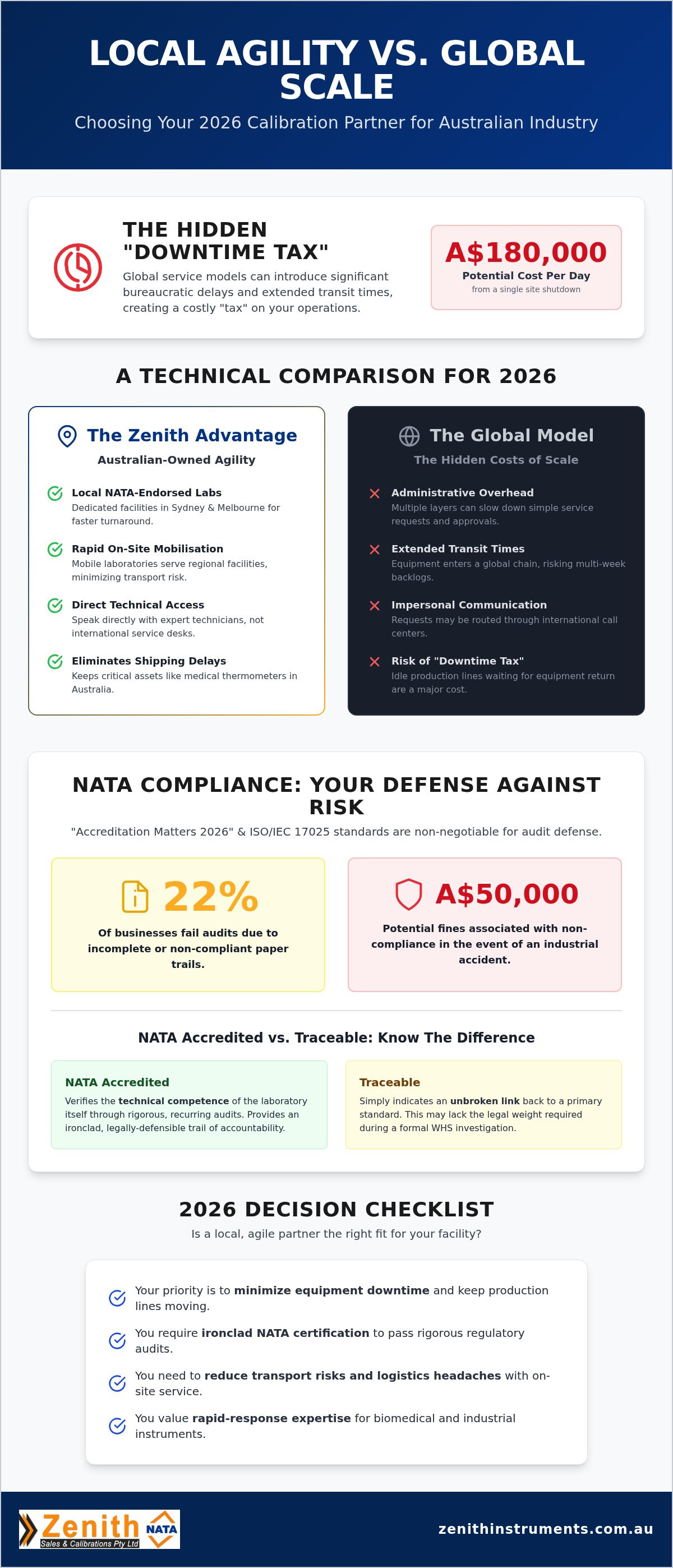
Selecting the largest global provider for your 2026 calibration cycle might actually be the most expensive way to manage your critical assets. While global scale suggests reliability, it often introduces a "downtime tax" through bureaucratic delays that Australian facilities can't afford. When your production schedule depends on an accurate medical thermometer calibration service, a multi-week backlog in a global service model can lead to site shutdowns costing upwards of A$180,000 per day. We know that maintaining ironclad NATA certification is your primary defense against audit failures and the A$50,000 fines linked to industrial accidents.
This article provides a technical comparison between Zenith Sales & Calibrations Pty Ltd's localized agility and Trescal's international reach to help you minimize equipment downtime. We'll explore how our dedicated facilities in Sydney and Melbourne, alongside mobile laboratory capabilities, align with the "Accreditation Matters 2026" standards. You'll learn how to manage the transition to digital certification and ISO/IEC 17025:2017 requirements while ensuring direct access to expert technicians who understand the specific logistical needs of regional Australian industries.
Key Takeaways
- Understand how Australian-owned agility eliminates the "downtime tax" inherent in global service models to keep your local production lines moving.
- Navigate the 2026 NATA standards and ISO/IEC 17025 requirements to ensure your certification remains ironclad during rigorous regulatory audits.
- Assess the logistical benefits of on-site mobilisation in Sydney and Melbourne to minimize transport risks and maintain operational continuity.
- Evaluate the technical depth required for a professional medical thermometer calibration service and how it integrates into a broader biomedical instrumentation strategy.
- Apply our 2026 decision matrix to determine whether your facility requires the extensive resources of a global provider or the specialized, rapid-response expertise of Zenith Sales & Calibrations Pty Ltd.
Calibration Service Models: Local Agility vs. Global Scale
In 2026, the Australian industrial sector has redefined speed as a critical performance indicator. We see that technical precision alone is no longer sufficient; it must be delivered within a timeframe that prevents production bottlenecks. To understand the stakes, one must first ask: What is calibration? At its core, it's the verification of instrument accuracy against a known standard. For healthcare providers, a professional medical thermometer calibration service ensures patient safety and regulatory compliance without the long lead times associated with overseas logistics.
The Trescal model represents the global conglomerate approach. They offer a vast one-stop-shop for international brands, leveraging a massive worldwide network. While this scale is impressive, it often introduces layers of administrative overhead that can slow down local service delivery. In contrast, the Zenith Instruments model prioritizes localized technical expertise. We maintain NATA-endorsed standards through dedicated facilities in Sydney and Melbourne. This structure provides direct technical accountability and faster communication channels than global competitors who may manage Australian requests through international service desks.
The 'Downtime Tax' in Global Service Chains
Centralized laboratory models frequently impose a "downtime tax" on Australian businesses. When equipment enters a global service chain, transit times often extend as items move through consolidated logistics hubs. These delays can lead to site shutdowns costing operators upwards of A$180,000 per day. International administrative layers also complicate simple service requests, causing friction in documentation and approval processes. In 2026, we've observed a distinct shift as Australian manufacturers return to localized partners. They've found that the perceived breadth of a global provider doesn't compensate for the operational cost of an idle production line.
Australian Agility: The Zenith Advantage
Agility is our primary competitive advantage. By maintaining NATA-qualified technicians on the ground in major hubs like Sydney and Melbourne, we eliminate the delays inherent in offshore shipping. Our infrastructure is built for rapid response. We provide specialized medical thermometer calibration service for clinics that can't afford to have critical diagnostic tools off-site for weeks. Our mobile laboratory capabilities allow us to mobilize quickly to regional mining and medical facilities, performing high-precision testing at your location. This proactive model ensures that routine maintenance doesn't become a production blocker, even for facilities in Canberra, Brisbane, or Newcastle.
NATA Accreditation and Compliance Standards in 2026
In 2026, NATA accreditation stands as the non-negotiable gold standard for precision in Australia. For any facility requiring a medical thermometer calibration service, the distinction between "traceable" and "NATA accredited" is vital. Traceability simply indicates a link back to a primary standard, whereas NATA accreditation standards verify the technical competence of the laboratory itself through rigorous audits every 18 to 24 months. Without this endorsement, your calibration reports may lack the legal weight required during a formal investigation or industrial audit.
The transition to "Accreditation Matters 2026" has introduced stricter requirements for electronic record integrity and real-time data validation. These updates to ISO/IEC 17025 ensure that every measurement is not just accurate at the time of testing, but documented with absolute transparency. We've seen that 22% of industrial businesses fail audits due to incomplete paper trails. By partnering with a provider that stays ahead of these regulatory shifts, you protect your facility from the A$50,000 fines associated with non-compliance in the event of an industrial accident.
Navigating WHS Regulations with Precision
Using uncalibrated or inadequately certified instruments in high-risk Australian industries carries severe legal implications. Safety auditors prioritize NATA-endorsed reports because they provide an ironclad trail of technical accountability. Our certification process is designed to meet these exact requirements, ensuring your equipment satisfies both internal quality benchmarks and external regulatory bodies. For a deeper look at the current landscape, consult our Instrument Calibrations in Australia: The 2026 Professional Guide. Maintaining these standards is the only way to avoid the A$180,000 daily costs associated with unplanned site shutdowns.
Technical Reliability and Error Elimination
Human error during data entry remains a significant risk in traditional calibration models. To eliminate this, we utilize a computerized closed-loop software system. This technology automates the data capture process, ensuring that the results on your certificate perfectly match the readings from our reference standards. Whether we're performing a medical thermometer calibration service or managing complex electrical testing, this system guarantees audit-ready accuracy across all thermal, pressure, and electrical categories. If you need to secure your facility's compliance, consider working with a NATA-certified calibration partner that prioritizes technical integrity.
On-Site Calibration vs. Laboratory-First Strategies
The choice between on-site mobilisation and laboratory-based testing is a fundamental decision for operational efficiency. Removing critical instrumentation from a production line often triggers a cascade of delays. For many facilities, a professional medical thermometer calibration service can be performed in-situ to maintain continuity. However, we must evaluate the technical requirements of the instrument against the environmental variables of the workshop. While global providers often default to centralized laboratory models, our mobilisation strategy brings the laboratory to your Sydney or Melbourne facility.
Transparency in mobilisation fees is essential to avoid the hidden costs often found in global service contracts. We prioritize clear communication regarding these expenses, ensuring that the cost of bringing a technician to your site is outweighed by the savings in equipment downtime. As noted by the National Measurement Institute, the highest levels of measurement traceability require rigorous control, but many industrial applications are perfectly suited for mobile service delivery. We assist our partners in determining which assets can be serviced on-site and which require the specialized environment of our primary labs.
On-Site Mobilisation for Industrial Efficiency
On-site calibration for pressure gauges and electrical equipment saves days of operational downtime by eliminating transit risks. Our technicians arrive with the necessary reference standards to verify your tool crib in one visit. This regional reach extends beyond our primary hubs, serving industrial corridors in Newcastle, Canberra, and Brisbane. This proactive model allows your team to continue working while we ensure your compliance is up to date, providing immediate results and audit-ready documentation without the equipment ever leaving your control.
Laboratory Excellence in Sydney and Melbourne
Some high-precision requirements demand a controlled laboratory environment. When dealing with complex instrumentation or extremely low measurement uncertainties, the stability of our state-of-the-art facilities in Sydney and Melbourne is mandatory. These environments provide the meticulous temperature and humidity control necessary for the most sensitive tools. We balance on-site speed with laboratory-grade accuracy, advising you when a medical thermometer calibration service requires the specialized infrastructure of our permanent labs to meet the strictest NATA standards and ensure long-term measurement stability.
Technical Breadth: From Medical Thermometers to Electrical Testing
Consolidating your entire tool crib under a single provider reduces administrative friction and ensures a unified compliance record. While global conglomerates often manage client requests through automated ticketing systems, we prioritize direct access to technical specialists. This is particularly critical for a high-precision medical thermometer calibration service, where diagnostic accuracy cannot be left to a faceless help desk. We provide the technical expertise to service global leaders such as Wika, Dwyer, and RKI, ensuring your instrumentation meets Australian standards without the delays of a global supply chain.
Our capabilities extend across the full spectrum of industrial measurement. We manage everything from biomedical equipment calibration to specialized torque wrench calibration. This breadth allows us to act as a primary technical partner for hospitals, clinics, and manufacturing sites. By maintaining a 92% success rate in returning failed units to within-tolerance specifications, we help you avoid the capital expenditure of unnecessary equipment replacement. If you need to verify your facility's readiness, book a comprehensive biomedical instrumentation audit with our team today.
Specialised Industrial and Biomedical Instrumentation
Precision in 2026 requires more than just a pass or fail result. For gas detector calibration, we verify sensor response against specific gas concentrations to ensure workplace safety in confined spaces. Similarly, maintaining accuracy in dimensional tools like calipers and micrometers is essential for high-tolerance manufacturing. Our meticulous approach ensures that every medical thermometer calibration service we perform aligns with the latest clinical requirements. For a detailed technical breakdown, refer to our guide on Digital Thermometers: A Professional Guide for Australian Industry (2026).
Electrical and Telecommunication Standards
Electrical instrumentation demands strict adherence to NATA requirements. We provide comprehensive testing for multimeters, insulation testers, and clamp meters to prevent measurement drift, which can reach 12% annually in high-use environments. Our expertise also covers telecommunication and networking equipment, ensuring signal integrity across your infrastructure. Maintaining these standards is the only way to safeguard against the A$180,000 daily costs of a site shutdown. Learn more about our mechanical capabilities in the Torque Wrench Calibration: The 2026 Guide.
The Verdict: Which Partner is Right for Your AU Business?
The choice between a global conglomerate and a localized specialist depends on your facility's operational priorities. Trescal offers an expansive global network that suits multinational corporations requiring standardized procurement across several continents. However, for Australian firms where equipment availability is the primary driver of profitability, the agility of Zenith Instruments is often non-negotiable. When your facility requires a medical thermometer calibration service, the choice is between a global ticketing system and a direct line to a NATA-qualified technician in Sydney or Melbourne. We find that the most successful operators in 2026 move away from transactional service models in favor of technical partnerships that prioritize rapid response and local accountability.
The Case for Zenith Instruments
Zenith Instruments is the ideal partner for firms requiring rapid turnaround, on-site service, and strict adherence to Australian-specific compliance frameworks. Our status as an Australian-owned entity provides a distinct advantage for government and defense sector contracts where local oversight is a prerequisite. We eliminate technical friction by providing direct access to the specialists performing your work. This transparency reduces reporting errors and ensures that complex NATA/ISO compliance audits are passed without the 22% failure rate seen in businesses with incomplete paper trails. By utilizing our Sydney and Melbourne hubs, you secure a partner that understands the logistical demands of regional industrial corridors.
Operational Precision for 2026
Securing your 2026 maintenance cycle requires a proactive approach to procurement. We recommend planning your calibration schedule at least 90 days before your NATA re-certification dates to account for peak demand periods. For facilities managing multi-category equipment fleets, requesting a comprehensive quote that covers pressure, electrical, and thermal instrumentation can streamline administrative workflows. This integrated approach ensures that every medical thermometer calibration service is documented alongside your other critical assets in our computerized closed-loop software. Precision in 2026 is not just about the measurement; it's about the service model that supports your operational continuity. Contact us at Zenith Instruments to finalize your 2026 calibration strategy and eliminate the downtime tax from your balance sheet.
Securing Technical Integrity for your 2026 Calibration Cycle
Choosing the right calibration partner is a strategic decision that impacts both your regulatory standing and your bottom line. While global reach has its place, the localized agility of an Australian-owned partner eliminates the logistical delays that lead to costly site shutdowns. We provide the technical depth required for everything from a professional medical thermometer calibration service to complex pressure and electrical testing. Our computerized closed-loop software ensures that your facility remains audit-ready, protecting you from the heavy fines associated with non-compliance.
By leveraging our NATA Accredited Laboratory and dedicated facilities in Sydney and Melbourne, your business maintains ironclad standards without sacrificing efficiency. Our Australia-wide on-site service ensures that your critical instrumentation remains operational where it's needed most. We're committed to delivering precise results that align with the rigorous requirements of Australian safety auditors and international frameworks.
Request a Precision Calibration Quote from Zenith Instruments to safeguard your facility against measurement drift and audit failures. We look forward to supporting your technical precision and operational continuity throughout the year ahead.
Frequently Asked Questions
Is Zenith Instruments NATA accredited for all types of equipment?
Zenith Instruments maintains NATA-certified standards across a specific and rigorous scope of measurement categories. We hold accreditation for pressure, electrical, temperature, and biomedical instrumentation at our primary laboratories. This endorsement ensures that our technical competence meets the ISO/IEC 17025 benchmark. While we service a broad range of industrial tools, clients should verify our current NATA scope for specific high-precision biomedical categories to ensure full compliance with 2026 regulatory standards.
Can Trescal calibrate Zenith-branded instruments in Australia?
Trescal operates as a multi-brand service provider and can technically calibrate various instruments found in the Australian market. However, as the original equipment supplier and service expert for our own product lines, we provide specialized technical depth and direct access to original components. Our technicians possess specific training on our computerized closed-loop software systems, ensuring a higher level of integration and data integrity than generic third-party global service providers typically offer.
What are the typical turnaround times for calibration in Sydney vs. Melbourne?
We maintain a standard turnaround time of 3 to 5 business days for most bench calibrations at our dedicated facilities in Sydney and Melbourne. This rapid response is a core component of our service model, designed to minimize the equipment downtime that often plagues global service chains. By utilizing our local hubs, Australian facilities avoid the transit delays and administrative bottlenecks associated with centralized laboratory models, ensuring your critical assets return to service quickly.
Does Zenith Instruments offer on-site calibration for regional mining sites?
We provide comprehensive on-site mobilization services for regional mining and industrial facilities across Australia. Our mobile laboratory capabilities allow us to perform high-precision testing in-situ, which is essential for heavy-duty equipment that cannot be easily transported. We frequently deploy technicians to key regional hubs including Newcastle, Canberra, and Brisbane. This service model eliminates transit risks and ensures that your site remains compliant with NATA standards without interrupting production schedules.
What is the difference between ISO 17025 and NATA accreditation?
ISO/IEC 17025 is the definitive global benchmark for the technical competence of testing and calibration laboratories. NATA, the National Association of Testing Authorities, is the sole national body in Australia recognized by the Commonwealth Government to accredit laboratories to this international standard. While ISO 17025 defines the requirements, NATA accreditation is the formal recognition that a laboratory has been independently audited and proven to meet those rigorous technical and quality standards.
How do mobilisation fees compare between local and global providers?
Our mobilisation fees are structured to provide transparent value by bringing expert technicians directly to your facility. Unlike global providers, who may include hidden costs within complex international service contracts, our Australian-owned model focuses on localized agility. By performing a medical thermometer calibration service or electrical testing on-site, we eliminate the transit costs and "downtime tax" inherent in laboratory-bound models. This ensures that your total cost of ownership remains manageable and predictable.
Can Zenith handle biomedical equipment calibration for hospitals?
We specialize in biomedical instrumentation and provide comprehensive medical thermometer calibration service solutions for hospitals and clinics. Our technical scope includes the precise adjustment and verification of diagnostic tools against NATA-endorsed standards. We understand the critical nature of patient safety and clinical compliance in 2026. Our technicians utilize specialized reference standards to ensure that every biomedical instrument in your tool crib meets the exact tolerances required by Australian healthcare regulations.
What happens if an instrument fails calibration during a Zenith service?
If an instrument fails, our qualified technicians immediately diagnose the mechanical or electronic fault to determine the necessary corrective action. We perform technical repairs and maintenance in our specialized laboratories to restore the unit to within-tolerance specifications. This proactive approach is highly effective; we successfully return the vast majority of failed units to active service. This prevents the capital expense of unnecessary equipment replacement and ensures your assets continue to meet rigorous NATA-certified standards.